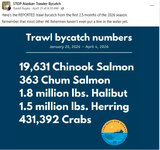
One of the key talking points from the trawl industry these days is that
most of the kings they catch aren't AK kings, so why should Alaskan's care?. While that may be true if you lump the Bering Sea and Gulf fisheries together, it is not true in the Bering.
In rebuttal, it is important to not only look at more recent data, but also trends over time.
Check this shizzle out.
% of Alaska kings in the Bering Sea trawl bycatch, 2008-2020.
2020 – 65%
2019 – 55%
2018 – 52%
2017 – 51%
2016 – 47%
2015 – 51%
2013 – 64%
2012 – 74%
2011 – 77%
2010 – 87%
2008 – 95.9%
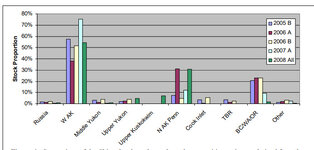
In 2010, 20% of the total # of kings sampled were from the Upper Yukon, 14% from the middle Yukon, and 11% from the middle Yukon. More recently, Yukon kings make up 1-2% of the king bycatch in the Bering. They are statistically insignificant and residents along the Yukon and Kusko rivers who have traditionally depended on kings for subsistence and survival haven't been able to harvest them for years now.
Here is the data for the Gulf of AK trawl fishery for the same time period, again % of AK kings in the total number sampled.
2020 – 14%
2019 – 26%
2018 – 18%
2017 – 13%
2016 – 15%
2013 – 14%
2012 – 19%
2011 – 29%
Now this isn't a terribly deep data set, but it sure looks like a trend to me.
Why don't AK kings make up a higher percentage of the total king bycatch? Because they have been all but wiped out!!!! The trawl nets cant catch them if they aren't there.
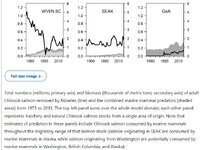
The data going back farther was collected and presented in a different format but still shows the same. AK kings used to make up the majority of bycatch in these fisheries until their numbers got low enough that the runs started crashing, as they continue to do today.