Making your own backpack. Designs, features, tips or tricks

Joined
Jun 26, 2017
Messages
546
I'm looking at making my own bag for a mr GLF. I have the Marshall and would like something smaller for day hunting. Looking to make something in the 2500-3200 ci range. I kind of like how the kifaru 14r looks with the center zip and the zip lid. Just curious if you guys have any tips/tricks if you've made one yourself or features of a backpack you really like.

Sent from my SM-G950U using Tapatalk
 
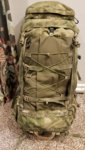
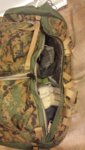
I've made a couple of custom bags. The appeal of making your own bag is putting in the features you like - and that varies from person to person. I'd recommend looking at pics from tons of bags and getting your hands on as many as you can. You'll learn something from every bag you make on what you would improve the next time.

Here are some features I like after two bags.
1. Side zip access to interior of bag.
2. Stretchy pocket on back.
3. X-pac to go against the frame so that blood is easily wiped off and doesn't soak in.
4. attachments for a meat shelf that lift the meat load about 1/3 of the way up.
5. Will fit multiple frames (for me - Kifaru and Exo). This requires planning for attachment points as well as making the frame sleeve correctly.
6. I like the basic configuration of the Exo straps on their packs - but adding the shock cord as I did on my last pack was a feature I used a lot.
 

Attachments

  • 20180702_180410.jpg
    20180702_180410.jpg
    293.5 KB · Views: 72
  • 20161027_071229.jpg
    20161027_071229.jpg
    185.8 KB · Views: 73
The large grab handles that kifaru puts top and bottom are very handy. As already mentioned that rear facing stretch pocket can be home to any number of frequently used items.
 
Some tips on sewing if you're gonna go for it. Take it slow and draw out all you pieces before you start cutting material or pattern paper. Take your measurements from the seams, not the edge of the fabric. A good width for seams from the edge is 3/8". If you figure out all your dimensions and add a 3/8" border all the way around, you're set. Fabric clips or pins can be real helpful when you're starting out for keeping all layers in check. Ghostline poster board (paper, not foamcore) at the supermarket has a 1/2" square grid on it for making patterns which helps keep things even. If you are making a symmetrical pattern piece, draw a line with a ruler and ball point pen down the middle of the pattern paper. This will create a crease that you can fold one half of the pattern over and trace the other side.

Those are some of the big steps to a bag coming together, there are many other little things but those will fall in line as you do it. If you have any questions on construction, shoot me and email at [email protected]
 
Thanks for all the response! I've got some 500d cordura coming but I'm curious do you guys like to use other materials as well? Also what is the stretchy material called?

Sent from my SM-G950U using Tapatalk
 
The DIY section may get more feedback on the specifies. Two stretch materials available on the secondary market I've seen are durastretch (outdoor wilderness fabrics carries it) and spandura (seattle fabrics carries it). Some folks like to use some xpac, its stiffer and crinklier though so back of the pack and bottom are spots where that gets used moreso. If you had a really abrasive application you could use 1000d but 500d holds up to normal use well.
 
For features I recommend several 1" loops in the seams next to the frame and in the seams between the side and outer panel. You can use them to lash on "stuff" and the loops are pretty low profile if you're not using them. I like two or three small pockets towards the top of the main bag for batteries, head lamp, keys, candy bars and more and more and more candy bars. A key hook is one of my favorite features, even though luggage-ee, but I don't like keys in my pocket or digging for them when needed. Just my opinions, others like a big open bag with zero pockets.

500D is perfect for a few test bags. You can then mix 330D, 200, 400, etc, on future bags. "test bags" because you'll never get exactly what you want, which is awesome because you'll have fun with the next few iterations. A rule of thumb for prototypes: first one is a turd/learning experience. Second might pass the laugh test. Third should be functional and not suck.

Post pictures!
 
Back
Top