

elkeaterco
WKR
Kyrgyzstan: Chasing Adventure and Ibex
What drives us as hunters?For me, it's novelty—the pull of the unknown. The desire to see what lies beyond the next ridge, to step into wild country where few have ever set foot. It's something deep in my nature, a restless urge to explore.
That drive has shaped my life.
Whether hunting or guiding in Alaska, chasing game in Mexico, or traveling across oceans, I've always been searching for something bigger. Over the years I've packrafted for moose and caribou, hunted Kodiak from floatplanes, chased bears in Prince William Sound, killed elk across the West, and guided sheep and moose in the Alaska Range.
But one hunt stayed in my mind longer than the rest—Mid-Asian ibex in Kyrgyzstan.
Last year I finally stopped talking and committed.
My good friend Cody had hunted there before and connected us with an outfitter in southern Kyrgyzstan. We booked direct, saved money, and gained access to prime ibex country.
The largest ibex in the world live in Kyrgyzstan in some of the most breathtaking mountains on earth. The Tian Shan rise along the Chinese and Tajik borders, with peaks over 24,000 feet. We would climb as high as 14,500.
The mountains alone were worth the trip.
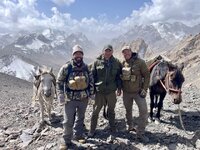
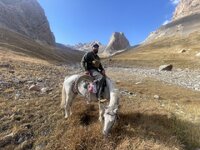
Towering rock walls, green valleys, and endless ridgelines made it feel like stepping back in time. Add horses and ibex, and it becomes a true expedition.
Our journey started with a flight over the North Pole to Dubai, then Bishkek and Osh. After hours of driving through rough country, we reached a lodge beneath the peaks. We checked rifles, loaded gear, and continued deeper with horses.
From there, everything went on horseback.
We rode seven hours into untouched mountains and reached spike camp after dark, exhausted after nearly 56 hours of travel. Three hours later, we were back up at 3 a.m., riding by moonlight into the high country.
We reached the Chinese border at first light and glassed vast basins.
The ibex had moved after yaks pushed through the area, but a herd was relocated miles away. A plan came together quickly.
What followed was one of the steepest horseback descents I've ever experienced—straight down scree and boulder fields—to reset for the next push.
First hunt
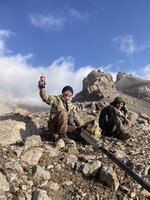
The next morning we rode a 14,000-foot pass under moonlight and reached the herd at first light. We moved on foot along a cliff base, found old ibex sign and even snow leopard scat, then climbed straight to a ridgeline.Our lungs burned in the thin air, but we were locked in. We built a small rock blind and set a plan for a guide to push the herd toward us.
Hours later, ibex began flowing across the ridge toward our position.
It looked perfect—until it wasn't.
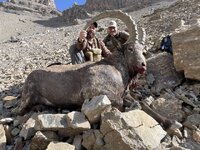
The herd spooked and everything exploded into chaos. What was an ambush became a sprint for position. I got set, took a shot, and believed I had hit. My huntsman told me to shoot again. In the confusion, my cousin Scott dropped a billy, and I followed with another as the herd broke.
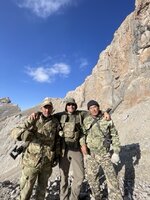
High fives followed, then the long recovery.
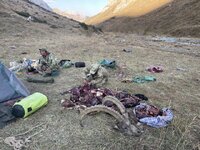
We found Scott's quickly. Mine required a hard traverse across scree, but it was recovered and fully processed. Nothing was wasted. Meat, hides, and nearly all organs were packed. Only offal was left for scavengers.
That night we ate kidneys, potatoes, bread, and chai tea under the stars.
We decided to continue.
The next morning our outfitter Talgar began the long walk out with meat and horns for paperwork while we stayed back and broke camp. The huntsmen told us we would now hunt like wolves—light, fast, and with little food.
We moved deeper and set a new spike camp near 14,000 feet.
Second hunt
The next morning we again rode by moonlight and located another herd. We climbed through scree, cliffs, and exposed ledges to a notch at 14,500 feet.Looking over the ridge, a herd of ibex fed across the canyon at 350 yards.
This time there was no rush.
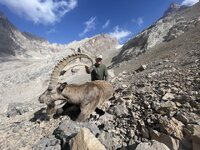
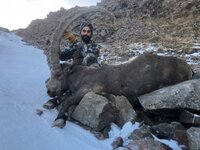
We studied them carefully until a giant billy stood out. He pushed 50 inches. I settled in and fired. He was hit hard, then disappeared into a rock fissure. Gone.
As the herd scattered, another group broke. My huntsman told me to shoot the lead animal. I did, and he dropped.
Because of the terrain, we couldn't safely descend for the larger billy. One lesson I've learned over years of guiding is simple—never guide the guide. Trust the men who live there.
We recovered what we could, took photos, and hiked back to horses, tired but satisfied.
Back at camp we processed meat, rested horses, and finally slept.
The next morning was slow, followed by a seven-hour ride out.
Closing
The ride out felt different. Bodies sore, faces weathered, but minds quiet. We had come halfway around the world and found more than we expected.Kyrgyzstan delivered everything I was searching for—epic mountains, wild horses, incredible animals, and true adventure.
For a blue-collar hunter, I believe this is one of the greatest mountain hunts left that is still within reach.
Life is short.
There will always be reasons to wait—money, work, timing, excuses. Most of them are bullshit.
If you have a dream hunt, start making it happen. Save, plan, commit.
Don't wait too long.
The mountains will still be there—but we might not be.
Jake Long
@elkhunter34
Attachments
-
 IMG_9803 Medium.jpeg129.3 KB · Views: 317
 -
 IMG_9844 Medium.jpeg107.1 KB · Views: 320
 -
 IMG_9886 Medium.jpeg152.7 KB · Views: 323
 -
 IMG_9911 Medium.jpeg136.3 KB · Views: 319
 -
 IMG_0030 Medium.jpeg107.1 KB · Views: 317
 -
 IMG_9975 Medium.jpeg129.2 KB · Views: 318
 -
 IMG_9980 Medium.jpeg110.7 KB · Views: 317
 -
 IMG_0119 Medium.jpeg154.4 KB · Views: 308
 -
 IMG_9999 Medium.jpeg165 KB · Views: 300
 -
 IMG_0142 Medium.jpeg141.3 KB · Views: 315


 Or rip on another culture/ethics. But will happily share my experience with you.


