Cedarsavage
WKR
I need insulate my shop. I’ve been pointed towards spray foam but I’ve read some mixed reviews on it and some people say it can off gas vocs for years afterwards. Anyone have experience or know about this?

Follow along with the video below to see how to install our site as a web app on your home screen.
Note: This feature may not be available in some browsers.

I'm not sure what your budget is, but I would think spray foam to correct R-value on underside of roof deck and a climate controlled or semi-controlled attic space would offer the best condensation control. Some of it is going to depend on the dew point. At zone 7 temps it will likely require a boatload of insulation or an uncomfortably dry house to meet your goals of condensation control.I've used it on some projects and didn't notice any significant off-gassing. We didn't do any testing to come to that conclusion, but it didn't smell like chemicals or anything. These were on spec homes, so I didn't live in them and I can't speak to any other adverse effects. I am preparing to finish out a living space on my own property and have been looking into this for my own purposes and have discovered that vented or unvented roof assemblies, insulation, vapor barrier choices is pretty complicated (I'm an engineer and I don't totally "get it" myself). I'm leaning towards not using spray insulation and just having a less efficient structure might be the way to go from a building longevity standpoint.
Here's an interesting article from the Building Science Corporation that is probabbly the leading authority on this stuff: https://buildingscience.com/documen...bsi-016-ping-pong-water-and-chemical-engineer
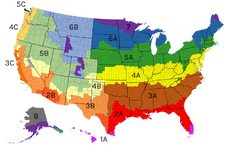
Makes a big difference in what climate zone you're in as well, so take that into consideration. I'm in climate zone 7 and condensation developing on the underside of the roof decking is almost a given.
https://www.energy.gov/eere/buildings/building-america-climate-specific-guidance
View attachment 1004076


a friend is a sprayer and I've done several buildings.
Most foam is now closed cell which does not off gas after its cured is my understanding.
it also acts as a Vapor barrier because the closed cells won't allow water in/through.
I did a shop addition with 3" of foam, then fiberglass inside, it's awesome.
I don't consider it a negative but worth noting, foam is stiff so the rain on the roof telegraphs inside noticeably compared to a fiberglass only roof.


This is the way to go, I did the same when i remodeled the 2nd floor of my house and I'm glad I didWe built a house a couple years ago and went with a combo of spray foam and fiberglass batt insulation. I am so glad we did. We have 2" of spray foam on all the exterior walls and then 4" of batt insulation. This house is sealed up tighter than a nuns c*nt which is great since we live in a windy section of CO. I didn't notice any issues with off gassing.
Building a pole barn shop this summer and for sure going to spray that as well.


Good pointQuestion, How do you know that the off gassing has an odor? Look at plastic dashboards in cars, they off gas for ever and you don't smell it. That's the nasty milky looking stuff on the inside of your windshield. That said my cousin in Michigan has done 2 of his houses and I asked him what he that. He pretty said everything that post has. He does his walls only and Blown in cellulose in the lids. Said he saved big on utilities.





