Imminent case head separation?

Yaremkiv

Lil-Rokslider
Joined
Jun 10, 2021
Messages
205
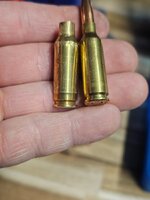
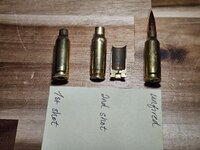
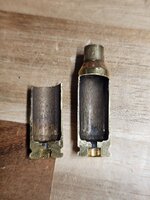
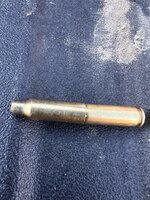
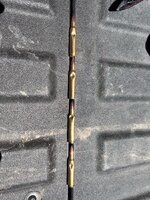
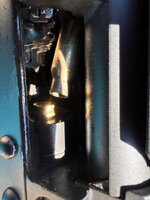
Hello reloaders of Rokslide. I'm developing a load for my 6 ARC Ar15 and I ran into a problem. The 1st shot was fine. The 2nd shot left a ring at the web of the case. I cut it open and it looks like the wall might be thinner in that area but the BTSD measurement only increased by .005". The brass is on its 2nd firing. It's first firing was as a factory round from Hornady. The charge was only 25.8 gr. of Varget shooting a 103gr. ELD-X. The unsuported portion of the case, just above the extractor groove didnt grow by even .001" after being fired. The case extracted and ejected without a problem. Primer pocket didnt loosen up. No ejector marks on the brass either. I'm relatively new to loading for gas guns. What am I missing? I only bumped the shoulders back .002" after its initial firing. Could my Ballistic Advantage barrels chamber be cut too long?
20260121_222053.jpg20260121_222919.jpg
20260121_222245.jpg
 
I don't have much to offer on the reloading side of things, but on the AR side of things, the gas system is something to consider carefully.

Short version: the higher the gas pressure at the gas port, the more you get things like case-head separation, broken extractors, broken bolt lugs, and a number of other issues. Essentially, because the BCG is being forced back before the bore has depressurized enough for the brass casings to pull back away from the chamber walls.

In Vietnam, there was an early period of common fielding of the M16, where they were using surplus 30-06 powder, IIRC, and it caused exactly these issues - because the pressure curve of the burning powder was spiking too close to the port. Slower burning powders peak in their pressure curve further down the bore. Lots of broken bolts, extractors, and separated case-heads.

You get similar things in improperly built SBRs, especially ones below 11" with short gas-system lengths. The longer the gas system, the less of an issue this is, as a general rule. You can also tune gas pressure/volume through things like adjustable gas blocks, or gas tubes with smaller ports from Black River Tactical. This is especially helpful if you're also running suppressed, as cans slow down the depressurization of the bore as well.

To be clear, I don't know if this is what's happening to your AR load. But, because this is a thing, as you're going though your diagnostics, be sure to ensure your powder is appropriate for an AR or your gas-system length, and not just bolt guns.
 
That doesn’t look like an imminent case head failure to me. I’ll explain why, and how to trouble shoot what I think is happening.

Here is an example of one of my own personal case head separations: image.jpg
This is Lapua 223 with 15 max length resizings (12 thousandths).

Note how high up the case the separation happened.

What I think you are seeing is the imprint of the bottom of your resizing die on your brass. This can be especially noticeable if you are using a “small base die.”

The way to tell for sure is to resize a piece of brass. At the top of the resizing stroke, take a sharpie, and mark the brass where it exits the die bottom. Alternatively you can take dry erase marker, and black out the case wall. Then do a full resizing stroke. The die should remove the dry erase ink where it makes contact with the brass.

You then compare your marked brass to the brass you are concerned about, and see if the imprint lines up with the die sizing mark.

If it lines up, you are good to go. That would be considered normal brass movement during resizing. If it doesn’t line up I would source a headspace gauge asap.
 
5 thou is pretty loose on the chamber. You're going to get thinning above the web just because of the brass flow....it's not going to destroy brass in one or two firings....but I'd be sacrificing a piece by my 4th reload to get an idea of the thinning.
 
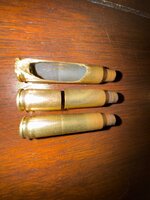
Here’s another example of a different type of case head failure. This time from an out of headspace 556 AK.
image0.jpeg

I don’t think pressure or headspace is your problem. You didn’t specifically mention any other issues that your rifle was having. And when headspace and pressure are excessive in a semi-auto system, it’s pretty obvious. There will be…other signs lol.

image1.jpegimage0.jpeg
In this case, about every 5th shot was a light primer strike. And when it would fire, the brass was completely mangled.

Edit to add: ultimately getting a headspace gauge is cheap insurance that your chamber is set up correctly.
 
Here’s another example of a different type of case head failure. This time from an out of headspace 556 AK.
View attachment 1008717

I don’t think pressure or headspace is your problem. You didn’t specifically mention any other issues that your rifle was having. And when headspace and pressure are excessive in a semi-auto system, it’s pretty obvious. There will be…other signs lol.

View attachment 1008719View attachment 1008720
In this case, about every 5th shot was a light primer strike. And when it would fire, the brass was completely mangled.

Edit to add: ultimately getting a headspace gauge is cheap insurance that your chamber is set up correctly.
Hey thanks so much for the help. Headspace gauge inbound. The slightly bulging ring around the case seems to be slightly lower than the mark left by the sizing die but I will confirm with a marker when I get back to the bench. I'm also understanding, after being told multiple times today, that an overgassed system could be the cause. I'll be checking the headspace and trying heavier buffers before I pull the bullets, dump the powder and restart.
 
Hey thanks so much for the help. Headspace gauge inbound. The slightly bulging ring around the case seems to be slightly lower than the mark left by the sizing die but I will confirm with a marker when I get back to the bench. I'm also understanding, after being told multiple times today, that an overgassed system could be the cause. I'll be checking the headspace and trying heavier buffers before I pull the bullets, dump the powder and restart.
Sounds like a solid course of action
 
What I think you are seeing is the imprint of the bottom of your resizing die on your brass. This can be especially noticeable if you are using a “small base die.”
I was going to suggest this before reading the buffer tube post. I had a lot of factory Hornady brass that was 1x fired, resized them with a small base die then reloading noticed the same ring. I was really freaked out by my inattentiveness to miss it when I looked over the brass but then realized it happened when I sized it. Odd it's not on all my brass though, about 15% of it or so.
 
Quick update: H3 buffer solved the bulge at the case web. Thanks everyone for your help!

Appreciate the update, and glad to see the heavier buffer worked.

If you want a little insight into what's going on...

The heavier buffer is slowing down the extraction just long enough for the chamber/bore to de-pressurize - and it confirms it's a bit over-gassed. You're pretty much at the maximum far end of "reliable" in how much energy the gun is transferring into the BCG. If you were in extreme cold, or the gun was very dirty, this can help keep it running longer before it stop would stop cycling. But it also means it's beating itself up more, and the recoil will be harsher than necessary.

If it works and you're good with it, awesome. If you want to tune it a bit to be pumping less gas, smooth out the recoil a bit, etc...one of the cheapest, easiest fixes is the Black River Tactical EZTune gas tubes I mentioned above. I've got a couple in ARs tuned with them, and they're great. More reliable than an adjustable gas block, and a lot easier to install.
 
Appreciate the update, and glad to see the heavier buffer worked.

If you want a little insight into what's going on...

The heavier buffer is slowing down the extraction just long enough for the chamber/bore to de-pressurize - and it confirms it's a bit over-gassed. You're pretty much at the maximum far end of "reliable" in how much energy the gun is transferring into the BCG. If you were in extreme cold, or the gun was very dirty, this can help keep it running longer before it stop would stop cycling. But it also means it's beating itself up more, and the recoil will be harsher than necessary.

If it works and you're good with it, awesome. If you want to tune it a bit to be pumping less gas, smooth out the recoil a bit, etc...one of the cheapest, easiest fixes is the Black River Tactical EZTune gas tubes I mentioned above. I've got a couple in ARs tuned with them, and they're great. More reliable than an adjustable gas block, and a lot easier to install.
Hey thanks I haven't thought of continuing to slow the system down. A reliable gun that doesn't beat itself up is definetly the goal. Is there a reason you went with the gas tubes instead of an adjustable gas block?
 
Hey thanks I haven't thought of continuing to slow the system down. A reliable gun that doesn't beat itself up is definetly the goal. Is there a reason you went with the gas tubes instead of an adjustable gas block?

You're welcome, glad the info is useful.

The reason for the EZTune tubes, primarily, is that adjustable gas blocks can malfunction. I have one that just a couple of weeks ago backed the gas-adjustment screw out on its own, opening things up so far that the BCG was being force-fed enough gas for the bolt to rip off a couple of case rims before I realized what was going on. Didn't separate the case head entirely, the extractor just jumped off a couple of rims within a mag, and then ripped two rims off, right underneath the extractor claw.

You also have to maintain adjustable gas blocks - the fouling will lock up the adjustment mechanism on some of them if you don't occasionally go in and twist the screw back and forth a bit to break up any of the fouling welded to it. Which, I have to think, just adds in another point of failure. And some are on the heavier side, compared to a traditional gas block.

It's not adjustable gas blocks are all 100% bad or anything, it's just that the EZTune tubes have ended up being a more reliable option, that are super easy to pop in and out. The more stone-cold reliable I need an AR to be across long round-counts, the more I'll lean towards one of the EZTune tubes.
 
You're welcome, glad the info is useful.

The reason for the EZTune tubes, primarily, is that adjustable gas blocks can malfunction. I have one that just a couple of weeks ago backed the gas-adjustment screw out on its own, opening things up so far that the BCG was being force-fed enough gas for the bolt to rip off a couple of case rims before I realized what was going on. Didn't separate the case head entirely, the extractor just jumped off a couple of rims within a mag, and then ripped two rims off, right underneath the extractor claw.

You also have to maintain adjustable gas blocks - the fouling will lock up the adjustment mechanism on some of them if you don't occasionally go in and twist the screw back and forth a bit to break up any of the fouling welded to it. Which, I have to think, just adds in another point of failure. And some are on the heavier side, compared to a traditional gas block.

It's not adjustable gas blocks are all 100% bad or anything, it's just that the EZTune tubes have ended up being a more reliable option, that are super easy to pop in and out. The more stone-cold reliable I need an AR to be across long round-counts, the more I'll lean towards one of the EZTune tubes.
I'll have to look at the tune tunes, sounds interesting and didn't know they existed. I just use plain adjustable blocks on my hunting rifles now since they don't get high round count. The defense guns all have the Superlative Arms bleed off blocks, supposedly the bleed off mode self cleans unlike the normal restrictive blocks. Curious about the tunes now though.
 
You're welcome, glad the info is useful.

The reason for the EZTune tubes, primarily, is that adjustable gas blocks can malfunction. I have one that just a couple of weeks ago backed the gas-adjustment screw out on its own, opening things up so far that the BCG was being force-fed enough gas for the bolt to rip off a couple of case rims before I realized what was going on. Didn't separate the case head entirely, the extractor just jumped off a couple of rims within a mag, and then ripped two rims off, right underneath the extractor claw.

You also have to maintain adjustable gas blocks - the fouling will lock up the adjustment mechanism on some of them if you don't occasionally go in and twist the screw back and forth a bit to break up any of the fouling welded to it. Which, I have to think, just adds in another point of failure. And some are on the heavier side, compared to a traditional gas block.

It's not adjustable gas blocks are all 100% bad or anything, it's just that the EZTune tubes have ended up being a more reliable option, that are super easy to pop in and out. The more stone-cold reliable I need an AR to be across long round-counts, the more I'll lean towards one of the EZTune tubes.
Makes sense. I'll grab the EZtunes because I really didn't want to use adjustable blocks.
 
I'll have to look at the tune tunes, sounds interesting and didn't know they existed. I just use plain adjustable blocks on my hunting rifles now since they don't get high round count. The defense guns all have the Superlative Arms bleed off blocks, supposedly the bleed off mode self cleans unlike the normal restrictive blocks. Curious about the tunes now though.

It's been an evolution for me. I'll share a little detail here, in case it might help anyone with AR gas systems...

My primary go-to AR is an ultralight with an adjustable BCG from 2A Armament. That BCG is super easy to tune to run reliably, without even disassembling it - but as an ultralight BCG, it needs to be. Slides and BCGs need to have enough mass and velocity to strip a round off a full mag and chamber it, but if you reduce the mass, that means you need to increase velocity of the moving parts, or increase the energy applied to and by the springs. Which also means messing with springs and the amount of energy applied the moving parts - just to keep everything balanced and reliable. As a general rule in ARs, it's best to keep the BCG, spring, buffer, etc milspec, just to keep these variables balanced, otherwise you end up chasing your tail in fixing cycling and reliability problems.

This 2A Armament BCG controls the gas flow right at the gas key with an adjustable valve - that means it's controlling the amount of energy applied to the moving parts, by restricting the gas flow down into the internal piston. Adjustable gas blocks regulate that volume at the barrel's gas port, at the expense of a heavier gas block. Moving that adjustment to the BCG means the same amount of (excessive) gas was coming down the gas tube as normal.

And instead of that gas going down the gas key and into the internal piston to be vented out the ejection port (under much lower temperatures and pressures), the more the valve is closed at the gas key the more high-pressure/high-temp gas is blown right back out the front of the gas key, all over the bolt, cam pin, cam channel, and along the raceways in the front half of the upper. Key places with lots of friction surface, getting blasted with friction contaminant. Suppressed, it's insanely filthy - just about the worst I've ever seen. It also had the side benefit of being pretty optimal for testing lubricant endurance and performance. Especially with the BCG also being lightweight.

To fix the gas and filth though, I didn't want the weight of an adjustable block (it's got a skeletonized titanium one on it), and went with the BRT tube. It cut down on the filth and gas quite a bit. This particular gun is an elegant, smooth joy to shoot, as far as ARs go, but it's more like a fine touring car, with limitations, than a Tacoma you barely have to think about maintenance for. Great for coyotes, but not the first one I'd send someone off to the trenches with. Since using the EZTune tube on it though, I've installed a couple of other BRT tubes, and have pretty much moved away from adjustable blocks entirely. This one adjustable block failing on me recently was a bit of a wakeup call, actually - I had to use an old M16 cleaning rod to pop the 2 casings out of the chamber. It was on a gun I thought was pretty damned reliable, with thousands of rounds on it. But it happened out of the blue in the course of 1 mag.

 
Thanks for the long write up and knowledge dump, definitely a good read. Only thing holding me back is that I like to switch ammo and tweak accordingly so I wonder how much that'll change things. I'll get one inbound this summer to test, have to figure out which application is best.
 
Back
Top