@Erussell01
Wind calling is an art. Very very smart people can be very bad at it. The best people at calling wind are shooting and living in the wind on a daily to weekly basis. Like
@Chris in TN said, the core problem is a lack of time practicing in the wind.
The more time you can spend in the wind, the more comfortable you can get with how your bullet responds to that wind.
Many different devices, scopes, mental models, and estimation tools exist to help people make better wind calls.
I have a framework that works for me. It has proven to be accurate enough for my uses and ranges. So that’s what I will discuss.
I won’t discount or bash anyone else’s model. I’m only going to show what I use and what I’m comfortable with.
I’m a visual learner, so bear with me while I show some pictures I put together:
This is the main problem.
We have the wind at our shooting location. But also wind at the target, and wind along the path of the bullet. None will be exactly the same. We also have directional uncertainty. Full value, half value, etc. it gets very probabilistic very quickly.
So at best I can say my wind will be “between value A and B.
I personally simplify greatly to pick a high value and a low value.
-I pick the average wind that I can measure or observe: 15mph for example in OP.
-I let that number inform which 2 wind number multiples it falls in between: 3 and 4 as discussed previously.
-and I let those two values assume all the inherent error of my estimations and measurements: AKA a wind bracket of probable hit.
For example:
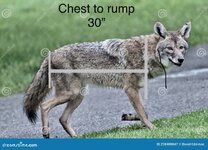
Most coyotes I’ve come across are ~about~ 30” from rump to chest (Plz let’s not get hung up on coyote size for the sake of discussion).
View attachment 1075842
My FFP reticle is a ruler. The hash marks cut a defined measurement that scales at distance. This is a subtension. MilRad, MOA are simply two ways of measuring, but the math can be done for both. I’m going to stay in miliradians since that is my base of experience.
(Target size in inches X 27.27)/distance in yards=Miliradians subtended.
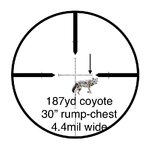
So 30” at 187yds is 4.4mils wide.
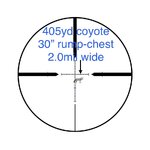
30” at 405yds is 2.02mils wide.
Here you can see the coyote scaled in the reticle for its appropriate distance:
View attachment 1075843
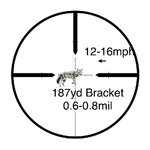
And here you can see the appropriate bracket showing me my expected error for high and low wind estimates. Note how my crosshairs are leading into the wind, and I am focused on my bracket over the vitals (feel free to zoom in):
View attachment 1075844
_____________________________
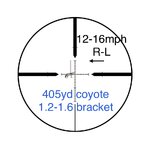
Now let’s do the same for 405yds:
View attachment 1075845View attachment 1075846
The key, for me at least, is I am comfortable accepting that I cannot make an exact wind call. Only an estimate of high and low winds.
So for me focusing on a “single” wind hold would not help my hit probability. Rather, when I use my ruler to show myself what the high limits and low limits will look like on the target, I can then decide if it gives me a high enough margin for a good hit.