HELP ME CHOOSE AN ARROW WEIGHT/BROADHEAD SETUP

At some point on the chart your KE will peak before beginning it's downturn.
That will be YOUR arrow setup.
That’s incorrect. KE rises continually with increasing arrow weight. KE does not peak at a certain arrow weight then drop thereafter. Any calculator that shows a peak in KE is flawed. The calculator on the Ashby Bowhunting Foundation* website correctly accounts for the relationship between arrow weight and KE, but many calculators out there do not.

Also, KE is completely irrelevant to arrow choice. For all practical purposes, your draw weight, draw length, and bow choice determine your KE. KE does increase slightly as you increase arrow weight, but the increase is negligible and should not factor into arrow decisions.

*Fair warning: ABF is a group of heavy arrow, high-FOC nuts, and they put out some very bad advice. Their online speed/KE calculator is, however, sound in its underlying math/physics.
 
That’s incorrect. KE rises continually with increasing arrow weight. KE does not peak at a certain arrow weight then drop thereafter. Any calculator that shows a peak in KE is flawed. The calculator on the Ashby Bowhunting Foundation* website correctly accounts for the relationship between arrow weight and KE, but many calculators out there do not.

Also, KE is completely irrelevant to arrow choice. For all practical purposes, your draw weight, draw length, and bow choice determine your KE. KE does increase slightly as you increase arrow weight, but the increase is negligible and should not factor into arrow decisions.

*Fair warning: ABF is a group of heavy arrow, high-FOC nuts, and they put out some very bad advice. Their online speed/KE calculator is, however, sound in its underlying math/physics.
KE=1/2M(V)^2
Velocity matters more than mass. You cannot continually increase mass to increase KE.

You are somewhat correct in that KE does not produce wound channels with arrows. HOWEVER most mechanical broadheads take around 40ft-lbs to open. Some are as high as 60. If you only have 65 pounds and your broadhead eats 55lbs you are what we call Fuc%ed
 
I've personally had great experience with a 450 to 475 grain arrow. Balance it well with your draw length and poundage, you can shoot 3d events and hunt a variety of species.
 
You cannot continually increase mass to increase KE.
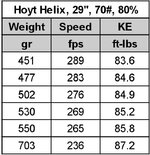
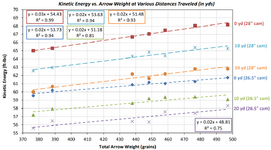
You absolutely can, but the KE increase is small and inconsequential for all practical purposes. Below are two datasets based on arrow speeds I personally chronographed (not estimated from a calculator) that show KE continually increasing with arrow weight. You can find many other datasets showing the same KE trend if you go digging.
Screenshot_20230302_205441.jpg554.png

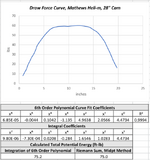
A bow is an energy conversion machine; it transfers the energy put in by the archer to the arrow. The bow's potential energy developed during the draw cycle is primarily a function of draw weight, draw length, and brace height. Cam profile and let-off percentage also have an effect. Once those parameters are set, the bow's PE is set. PE can be calculated by plotting a draw-force curve and calculating the area under the curve. Below is an example from my old Mathews Heli-m.
Screenshot_20200826-094043.png

The arrow's KE is equal to the bow's PE minus energy lost to friction and to accelerating the string/cams/limbs. The bows I've tested have shown approximately 85-90% efficiency at converting PE to KE. As the arrow gets heavier, everything gets slower, and less energy gets lost to acceleration of string/cams/limbs. PE is still fixed, but losses are reduced; thus, energy transfer efficiency increases (slightly) and the arrow's KE increases (slightly). I've seen this behavior with every bow I've ever tested.

If you have a few hours to kill, here’s an old thread on Archery Talk discussing this topic ad nauseum: https://www.archerytalk.com/threads/peak-ke-and-arrow-weight.6172572/#replies
 
I've passed through the knuckle on two mature bucks with this setup:
RIP TKO 250, 75 HIT, 10 grain Impact Collar, Iron Will Wide Single Bevel 125
 
Get onto podiums website and use their calculator.
Enter all of your information, and then study the chart. At some point on the chart your KE will peak before beginning it's downturn.
That will be YOUR arrow setup. And every person will have a different number. Don't copy someone else's setup, because their numbers will never match your own.

View attachment 1000115
nice tool! thanks for the reply, will check it out
 
I would go with something very simple. I wouldn't even mess with 5mm shafts for what you're looking for.

Go with 350 BEA Spartans or Victory Rivals. Us the stock SS inserts add 25 grains of brass behind them, Cut them to 28 inches and screw on a 100 grain head of your choice.
 
Don’t worry too much about weight. 400-500 grains is a good spot to be. Focus more on choosing a quality insert system and broad head.
 
Any carbon 300 spine arrows.

Cut them as short as you can and have broadheads and inserts not contact your rest.

Square BOTH ends of your arrows.

Fletch with anything having at least as much steering capability as 3 bohning blazer vanes.

Use factory nocks, or the lightest replacement you can find. No lighted nocks.

If you have to wrap, white or reflective, and make it as short (light) as possible.

Buy 100gr stainless half out inserts that match your arrows. The last two dozen I bought came from Amazon, spun true, and were tight on weight.

Buy whatever 100gr cut on contact fixed head you prefer. Make sure the blades are very very sharp. Hair popping sharp.

This will put you around 460- 475 grain total arrow weight. It will make two holes through any whitetail.


Spend time to tune your bow. If you’ve squared both ends of your arrows, and your bow is in tune, you should have no problems at whitetail distances. If you shoot broadheads and field points and they don’t hit within 1” of each other at 30 yards, your bow is out of tune.

I like to shoot them together at 40 or 50 as it magnifies any issues.


Bow tune (an arrow flying true and not wasting any potential energy correcting flight or hitting an animal with side loading), and FOC, are both free penetration potential. They eliminate the need for you to consider shot angle. If you can see the front half of a deer in reasonable range (my personal opinion is that’s 25-30 yards for the most anxious animal in the woods), aim so that your arrow will pass through just behind and above the heart. You will make two holes.


Going heavier than this will introduce a lot of work and cost to get arrows doing what you want.

Going lighter than this will reduce cost and buy you increased range potentially. But it if you shoot enough animals, it will eventually cost you an animal - either because you cant take the shot offered, or because you did and got no penetration. Or you’ll miss your point of aim and get no penetration. Same with expandables.


Don’t overthink it.
 
Back
Top