
thinhorn_AK
"DADDY"
- Joined
- Jul 2, 2016
- Messages
- 13,909
My bad, I walked right into that one.Wait a minute, I thought you don't cast the rod. I'm confused, now you're getting me off to a bad start

Follow along with the video below to see how to install our site as a web app on your home screen.
Note: This feature may not be available in some browsers.
My bad, I walked right into that one.Wait a minute, I thought you don't cast the rod. I'm confused, now you're getting me off to a bad start
No worries my friend. I've never heard of the rod casting thing but at one time I was pretty involved with the old FFF casting instructor program and there were raging debates for years over various casting "defintions". In print people would say you have to use a word this way but then in conversation they'd immediately revert back to old usage without realizing it because language isn't easy to change.My bad, I walked right into that one.
Pretty much exactly what I just did. I’m in the middle of dealing with all sorts of fishing stuff right now. Between making sure I’m all set for the spring once ice is off here, prepping g for my trip to fish down in Belize, then getting ready for a bonefish trip to Molokai over the winter, I’ve been unconsumed with this stuff for a bit, add some winter steelhead and that’s all I’ve been doing. Now I need to think about going on a few bear hunts and an aoudad hunt this time next year.No worries my friend. I've never heard of the rod casting thing but at one time I was pretty involved with the old FFF casting instructor program and there were raging debates for years over various casting "defintions". In print people would say you have to use a word this way but then in conversation they'd immediately revert back to old usage without realizing it because language isn't easy to change.
Yeah. I was being funny. Or trying to.I think all my rods are capable of it, I do t think I am though.
Luckily I’ve never really needed to get my line more than 50-60 feet out.

Anything but swinging for steelhead is lameNow that is a strange way to “fly” fish. I’ve done that for steelhead and it’s cool to
Be fishing but not really a style that I love. Like 9feet of 30lb mono, a bobber, weight, an egg and then a hook a few inches under that. It works, I’m not sure it’s really fly fishing though.
What’s super lame though is steelhead fishing with a bobber and a spin rod….

Swinging is cool but it’s lame to be stuck on small sections of giant awesome rivers. I got into Spey last year but it wasn’t very effective since I fish form a boat 95% of the time.Anything but swinging for steelhead is lame
Yeah I was too.Yeah. I was being funny. Or trying to.

Jimmy’s is a great shop, I miss talking to Jimmy when I lived in Idaho Falls. I hope it’s still great now that Fly Fish Food has taken it over.


Thanks for all the comments from everyone.
After researching, watching videos, feedback from here... I will be buying the Lamson and putting some SA line from the local fly shop Jimmy's in Idaho Falls. It seemed best band for the buck and that's what this current build is aimed towards.
Has anybody had any experience with the KastKing Chest Pack? Seems like a decent bargain.
Kastking chest pack
Remember, this is to help all new fly fisherman get started with above average gear without spending 1500 dollars on a reel/rod combo. If all goes and I enjoy it as much as I think I will, Ill upgrade next spring to some fancy stuff...

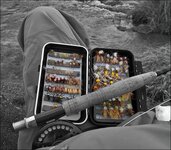
 This is her approach...

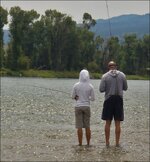
Reading from other threads I picked up a TFO NXT Black from Sierra for $79.90. 9' length in 5W.
Now ive done a little research on reels. Liquid Lamson, Sage Spectrum, Orvis Clearwater, TFO is what I narrowed it down to.
Need advice and links to good deals for..
1. Reel
2.Backer and Line (Size)
3.Tippet (Size)
4. Fly's for South Fork Snake you'd recommend. And a tip for methods (Nymph or Dry flies?)
5. Any good pack or chest rig that would be great to start with.
We fly fish because we like it and we enjoy it. Fly fishing is not, and never will be the best way to catch fish effectively
I love these kinds of responses. What an educational public service for a guy (like me) who has an interest in fly fishing. Thank you!I was a licensed and bonded hunting and fly fishing guide (#2725) in California from 1995 to 2012 and was a contributing editor for California Fly Fisher magazine from 2001 to 2012.
That'll work.
That'll work, too. In truth, though, just about anything will. Most trout aren't going to be played off the reel. It generally takes an unusually large and unusually spunky trout for things like "low initial start up torque" on a disc-drag reel to matter, or even the disc drag itself, for that matter.
1. We've covered that. In trout fishing, and indeed most freshwater fishing, you can pretty much use whatever you want, from a cheap $9.99 Aventik CM to something with a caged frame and exposed palming rim spool machined from bar stock aluminum and Type 3 anodized, having a disc drag with low initial startup torque, that cost several times more. The TFO reel that you like will work just fine.
2A. Most "trout class" fly lines have cores at around 20# test, so it is pointless to use backing stronger than that. 20# braided Dacron, dyed orange, and made by Cortland, is what I use, but you can use whatever you want in 20# braided Dacron.
2B. Line size is dictated by your rod. You have a five-weight rod. Pair it with a five-weight line to begin with. A true five-weight fly line is supposed to weigh 140 grains over the first 30' of "head," regardless of taper or type, but there's a range of tolerance, where a line is still considered a five-weight if it weighs 136 grains to 146 grains.
Your first line should be a floating line. That is the most useful for trout fishing on rivers and streams.
You will find five-weight floating lines in either weight-forward (WF) or double-taper (DT) formats. In floating line, I have a strong personal preference for DT lines. They roll cast better, tend to float like corks, come off the water easier and cleaner, AND, contrary to conventional wisdom, and as proved to me time and again by champion tournament castr Steve Rajeff, they also shit all over WF lines for distance.
To be specific, I prefer Cortland 333 or 444 DT -5F as my general purpose trout line. The difference between those two is that 444 costs more and has welded loops at each end, which I don't need or want, so I generally buy the cheaper of the two. Also, the Cortland 333 and 444 lines are true to their line class in terms of how much they weigh over the first 30' of head. When I buy a five-weight line, I want it to actually be a five-weight line and not a five and a half weight, or a five and three quarters weight. And, both the 333 and 444, which are the same nowadays excepting for presence or absence of welded loops, both float like corks. I have a few of these still in use that are two decades old, so they last a long time, too, if you take care of them.
3. In trout fishing, tippet is something I add to a tapered leader to restore casting performance if the leader has been shortened due to multiple fly changes. It is sized the same as my leader's built-in tippet. How I choose leader / tippet size is to divide the hook size of my fly by 3 and 4. If, for example, I am fishing a size 12 fly, doing this will give me a choice of 3X or 4X as the leader and tippet size. The X number is like wire gauge; smaller is thicker. If my size 12 fly is heavier or bulkier than normal, I want to use the stiffer of the two choices, which would be 3X in this case.
4. I've fished for trout on rivers in California, Oregon, Arizona, New Mexico, Utah, Colorado, Montana, Wyoming, and Idaho, and generally have the same 13 fly patterns in my box. They're generally not exotic, nor are they location specific. I fish the same elk hair caddis on the upper Madison River in Montana that I've fished on the South Fork of the Kern in California, for example.
Right now, my fly box for general trout fishing contains examples of: Parachute Adams, Elk Hair Caddis, Blue-Winged Olive, Chernobyl Ant, San Juan Worm, Prince Nymph, Pheasant Tail Nymph, Gold Ribbed Hare's Ear, Bead-Head Olive, Copper John, Zebra Midge, Muddler Minnow, Woolly Bugger, and Olive Matuka. If you search "Dozen must-have trout flies," you'll get a list similar to this, and you'll get it for a reason.
5. I'm a simple guy and like to keep things simple so I don't carry a bunch of crap when I go catching. Any small chest pack that'll hold my MFC fly box, a spare spool loaded with a sink-tip line, leaders, tippet material, hemostats, a thermometer, nippers, fly dryer, fly float goop, and a leader straightener will work for me.
There are two things not on your list that I would recommend.
One is a Tie-Fast tool for tying nail knots. The other is a copy of The Curtis Creek Manifesto by Sheridan Anderson.
AND, contrary to conventional wisdom, and as proved to me time and again by champion tournament castr Steve Rajeff, they also shit all over WF lines for distance.
The rod would have been a G. Loomis of some kind. Steve was designing fly rod tapers for Loomis at the time. As for the line, all I knew was that it was very obviously a DT of some kind and not a WF.When he showed you that do you happen to remember what rod and line he was using?

@Cherokeeguide I see it's gone but you mentioned your "old, soft, slow" Fenwick. I have a mid 80's Powell Rod Co Signature 8'6" 5/6 wt. I would describe it the same way as your Fenwick but I'm a hack. Since I was poor at the time it was my only rod and I learned to use that thing on all sorts of water and huck everything with it. Did you ever use or try one of those old Powell's? If so I'm curious as to how would you describe those rods action?
Old, soft, slow 5/6 or 6 weight 8 1/2' rods, made from first generation graphite, are about the most versatile fly rods ever produced in the history of fly fishing, particularly when paired with a competent caster. A competent caster can throw all 92' of a Cortland 333 DT 5F or DT-6f line out of old, soft, slow rods like ours, with no problem, and it takes an excess of 120 mph of line speed off the tip to get that kind of distance.




