Follow along with the video below to see how to install our site as a web app on your home screen.
Note: This feature may not be available in some browsers.
UPDATE:
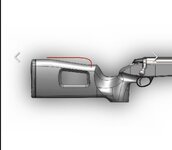
Our CAD designer has done very well for us. This is very close to final design. We are having him make a couple tweaks from what you see here, but otherwise, it’s very close.
The grip is a scanned Master Sporter grip profile. We did have him alter the area directly behind the receiver tang to allow a thumb in line with the bore, or wrapped like a traditional Master Sporter grip.
The barrel channel will be Sendero profile.
The two changes that we’re having him make are more radius on the bottom edges of the forend, and to cut the window in the butt an additional 1/4” lower. We may drop comb height a touch. We want comb above bore centerline, but not a lot. Maybe 3/16” or 1/4”.
Tell us what you think!
View attachment 1089947View attachment 1089948View attachment 1089949
Maybe for bolt removal clearance?^this or split the difference.
The curve up at the front of the comb on the drafted shape is kinda goofy, why do that? Might as well ha a lesser neg comb angle if you need to do that.
I have some concerns about the strength of the stock in the grip area, with that much material removed.
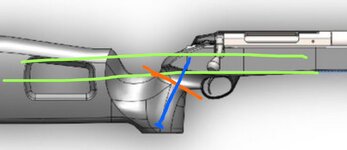
Wood gets its strength from the grain, even plywood. On a typical wooden stock, the strength primarily comes from the material left in between the green lines. The grain is able to continue from the forend into the butt of the stock. On this stock, I don’t see any grain continuing between the forend and the butt.
The inherent weakness of wood can be offset by orienting the grain vertically on a solid wood stock, like a good axe handle. Another method of reinforcement is to laminate layers of something such as fiberglass, in the proper orientation, between layers of wood laminate. Boyd’s appears to address this weakness by putting a fastener in the approximate location of the blue line.
As it is, I’m concerned that this stock will be at risk of breaking in the grip area (orange line), similar to the wooden Rokstock.
When you decide to sell that, you just let me know lol. Somehow the "patchwork" ended up looking like intentional asthetic improvement, and creates a beautiful contrast.More
I don’t foresee it being front heavy.Apologies if this was already addressed, but does the removed material in the stock increase the chances for an overly front heavy gun once a suppressor is added? Having some more weight could be preferable if it means great balance with on the complete rifle set up.
You have a valid concern. However, be assured that the manufacturer knows what is required at the wrist to avoid being prone to breakage. We will make sure the design provides adequate strength. On your lowest green line, a little structure is required to avoid breakage, but only 1/4” or so. If the manufacturer sees that we need to have the web of the wrist a touch higher, we will do so.I have some concerns about the strength of the stock in the grip area, with that much material removed.
Wood gets its strength from the grain, even plywood. On a typical wooden stock, the strength primarily comes from the material left in between the green lines. The grain is able to continue from the forend into the butt of the stock. On this stock, I don’t see any grain continuing between the forend and the butt.
The inherent weakness of wood can be offset by orienting the grain vertically on a solid wood stock, like a good axe handle. Another method of reinforcement is to laminate layers of something such as fiberglass, in the proper orientation, between layers of wood laminate. Boyd’s appears to address this weakness by putting a fastener in the approximate location of the blue line.
As it is, I’m concerned that this stock will be at risk of breaking in the grip area (orange line), similar to the wooden Rokstock.
Yep, we’ll drop the top comb line a little, which will decrease that angle.I’d guess if you are decreasing the above bore height you’ll want a higher contact point for the cheek. Less of a sweeping up to the rear like a Rokstok, and more of a flatter top to allow for a cheek rest to be added if needed.