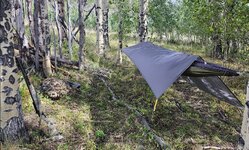
I wrote out my setup in a different thread, so I wont go into that detail here.
There seems to be a few misconceptions people have about hammocks, specifically about the camping style ones we use. The first one is about hanging them, or lack there of. I live in the great plains in South Dakota. There is nowhere in this state I've failed to find a place to hang. It's really no different than if you had a tent. Would you pitch a tent in the middle of the grass field? Maybe someone would, but they wouldn't get away with it for long. No, you find a reasonable spot, ideally out of the wind, and in this case with at least a tree. Yes, you can hang a hammock from a single tree, although 2 trees are the way to go. In the last 3 years I can only remember one time I had to use one tree, and I've never once had to sleep on the ground without choice. Not even a close call. If you are in an area with lots of dead trees, I promise you can find 1-2 good live trees within a few hundred yards. The only places hammocks will not work is if you are way above the treeline at high elevation. assuming you would want to camp up there. The other might be somewhere such as northern alaska tundra where trees don't grow. For 99.9% of the lower 48 states you are going to be just fine. I would actually go so far as to say finding a suitable hammock hanging spot is easier than finding a suitable flat spot for a tent. The terrain it taken completely out of the equation, although I wouldn't hang over the edge of a cliff.
Another misconception I often see is about comfort, or lack there of. I'm not really certain why this comes up, and I'm sure some people simply don't like them, but I'm pretty sure most people who say this have never really tried one that wasn't trash. Again, we are talking camping hammocks, which can be gathered end or bridge hammocks. They are not the $15 rope things you hang in your yard for decoration. There are tons of dirt cheap Chineese camping hammocks out there, and I'm betting lots of them have zero design to them, such that they too are about as useful as a decoration. Not all of them are horrible, I had, actually still have, a cheap one that is not too bad. Do your research online to find brands of cheap ones that are good. All of the higher end brands are very good. The best way to describe a hammock is a hanging cot. Between a pad on the ground (in a tent or not), or a hammock it isn't even a close call. The comfort of a hammock is a mile ahead. A cot in a tent can be just as good, provided it is big enough, but that's not really lightweight gear at that point. The one instance I think someone wouldn't want a hammock is if they are a stomach sleeper. Why anyone would want to sleep face down is beyond me, but many people do. If you are one of those, then a hammock probably isn't the way to go. People with bad backs, a hammock can be a godsend. Sometimes I get asked about tossing and turning at night, or even getting into and out of a hammock. There's no issue with either. You can roll around in them all you want, it's no different than a cot.
The last misconception I often hear, and this is a big one, is that you wouldn't want a hammock in a storm. Nothing could be farther from the truth. I've spent plenty of time in bad storms in tents, even big canvas wall tents in the Boy Scouts. I've been through storms in lean to shelters. I've been through storms in a bivy sack with a rain jacket over my head. Canvas wall tents and cots are the best, no surprise, but besides that the hammock is the best there is. Lightweight tents especially are the worst in rain. From frames that don't hold up to the wind, to water pooling inside, I have yet to see a tent that is as good as a hammock can be. If you were to get a tent, absolutely get one with solid poles. Flexible poles do not hold up. If you've never slept with the side of a tent pushed against your face, you've never really been in a bad storm. There are plenty of normal tents that fit the bill, but last time I looked most ultra light tents were pretty flimsy. That was 10 years ago though, maybe there are better options today. A quick search shows there are tents that are supported by hiking sticks, and that may be a great way to go. Or just get a hammock. The hammock itself is off the ground as high as you want, it will never get wet on the bottom. The top side is all about your tarp. If you get wet at all, you messed up. Something like the Warbonet Super Fly tarp set up right, you will not get wet. Rain could be going perfectly sideways, and you would not get wet. They do have limits like anything, but even gusts of 40-50 mph winds they hold up fine.
Hopefully that clears up some misconceptions. I don't know a lot about the exact weights you can achieve with each setup. You can see some crazy low numbers from backpacker hammock setups, but those kinds of setups are not what you would want as a hunter. If weight was the only thing that mattered we would all be using bivy sacks which work fine for a day, but are miserable for a week. One of the great things about hammocks and tents is it gives you a place to dry things out, and get out of the wind. Again about the weights, all setups can vary depending on need. Someone winter camping Alaska would probably need a much more robust setup for a hammock, where a tent might end up being lighter because it doesn't need as much stuff. Same thing for those down south where all you would need is a hammock, bag or quilt, and a tarp. The Hammock is going to be a lighter setup than the tent and all that goes with it. For most of us I think the differences are going to be so close I don't think I would consider weight when going for a tent or hammock. When I say hammock setup, this is what I consider the things to have for most people, including right now in Colorado. The hammock itself of your choice. An underquilt. A sleeping bag or top quilt. A tarp. That's all that you need. Lots of people get concerned about the underquilt, but there's no reason to be. It's just some insulation you hang below you. The down ones are fantastic, but you don't need to spend a fortune, especially not for september type weather. You can get a decent synthetic one from Arrowhead for $115, and I'm sure there's plenty of Chineese ones out there for much less that do a good enough job. The one area you shouldn't skimp is the tarp. I used a plain old blue poly tarp, it worked, but it is not something you want to use for backpacking. Don't try to save those 2 ounces by getting the most minimalist tarp you can. Save that weight by using lighter rope, and or don't bring stakes with you. A Warbonnet Superfly is in the ballpark of 20 ounces, and you will never regret it. Using a tarp without doors requires a bigger tarp to compensate. Trying to use a bare minimum size tarp only results in failure.
Edit: You might also need a bug net. Most good hammocks come with them built on. A cheap hammock with a separate bug net works too.