
First Time Past 400: 24-Shot Group Evaluation at 420 Yards (Seated Tripod / Arca / 17.5° Uphill)

Joined
Jul 10, 2026
Messages
4
Location
West Coast, BC
1783713339373.png
1783713851296.png

Hey guys,

Just joined the forum. Been lurking for a few years now.

Looking for some objective feedback on a recent training session. This was my first time ever stretching a rifle out past 400 yards. It is difficult to find any areas that allow for longer shots due to the topography of the land where I live. This isn't typically long range to most guys, but I have to start somewhere!

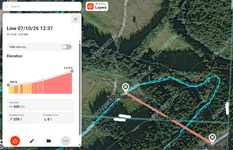
I am a newer shooter (3 years now) but I have very good mountain hunting available to me. This year I have been rucking since February in order to get in shape for the coming season (47, 5'6", 186lbs down to 162lbs). I wanted to test my real-world field capability from positions I might actually encounter on a mountain, so I set up on a gravel forest service road (FSR) with an approximately 10% road grade, shooting steep uphill at a target positioned with a 17.5° look angle.


My Setup:
  • Rifle: SIG Cross in 6.5 Creedmoor +Heller Arms 3PRT Brake (Total weight with optics: 9lbs8oz).
  • Optic: Burris Veracity PH 4-20x50.
  • Mount: Sirui AM324 with spikes, Leophoto EB35 ballhead. Small 2.5" Arca rail directly locked into a tripod ball head. DIY sling tensioner. (The ball head was locked but able to move with moderate pressure).
  • Ammo: Barnes VOR-TX Factory 127gr LRX.
  • Chrono Data: 2,774 FPS average muzzle velocity (elevation when tested was 640ft ASL)

The Scenario:
  • Time/ Weather: 0900 Pacific, 18C/ 65F, Overcast
  • Distance: 420 yards on the HUD.
  • Angle: 17.5° uphill incline (378 ft elevation gain).
  • Position: Seated directly on the gravel FSR (no bum pad), rifle balanced on the ball head (no dedicated mechanical rear support).
  • Tension System: I built myself a tension strap that I hook into the rifle swivel mount in front of the ball head, then carabiner it to my belt loop. This was made from an elastic-style single-point sling. Got the idea from a commercially available item.
  • Course of Fire: 24 consecutive shots.

The Execution:

To establish a baseline for my raw mechanics, I chose not to call the wind or hold for it, simply because I have no experience with wind-calling at this time. I dialed my elevation into the Burris HUD to get my vertical solution and focused entirely on breaking clean shots.
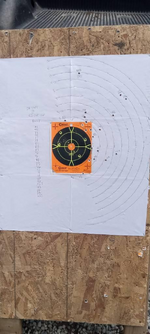
The Results (See Attached Images):
I measured every single bullet hole's radial distance from the exact center of the bullseye (in millimeters). Here is the raw breakdown:
  • Total String: 1.693 1.772 2.205 2.520 2.874 3.071 3.189 3.346 3.386 3.622 3.661 3.701 3.740 3.937 4.331 4.449 4.449 5.079 5.197 6.417 7.165 9.488 9.843 9.961
  • Closest shot: 1.693 (0.38 MOA from center).
  • Average deviation (Mean Radius): 4.543 (1.03 MOA from center).
  • Furthest flyers: 9.488 9.843 9.961
  • (~2.26 MOA from center).
  • Overall group shape: The core 19 shots are tight, but the overall group shows a distinct push up and to the right..
Because I didn't hold for wind, the horizontal drift makes sense for a shifting breeze. However, I’m seeing about 12 inches of total vertical dispersion from the very lowest shot to those top three flyers.


My Questions for the Forum:
  1. Given this is my first time out past 400 yards (or even close to that), the position (seated/Arca ball head/17.5° incline), and a 24-shot sample size, how can I improve on this?
  2. What is the best way to start figuring out wind?
  3. What is the best way to eliminate that vertical stringing?
  4. What field-practical modifications can I make to my position to stabilize the rear when craning upward at a steep angle? I felt like the buttstock wasn't always placed in the optimum shoulder position.
This is all new to me and my goal is to be breaking clean shots consistently. I am open to suggestions on changing projectiles etc. I do not reload and will not be looking at that avenue for some time. I like the rifle and I find I am shooting it better than my 7RM. I believe that is down to the lesser felt recoil.

Appreciate the blunt feedback. Tear it apart.
 
Looks like inches to me👍
I would concentrate on being square to the rifle and constant cheek pressure, as well as the same height of butt placement.
It may also be that your rifle isn’t precisely zeroed.
Right on. Thank you for the reply.

Yah I chaged that up after buddy there dropped his soother or his butt plug, not sure which it was.

It definitely feels different in the shoulder sitting down pointing up, compared to level off the table/bipod. Rifle is good at 100 yards and does cloverleaf occasionally. I'm currently shooting 1.2 MOA average for 5 shot groups at 100 yards. I'm not an expert by any means and joined this community to help improve my shooting capabilities.
 
Curious what your 10-20 shot 100 yard group under same conditions/positioning looks like?
Only shot 5 shot groups at 100 yards , never 10 or 20 shot groups unless it's the 22lr. They are ammincable. Rifle shoots far better than I can and probably than I ever will. Larger shot groups are new to me and so is the longer range.
 
What size group did the first 3 make?
Blake I couldn't tell you but I'll check this on the next trip. I just took position and shot . Now that I think about it I could have let the barrell cool much longer between strings.

It's a decent drive back up the switchbacks to the target, so I was just hoping that I was on paper to be honest.

I'll be going out again next week, once work duty permits. I will take into consideration the points here given, starting with confirming my 100 yard zero and progressing from there.

Really appreciate those that took the time out of their day to post positive comments.

Thank you
 
Blake I couldn't tell you but I'll check this on the next trip. I just took position and shot . Now that I think about it I could have let the barrell cool much longer between strings.

It's a decent drive back up the switchbacks to the target, so I was just hoping that I was on paper to be honest.

I'll be going out again next week, once work duty permits. I will take into consideration the points here given, starting with confirming my 100 yard zero and progressing from there.

Really appreciate those that took the time out of their day to post positive comments.

Thank you
Could be a combo of barrel heating and fatigue on your body. Prone is a good baseline. Then go for alternative positions..
 
Do you have anything to verify you're not canting the rifle, and yes, if cheek pressure isn't there, roll up a towell around the stock as a temporary check to see if a more positive cheek weld.
 
Blake I couldn't tell you but I'll check this on the next trip. I just took position and shot . Now that I think about it I could have let the barrell cool much longer between strings.

It's a decent drive back up the switchbacks to the target, so I was just hoping that I was on paper to be honest.

I'll be going out again next week, once work duty permits. I will take into consideration the points here given, starting with confirming my 100 yard zero and progressing from there.

Really appreciate those that took the time out of their day to post positive comments.

Thank you
If possible, get a target that will give you instant feedback. Ar500 is nice, but not necessary. I have a couple of mild steel targets that have held up for years, albeit they are very scarred lol. Something in the 10” range is a good starting point. Check with a local metal recycler, and look for something at least 3/4” thick. 1” is better.
If they have Ar500, 1/2” is plenty.
 
Get a scope level. $20 and it'll help you eliminate questions, if nothing else.

I wouldn't worry about barrel heat with modern barrels. Especially if you're breaking and rebuilding position every 2-3-4 shots, which you should be doing, as you need training on building the positions as much or more than you need practice shooting from them.

Get a big steel target. There's no way I'd pay a single dollar for a target made of less than AR500 steel, for centerfire rifle use. I have a big disc blade I shoot at with .22lr, and only .22lr, but for everything else, just get a big AR500 gong. Buy once, cry once, and never worry about reverse ricochets. I adopted this stance about three seconds after a .45ACP round hit the ceiling of the porch I was shooting from one day ~20 years ago.

(3/8" AR500 is plenty for impacts under 2800'ish)

Eliminate the worst 20% or less of your shots and the rest are absolutely not bad at all, and for a first-timer, you did well. Don't lose sight of that. Remember that this is supposed to be fun.


ETA: Also, find some cheaper ammo.
 
I would concentrate on being square to the rifle and constant cheek pressure, as well as the same height of butt placement.
...and build a more solid position that includes rear support. Either prone, with a rear bag -- or lower the tripod until you can use something like a backpack from a seated position.

It may also be that your rifle isn’t precisely zeroed.
Quite likely, but concentrate on consistent grouping for now. Once you can do that for 20 shots or so, a solid zero is just a few clicks away.

Good luck!
 
My Questions for the Forum:
  1. Given this is my first time out past 400 yards (or even close to that), the position (seated/Arca ball head/17.5° incline), and a 24-shot sample size, how can I improve on this?
  2. What is the best way to start figuring out wind?
  3. What is the best way to eliminate that vertical stringing?
  4. What field-practical modifications can I make to my position to stabilize the rear when craning upward at a steep angle? I felt like the buttstock wasn't always placed in the optimum shoulder position.
When training and learning, a primary goal is to control variables and identify and reduce sources of uncertainty in POI. Some inputs to your questions:

1. Two things here: recoil control, and building a stable position. For recoil control, you need to first be mindful of anything that causes/allows the rifle to move between the time the trigger breaks and the bullet is released, and second, you need to minimize that movement not only to reduce POI uncertainty, but also so you can more easily and reliably see the bullet's trace and impact, and adjust POA accordingly. You want the rifle to recoil straight back and eliminate muzzle rise. Clamping the rifle into a tripod is an advanced technique, and inherently causes muzzle rise since the tripod head acts as an leveraging apex under recoil. You would be better served by putting a good sand-filled bag (like the heady-filled Shmedium) over the tripod with no head, which allows the rifle to better slide straight back under recoil. Similarly, make sure your rifle is set up so the cheek rest is not too high such that you are putting a lot of downward force onto the stock with your cheek. This causes the rear of the rifle to drop under recoil, throwing shots high.

When it comes to building a stable position, the goal is to create two points of solid contact for the rifle, one at front and one at back. When shooting off a tripod or long bipod, ideally you would have another tripod as a very solid rear support, but that's not very practical in the field most of the time. A good alternative is to use a pump pillow or some proxy, like a pack, bunched up jacket, etc., to give your strong-side elbow something to rest and stabilize on, filling up the space between your legs/core and your elbow. Another option is to shoot from kneeling, and use your strong-side raised knee as a rest for your strong-side elbow.

2. Two suggestions to start learning about wind: first, get a Kestrel and use it while training, and second, read about and practice judging what different wind speeds do to heat waves in the air and various types of vegetation in the field. During a training session, first guess the wind speed and direction, then measure it with the Kestrel. This allows you to calibrate your wind judging abilities using your senses against known values. Also read about and understand how wind affects your bullet when the wind is coming from different angles. Learn to correlate the visual effect of the wind on mirage and trees, grass, leaves, etc., down range with various wind speed values.

As you practice these two techniques while training, you will develop the ability to read various wind profiles between you and the target, based on the feel and sound of the wind at your location, and seeing what it is doing to mirage and vegetation down range. Keep in mind that wind speed/direction can change multiple times between you and the target, creating various wind profiles that you need to mentally account for when judging a net wind call.

3. Vertical stringing can come from a combination of vertical dispersion in the rifle/load, and vertical movement during the shot (poor recoil control leading to varying degrees of muzzle rise). I've already touched on recoil control, but you can also reduce vertical dispersion in the load/rifle. First, I would use something like Hornady Precision 147 gr ELD-M factory ammo for training, which not only has better external ballistic performance, but is also more affordable than Barnes 127 LRX ammo. Check for vertical dispersion in your groups at 100 yards, and use a chronograph to assess the muzzle speed variation (ES and SD) of at least 10-shot strings, and 20 shots is much better. The goal I aim for is an ES under 50 fps and SD under 10 fps with a sample size of 10 shots.

4. I've mentioned field supports and building a stable position, but part of this is making sure the rifle stock is correctly sized and adjusted for your body. You should have the butt of the stock as close to the centerline of your body as possible - I like it to be on/below the collar bone, and as high as needed to get a snug (but not hard!) cheek weld and a good sight picture with your head in a vertically fairly natural position. This will help with your natural point of aim and recoil control.

As others have mentioned above, I also suggest the following:

- Eliminate/control variables to identify and separate what the rifle is capable of and what you, as the shooter, are capable of. Bench or prone with stable front and rear rests first to see what the rifle can do, then shoot from various field positions to see where you are at as a shooter.
- Scope level is helpful to further eliminate variables for training and learning purposes. Using a level during training helps you build muscle memory that translates to the hunting fields.
- Similarly, eliminate the barrel heat variable by letting the barrel cool every 5-10 shots.
- A painted steel target provides better visual and audible feedback than paper. Get some 3/8" AR500 plates, as they give much better visual (you can see them swing) and audible (they make a much more distinguished ring) feedback than heavy, thick mild steel.
 
Back
Top
