DRT-Hauler
FNG
Hey guys,
Just joined the forum. Been lurking for a few years now.
Looking for some objective feedback on a recent training session. This was my first time ever stretching a rifle out past 400 yards. It is difficult to find any areas that allow for longer shots due to the topography of the land where I live. This isn't typically long range to most guys, but I have to start somewhere!
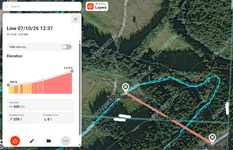
I am a newer shooter (3 years now) but I have very good mountain hunting available to me. This year I have been rucking since February in order to get in shape for the coming season (47, 5'6", 186lbs down to 162lbs). I wanted to test my real-world field capability from positions I might actually encounter on a mountain, so I set up on a gravel forest service road (FSR) with an approximately 10% road grade, shooting steep uphill at a target positioned with a 17.5° look angle.
My Setup:
- Rifle: SIG Cross in 6.5 Creedmoor +Heller Arms 3PRT Brake (Total weight with optics: 9lbs8oz).
- Optic: Burris Veracity PH 4-20x50.
- Mount: Sirui AM324 with spikes, Leophoto EB35 ballhead. Small 2.5" Arca rail directly locked into a tripod ball head. DIY sling tensioner. (The ball head was locked but able to move with moderate pressure).
- Ammo: Barnes VOR-TX Factory 127gr LRX.
- Chrono Data: 2,774 FPS average muzzle velocity (elevation when tested was 640ft ASL)
The Scenario:
- Time/ Weather: 0900 Pacific, 18C/ 65F, Overcast
- Distance: 420 yards on the HUD.
- Angle: 17.5° uphill incline (378 ft elevation gain).
- Position: Seated directly on the gravel FSR (no bum pad), rifle balanced on the ball head (no dedicated mechanical rear support).
- Tension System: I built myself a tension strap that I hook into the rifle swivel mount in front of the ball head, then carabiner it to my belt loop. This was made from an elastic-style single-point sling. Got the idea from a commercially available item.
- Course of Fire: 24 consecutive shots.
The Execution:
To establish a baseline for my raw mechanics, I chose not to call the wind or hold for it, simply because I have no experience with wind-calling at this time. I dialed my elevation into the Burris HUD to get my vertical solution and focused entirely on breaking clean shots.
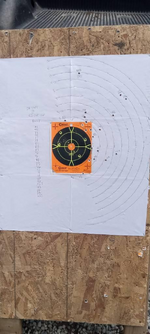
The Results (See Attached Images):
I measured every single bullet hole's radial distance from the exact center of the bullseye (in millimeters). Here is the raw breakdown:
- Total String: 1.693 1.772 2.205 2.520 2.874 3.071 3.189 3.346 3.386 3.622 3.661 3.701 3.740 3.937 4.331 4.449 4.449 5.079 5.197 6.417 7.165 9.488 9.843 9.961
- Closest shot: 1.693 (0.38 MOA from center).
- Average deviation (Mean Radius): 4.543 (1.03 MOA from center).
- Furthest flyers: 9.488 9.843 9.961
- (~2.26 MOA from center).
- Overall group shape: The core 19 shots are tight, but the overall group shows a distinct push up and to the right..
My Questions for the Forum:
- Given this is my first time out past 400 yards (or even close to that), the position (seated/Arca ball head/17.5° incline), and a 24-shot sample size, how can I improve on this?
- What is the best way to start figuring out wind?
- What is the best way to eliminate that vertical stringing?
- What field-practical modifications can I make to my position to stabilize the rear when craning upward at a steep angle? I felt like the buttstock wasn't always placed in the optimum shoulder position.
Appreciate the blunt feedback. Tear it apart.