Field judging bears thread with photo examples

To add on for the guys in here that feel bad for taking a smaller bear, it could always be worse. I talked to my taxidermist the other day who mentioned getting a 30” nose to tail bear that someone wanted to rug. Neither of us were sure how a game warden would let that slide. I’m sure it will make a great bath mat
Nothing like a good set of cub mittens to keep a man warm during the hard times.
 
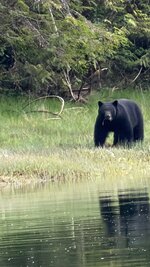
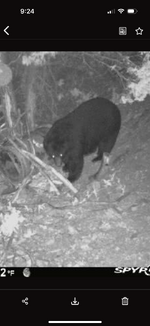
Very likely the biggest black bear I’ve ever seen. This was in late June over 10 years ago in North Central CO. Hate to make too many guesses but looking back I bet he wasn’t far off of a 7 foot square and certainly over a 20” noggin. Guessing he did a serious number on elk calves to get that big.

IMG_6248.png
 
Example

absolute unit.

To add on for the guys in here that feel bad for taking a smaller bear, it could always be worse. I talked to my taxidermist the other day who mentioned getting a 30” nose to tail bear that someone wanted to rug. Neither of us were sure how a game warden would let that slide. I’m sure it will make a great bath mat

IMG_6283.jpeg

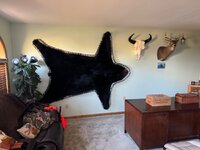
From nose to tail he is 84” and from claw to claw he’s 81”, skull was 20 - 7/16” if I remember correctly. I had to hang him horizontally as any other way was too long to keep him off the floor.
 
There are a couple of ways to gather more clues on physical bear size to avoid shooting "mitten" bears.

One is to always be mindful of the size of the trees and in particular stumps in the area you are hunting. It's hard if all there is are little Lodgepole pine, but if there are big old Doug or Grand Fir or even big old Ponderosa Pines those stumps and trees will give a general marker of relative size.

Another is to learn to use your scope reticle in an unloaded gun to calculate size (depth and nose to tail). That can either be marked mil/moa dot system or a simple duplex. You need to have a range finder and you are good to go.

If its an ffp dot reticle, do the math after determining the distance (look up the formula for either moa or mil). Do a little dope card with the formula and carry it with you.

For an sfp duplex, just set up a 6'x3' piece of cardboard at various distances and record the gaps or spillover out of the fine reticle at 3/6/9x and create a mini "size dope card". If you know at 200 yards on "x" power there should be "x" spillover into the coarse reticle then you have a have a rough starting point. Not perfect, but a good start.

Patience above all is the key to bear hunting.
 
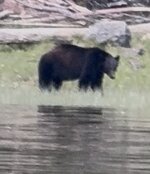
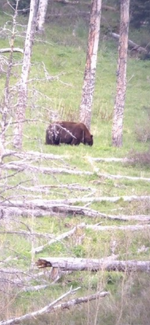
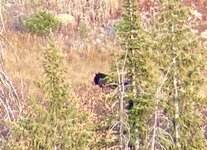
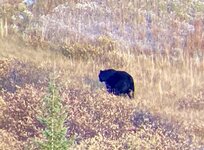
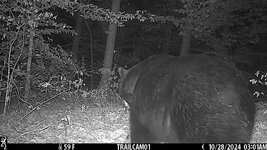
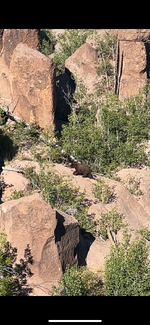
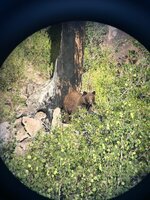
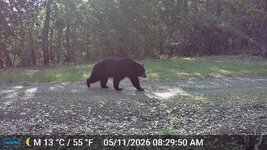
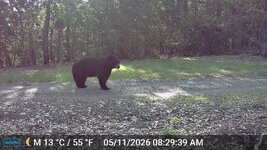
Alright guys, I’m completely ignorant on bears. I’ve only seen 1 in the wild while deer hunting and I can’t tell if it’s a sow or a boar, decent sized or small, I have no clue. Give me your thoughts so I can learn!IMG_2300.pngIMG_2301.pngIMG_8195.jpeg
 
Alright guys, I’m completely ignorant on bears. I’ve only seen 1 in the wild while deer hunting and I can’t tell if it’s a sow or a boar, decent sized or small, I have no clue. Give me your thoughts so I can learn!View attachment 1064572View attachment 1064573View attachment 1064574
First pic is misleading from angle.
Second pic shows wide front leg stance/flare at elbows and wide shoulders. No taper on front legs.
Third pic shows wide head/ears to outside of head and start of a crease in forehead. Has a wide head/shorter broader face.
Add in guessed size of burned tree in background and i would say a nice color phase boar BUT i am confused by placement in escape terrain (more of a sow behaviour) and i would want to watch it move a bit and make sure.
If its first week in June, it's location would make sense due to boars cruising for sows in heat.
 
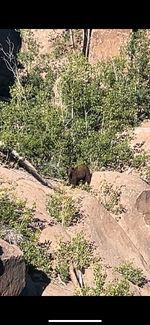
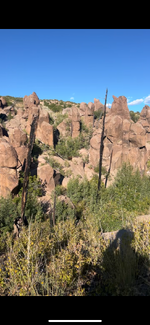
@tater wish I could share the video those pics are screenshotted from. This was first week of September. Didn’t know boars preferred different terrain. Here’s a zoomed out screenshot of the type of area he was in IMG_2309.png
 
Hoping this guy shows again this year. Between work and a family vacation, didn’t get to hunt him before the quota was met. Had a big fire in the area last fall, so curious to see what shows up. Seemed like a shooter to me:

IMG_4785.png

IMG_4826.jpeg


I think this was the same bear a few days later:
IMG_4842.jpegIMG_4841.jpeg
 

Attachments

  • IMG_4825.jpeg
    IMG_4825.jpeg
    230.8 KB · Views: 3
Anybody have a milling chart for bear?

This bear looked like a Volkswagen Beetle at 411 yards. Total newb.

View attachment 1062672

An easy tell from a distance is the way the ears sit on the head. If they look long and pointy, positioned high and close sort of like how a German Shepherd’s might look, it’s likely a fairly small bear. If the ears look small on the head and spread out wide, pointing kind of outward, it’s going to be a mature bear. Another good tell is that the shoulders are wider than the head/neck.

Another thing to look for is the walk. If the legs swing out wide as it walks in a semi-circle sort of motion, that’s going to be a big bear. Big ole bears have a pretty distinctive gait and when you see it you’ll know what I’m talking about. They’ll also walk around without a care in the world instead of looking skittish and cautious like younger bears.


Sent from my iPhone using Tapatalk
 
I can't speak to black bear terrain use in mesa country, but this is what i know from here in BC.

In the spring, sows with cubs and smaller, less dominant bears will try to feed in pockets and be in terrain that allows them to either tree quickly or to utilize rocky outcrops for escape. Where i live and hunt black bears are not the alpha predator. Grizzly bears and wolves can hit them hard.

Areas with houndsmen that run bears also create critters that are situationally aware of terrain.

Sows with one year old cubs are even more vigilant during late May/early June during rut when boars will kill yearlings to push sows into estrus. They are never more than a quick dash from trees and mature sows are VERY aware every second where their cubs are and where they themselves are in relation to safety.

A big black bear boar is comfortable in open feeding spaces and will traverse across areas with less escape cover. They walk like they can handle themselves because they usually can. I've watched big spring boars sleep in open spaces knowing they are safe.

A big boar will sprint for fifty yards, stop and face off. Young boars and sows will run and keep running.

Black bears are territorial, and there is always competition for feed, cover and sows. I watched a boar for eleven years as he went from early adult trying to stake a claim to "king of the hill" to the last autumn when i knew it was his last (the joys of chasing bears with a longbow). He taught me a lot about terrain and territory.

 
Back
Top