Equipment versus practice posts and Rifle practice/shooting

I see what you are saying. It’ll be fine for my zero distance and then beyond my zero distance my point of impact will start to diverge horizontally a little—since my scope is off to the right the POI will be off to the left. I’m guessing the divergence at twice my zero distance will be an inch or less (similar to the horizontal distance my scope is offset from the rifle bore). So it’s probably okay for positional practice but not so much for precision shooting.
 
Canting of the rifle would have the same effect as canting the rifle when shooting roll over prone (basically laying on your side to shoot under vehicles).

When firing a rifle sideways the rule of thumb is to aim high and to the magazine side, and the further your target is away the bigger your correction needs to be. That's fine for shooting across the street but I'd avoid getting my optic out of line for precision shooting. Optic height over bore will effect how far off your zero is when canting the rifle.

Maybe that context will help explain it.
 
Anybody else shoot 22 trainers?
I'm just starting to enjoy the .17 HM2 trainer I put together. Loads of fun (and far more centerfire-like than a .22 LR).

What I’ve come to realize that my natural point of aim in these positions has the rifle laying canted to the left about 30 degrees. It helps my right wrist be comfortable and keeps my neck in a neutral position and allows me to lay my cheek on the stock.
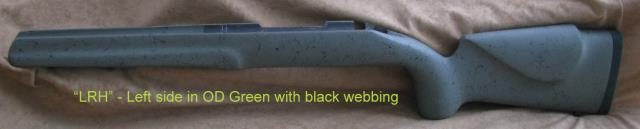
Skinny, ambidextrous stocks reliably result in a ~10° left cant if I shoulder the gun with my eyes closed and then open them in the scope. For all the hate they seem to get online these days, this is what the old Monte Carlo cheek piece fixes. The Pendleton LRH I chose puts my NPoA dead on:
1782332744113.png

Tape some foam or whatever up and over the comb with a chunk down the shooter side of the stock until you get the results you want.
 
I don’t think that is true. As long as I hold the scope level it should not matter how twisted the rifle is underneath.

I’ll try it at the range and report back.

But I also hear what your are saying. If literally everyone uses the same technique. There is probably some wisdom to it.
Are you serious? Or trolling in your basement.....
 
I’m not saying it's good technique, but I think @Pizzlegreet is correct.

Assuming the bore is parallel to the z-axis of the scope reticle, and as long as the reticle is vertical when shooting, it’ll work. If anything, his POI might be 1/2” to the right.
 
POI might be 1/2” to the right
With the rifle canted so that his crosshairs are vertical, at any distance past his zero distance the bullet impact will be low and left while any distance nearer than the zero distance the bullet will impact high and right.

@Pizzlegreet This article has more information on the effects of canting with drawings, pictures, videos, and links to other articles on the subject all written by high level marksmen.

Jay

 
With the rifle canted so that his crosshairs are vertical, at any distance past his zero distance the bullet impact will be low and left while any distance nearer than the zero distance the bullet will impact high and right.

@Pizzlegreet This article has more information on the effects of canting with drawings, pictures, videos, and links to other articles on the subject all written by high level marksmen.

Jay

Looks like that article addresses varrying cant, not a constant cant offset with plumb scope.

1st: 30 degrees is quite extreme

2nd: I wouldn’t use that significant of a scope cant as a solution for any system I wasn’t shooting at just one distance. You will create a windage offset that will mean you’d have a windage error at any distance other than the one you zeroed the rifle at. 1-3 degrees, sure. 30 would cause more issues than I’d consider dealing with. It sounds to me like your rifle doesn’t fit you well, you shouldn’t have to do that.
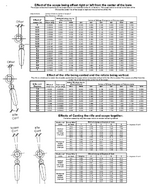
Carl, I've trusted that the below chart is accurate for a number of years but that is blind trust without straining my engineering-dropout brain. My interpretation of this chart is that if the rifle cant is consistent you should have the same constant offset at all ranges. Is that not the case? Obviously 30 degrees is extreme but just want to make sure i'm not misunderstanding as it applies to much milder cant angles.

1782394939689.png
 
Looks like that article addresses varrying cant, not a constant cant offset with plumb scope.
Correct, but in his situation the rifle bore and scope reticle will never be coplanar in any axis. There will be only 1 point where they meet aka the zero point. Past that point , the bullet will be divergent in both the x and y planes absent the effects of wind where as a rifle with a scope reticle that is coplanar in the y axis and held vertical will only have a change in the y plane past the zero range absent the effects of wind.

Jay
 
Back
Top