Critique my ChatGPT custom arrow build recommendation

Neckbone

WKR
Joined
Sep 21, 2022
Messages
316
Hoyt Alpha X. 26.5' draw length, 65lb draw weight. Asked ChatGPT to build me the best custom arrow for my bow using Montec G5 125 grain boradheads. Tailored for hunting elk

Easton Axis 5mm shaft, 300 spine - 27.5''
Easton brass HIT insert, 75 grain
Easton Broadhead alignment ring, sizs 5
Either AAE Max stealth 3 fletch helical or Blazer 4 fleth slight helical
Optional luminoc/nocturnal FIT

485 grain arrow with 14-15% FOC

What say you? I have some Victory VF TKO out of the box 28" arrows 350 spine ive been shooting with... any real world difference in the arrow build? I know nothing avbout custom arrow building
 
You Victory arrows should be considerably lighter around the 420 grain area. I would say 485 grains is pretty heavy. Unless you like being heavy and slow.

I would suggest sticking with the Victory VF TKO or going with either the Victory HLR or Easton 5.0 in a 350 spine. Cut to 26" witht the 50 grain insert, nock and fletching should have you right around 400 grains.
 
ChatGPT has been reading too much Ashby. It’s mistaken about total weight of that Axis build and recommending an excessively heavy arrow for a 26.5”/65# compound bow.

27.5” shaft @ 10.7 gpi + 125 gr head + 75 gr insert + 5 gr BAR + 3 vanes @ 8 gr/ea + 20 gr lighted nock = 543 gr, which is going to be on the slow side at your specs (≈240 fps)

I would go lighter and shorter. IMO the easy button would be a standard diameter (6.5mm/.245”) 350 spine shaft around 8-9 gpi cut an inch shorter than your draw length with a standard weight (≈15 gr) insert, unlighted nock, and 3 high profile vanes (0.5-0.6” tall by 2-2.5” long). Victory VF TKO configured as such would be around 400 gr and 280 fps.
 
I bel
You Victory arrows should be considerably lighter around the 420 grain area. I would say 485 grains is pretty heavy. Unless you like being heavy and slow.

I would suggest sticking with the Victory VF TKO or going with either the Victory HLR or Easton 5.0 in a 350 spine. Cut to 26" witht the 50 grain insert, nock and fletching should have you right around 400 grains.
I believe I weighed them at 432 grains total...

I often see 450 grains come up as a good benchmark for total arrow weight for elk hunting. I get there is a lot of variables that come in to play and that isnt necessarily an appropriate weight for all archers. Then you have the light/fast camp vs the heavy/penetration camp..

Be curious to chrono my arrows..
 
ChatGPT has been reading too much Ashby. It’s mistaken about total weight of that Axis build and recommending an excessively heavy arrow for a 26.5”/65# compound bow.

27.5” shaft @ 10.7 gpi + 125 gr head + 75 gr insert + 5 gr BAR + 3 vanes @ 8 gr/ea + 20 gr lighted nock = 543 gr, which is going to be on the slow side at your specs (≈240 fps)

I would go lighter and shorter. IMO the easy button would be a standard diameter (6.5mm/.245”) 350 spine shaft around 8-9 gpi cut an inch shorter than your draw length with a standard weight (≈15 gr) insert, unlighted nock, and 3 high profile vanes (0.5-0.6” tall by 2-2.5” long). Victory VF TKO configured as such would be around 400 gr and 280 fps.
Good catch on the shaft weight. Crazy it missed something so simple as that.. Clearly the AI thing has a long way to go.

At an inch shorter than draw length, will that put my broadhead behind my bow hand? I know people do this but I am not down with that...
 
I think the use case is important. Are you stalking animals and shooting them from the ground. Or set up in a tree, taking shorter hard angled shots.
If your hunting from a tree i think the heavier axis is the better option, if your shooting from the ground i like the lighter setup.
 
I think the use case is important. Are you stalking animals and shooting them from the ground. Or set up in a tree, taking shorter hard angled shots.
If your hunting from a tree i think the heavier axis is the better option, if your shooting from the ground i like the lighter setup.
Good point, edited post

This is for Elk hunt, on the ground
 
At an inch shorter than draw length, will that put my broadhead behind my bow hand? I know people do this but I am not down with that...
Maybe. Make a mark on your current arrow at 25.5” if you want to see how that would look in relation to your bow hand. It’s not uncommon to cut arrows shorter than draw length, but I understand your hesitation.
 
Good catch on the shaft weight. Crazy it missed something so simple as that.. Clearly the AI thing has a long way to go.
As soon as I saw the total arrow weight that AI presented, I knew it was wrong. Also, Easton shows the BAR6 for the 300's, not the BAR5's. On a side note, I have used 5mm type arrows for 20 years, and have never used.....nor seen a need for the BAR's.

I have used 500-520gr arrows for close to the past two decades, but I've also been shooting 70+lbs with a 32.5" draw. This year I decided to try something new.......420gr arrows w/100gr BH's. Even with the bow turned down, they're still flying at 305fps. I'm not completely sold just yet, I might use 125's to keep it under 300fps. I'll be doing accuracy and consistency testing with the two for the next few weeks.

If there's one problem that I can identify from the past 20 years, it's unseen (or unnoticed) twigs, branches, etc. A tighter trajectory window would solve a lot of these issues for me.
 
Good catch on the shaft weight. Crazy it missed something so simple as that.. Clearly the AI thing has a long way to go.

At an inch shorter than draw length, will that put my broadhead behind my bow hand? I know people do this but I am not down with that...
An inch shouldn't put the broadhead behind your bow hand if thats a concern of yours... However, theres a lot to be gained by shooting as short of an arrow as you can manage. I put a hamskea overdraw on my bow and shoot arrows that are 4.25" shorter than my draw length. The overdraw has a guard that keeps the arrow from being able to get to your hand, and its pretty much impossible for me to get any part of my hand into the arrow path.

Having as short of an arrow as possible will allow you to shoot a lighter spined arrow while still being stiff enough to tune. Lighter spine means lower GPI, which allows you to redistribute weight onto the front of the arrow for higher FOC without slowing your arrow down. Now you get better accuracy, flatter shooting setup... and supposedly better penetration (if you believe the FOC penetration hype).
 
ChatGPT has been reading too much Ashby. It’s mistaken about total weight of that Axis build and recommending an excessively heavy arrow for a 26.5”/65# compound bow.
This points out the flaws with the current Chat GPT AI model. It's a compiler of internet info sources....and it's not capable of critical thinking. The AI models don't assess whether it's better to have flat trajectory- it only regurgitates current internet trends. They don't factor in trajectory or that some BH designs are more effective penetrators than others.

In other words- some AI models don't have critical thinking skills- Yet. There was one AI model that beat some of the best chess and Go players in the world- so it's coming.

I agree with Mighty Mouse- best strategy is to take into account your specs- DL, bow weight, etc...then factor in shot distances and your style of hunting.

Examples would be; If you are a tree stand guy shooting short shots, a heavier arrow doesn't hurt you. If you are a ground hunter taking 50y shots, better Trajectory from a lighter arrow means better shot locations.
 
I would say ditch the 75gr brass hit insert; go with the normal aluminum hit insert in combination with an aluminum footer instead. If you go a bit shorter arrow length, you probably could go to a 340 spine and save some finished arrow weight too.

Footered axis arrows are incredibly durable in my experience. Never shot an elk, but I would not hesitate with that setup.
 
Good catch on the shaft weight. Crazy it missed something so simple as that.. Clearly the AI thing has a long way to go.

At an inch shorter than draw length, will that put my broadhead behind my bow hand? I know people do this but I am not down with that...

My DL is 27.5 and I cut my arrows to 26" and still could go shorter.

If you don't consistently hit your fingers with the vanes, you won't get cut by the broadhead either.
 
Thanks for this thread! I tried using AI for arrow build advice too, but found that it told me what it thought I wanted to hear. If I asked if heavy arrow and big FOC was good it quotes Ashby studies and pushed me that way, but id I questioned any aspect of its reasoning it would back down and then go on to quote the other side of the debate. (Light arrows, normal FOC.) it just showed me that AI is only quoting and compiling whatever it can scrape from the web.

As for arrow build, im going to go out in a limb here and say that for compound bows with pull weight of 55 pounds and over and draw lengths of 25.5 inches and longer arrow weight has little effect on terminal effectiveness as long as you are somewhere between 380 and 550 grains and at 60 yards and under.

I stressed so hard and spent a lot of money to get my arrow build down to 418 grains this year and it is clear to me now that it was a wasteof time and money.

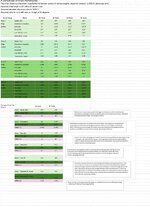
Take a look at the chart I put together and tell me what im missing. Lots of people argue that a heavier arrow will penetrate more, and lots of people argue that a lighter arrow will shoot flatter and arrive faster. But even at 80 yards the differences are minor from a realistic hunting perspective.

What is clear to me as a newb at archery is that what is most important is

1st- an accurate arrow that can group in a 10” kill zone diameter for 9-12 arrow groups over and over at any distance you are wanting to shoot an animal at

2nd- that you absolutely get the range to your target correct. Just a 5 yard mistake in ranging an animal has a far bigger negative effect on your arrows ability to kill humanely than arrow weight.

This makes me think that what we should really be building arrows around is their forgiveness, durability, ease of tuning and cost rather than trying to make an arrow 380 grains or 580 grains etc

If thats the case, how do we go about figuring out what arrow is going to be forgiving and tunable with our given bow? Reminds me of trying to figure out what powder will work best with a specific bullet and cartridge.

Thoughts?
 

Attachments

  • IMG_3025.jpeg
    IMG_3025.jpeg
    416.7 KB · Views: 6
Thanks for this thread! I tried using AI for arrow build advice too, but found that it told me what it thought I wanted to hear. If I asked if heavy arrow and big FOC was good it quotes Ashby studies and pushed me that way, but id I questioned any aspect of its reasoning it would back down and then go on to quote the other side of the debate. (Light arrows, normal FOC.) it just showed me that AI is only quoting and compiling whatever it can scrape from the web.

As for arrow build, im going to go out in a limb here and say that for compound bows with pull weight of 55 pounds and over and draw lengths of 25.5 inches and longer arrow weight has little effect on terminal effectiveness as long as you are somewhere between 380 and 550 grains and at 60 yards and under.

I stressed so hard and spent a lot of money to get my arrow build down to 418 grains this year and it is clear to me now that it was a wasteof time and money.

Take a look at the chart I put together and tell me what im missing. Lots of people argue that a heavier arrow will penetrate more, and lots of people argue that a lighter arrow will shoot flatter and arrive faster. But even at 80 yards the differences are minor from a realistic hunting perspective.

What is clear to me as a newb at archery is that what is most important is

1st- an accurate arrow that can group in a 10” kill zone diameter for 9-12 arrow groups over and over at any distance you are wanting to shoot an animal at

2nd- that you absolutely get the range to your target correct. Just a 5 yard mistake in ranging an animal has a far bigger negative effect on your arrows ability to kill humanely than arrow weight.

This makes me think that what we should really be building arrows around is their forgiveness, durability, ease of tuning and cost rather than trying to make an arrow 380 grains or 580 grains etc

If thats the case, how do we go about figuring out what arrow is going to be forgiving and tunable with our given bow? Reminds me of trying to figure out what powder will work best with a specific bullet and cartridge.

Thoughts?
How did you calculate the "5 yard error" miss values? Those values seem exaggerated to me. If I hold for 15 yds but the target is actually at 20 yds, I don't think I'm missing by 4-5". Same thoughts for the longer ranges...I don't think I'm missing 2 ft low if I hold for 75 yds on an 80 yd target.
 
Back
Top