
Yoder
WKR
- Joined
- Jan 12, 2021
- Messages
- 2,200
How in the hell could it cost $10k for what will be a few cans of paint, and what 40 hrs of labor? Are they lawyers? That's like $200/hr for something a smart monkey could do.

Follow along with the video below to see how to install our site as a web app on your home screen.
Note: This feature may not be available in some browsers.

Labor, overhead etc isn't cheap.How in the hell could it cost $10k for what will be a few cans of paint, and what 40 hrs of labor? Are they lawyers? That's like $200/hr for something a smart monkey could do.
Premium paint is $90 a gallon. Do you think a skilled tradesman is worth $10 an hour?How in the hell could it cost $10k for what will be a few cans of paint, and what 40 hrs of labor? Are they lawyers? That's like $200/hr for something a smart monkey could do.
$200/hr to paint the interior of a house is insane. My children have painted their own rooms. You would have to be eating crayons to pay that.Taperpin/Displacedtexan you guys are doing an excellent job explaining it and laying out how it is, but you're going to run out of crayons long before some of these guys understand it.
If you've never bid residential projects for homeowners, its hard to fully grasp.
So it's harder to paint a wall than change a ball joint? How skilled do you need to be exactly? Does the $90/gallon paint have gold leaf in it? If they bid $100/hr I could understand. I know things are expensive and nobody wants to work anymore.Premium paint is $90 a gallon. Do you think a skilled tradesman is worth $10 an hour?
It's amazing to me how people think that skilled tradesman should be charging $25 an hour to perform services that have taken years to perfect, meanwhile will pay a mechanic $140 an hour to do ball joints that anyone could do watching a YouTube video.....
Sent from my SM-G990U2 using Tapatalk
Where did the $200 an hour number come from? Did I miss something?So it's harder to paint a wall than change a ball joint? How skilled do you need to be exactly? Does the $90/gallon paint have gold leaf in it? If they bid $100/hr I could understand. I know things are expensive and nobody wants to work anymore.
Sorry, $10k or more to paint a 2k sq ft house just seems a little crazy to me. I had a B dry system installed in my basement. They jack hammered for two days straight, installed drain pipes around the entire basement with a sump pump the buried a 200 ft discharge pipe. Total cost was $8500. We're talking about putting paint on the wall. I would imagine professionals could get it done pretty quick. Maybe use sprayers, automatic rollers. How much time could it take? I don't live in the Trump tower. I don't need meticulous, perfect paint put on the wall at $90 gallon. Maybe others here have million dollar houses and value that, I'll just go to Lowes for paint and do it myself for free.It’s Yoders home owner estimate based on his kids doing some painting and being able to paint a house in 40 man hours.
No one wants to work for nothing...So it's harder to paint a wall than change a ball joint? How skilled do you need to be exactly? Does the $90/gallon paint have gold leaf in it? If they bid $100/hr I could understand. I know things are expensive and nobody wants to work anymore.

I'm not trying to bust your balls (To hard) but people don't understand that construction services are more than say, a can of paint and a roller.Sorry, $10k or more to paint a 2k sq ft house just seems a little crazy to me. I had a B dry system installed in my basement. They jack hammered for two days straight, installed drain pipes around the entire basement with a sump pump the buried a 200 ft discharge pipe. Total cost was $8500. We're talking about putting paint on the wall. I would imagine professionals could get it done pretty quick. Maybe use sprayers, automatic rollers. How much time could it take? I don't live in the Trump tower. I don't need meticulous, perfect paint put on the wall at $90 gallon. Maybe others here have million dollar houses and value that, I'll just go to Lowes for paint and do it myself for free.
Homeowner discount is less than half what the lowest volume contractor account will get you.I have found the high $ paint to be worth buying for exterior, it probably is also good for interior. Maybe not the top/top tier paint but I would use something from the top 25% of what is available. If your painting your own home then it is probably worth opening an account at sherwin williams and getting the discounts....also worth buying the very wide roller and accessories....it is crazee how fast you can do a prepped room with one.
Good luck.

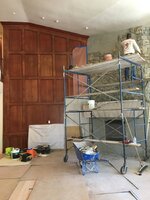

I was raised by a house painter. I can always tell when someone does a DIY paint job. lolBack 2009-ish I was working with a guy and we got $1 per foot to paint houses - 2 coats of cheap paint. Your 2,000 SF house would have been $2,000. With inflation and such, $2-$3/ft would not seem unreasonable and be $4,000-$6,000. High ceilings add complexity. We use a ladder to cut it in and extend-a-pole technique for rolling - do the same on exterior.
I have no idea how much I save myself by doing stuff.
Anyway - back to you. Some options:
find a part-time painter, someone who wants to make a couple bucks over a weekend or two......
have a house painting party with good food, beer/wine (after) and pay folks $100/$200/$250 each.....
neighborhood high school/college kids, relatives high school/college kids, etc. some still have a work ethic (use them for the high spots).....
ask folks for help at your church if you go to one.
I also have a guy at work who will do anything for $50/hr and do it right.

I see the comparison you’re making but look at it like this. The value of the skill can fluctuate depending on the trade but the cost of operating vehicles, carrying insurance, administrative support stay fairly close for a lot of trades so a difference of +/- $15hr is a realistic measure not something like $50-$100. There was mention of dealership mechanic work at $150. Why is that less? Because you’re not paying for their dead time of loading up and commuting to you.Sorry, $10k or more to paint a 2k sq ft house just seems a little crazy to me. I had a B dry system installed in my basement. They jack hammered for two days straight, installed drain pipes around the entire basement with a sump pump the buried a 200 ft discharge pipe. Total cost was $8500. We're talking about putting paint on the wall. I would imagine professionals could get it done pretty quick. Maybe use sprayers, automatic rollers. How much time could it take? I don't live in the Trump tower. I don't need meticulous, perfect paint put on the wall at $90 gallon. Maybe others here have million dollar houses and value that, I'll just go to Lowes for paint and do it myself for free.


