Letting a foreign nation come into your land and take your precious minerals kinda seems like what happened in Mexico and South America by the Spanish Empire. Didn’t really seem to help the security of any of those indigenous nations.
If these minerals are really critical to our national security then we should keep them. If that means leaving them in the ground because we don’t have the means to mine them and the process them in our country, then so be it. At least we’ll still possess them.
This national security argument is bs. It’s just a card they’re playing to justify their actions because they lack anything
The conservation and environmental community has spent decades pushing policy that has directly led to this increasing in mining, the prevalence of foreign mining companies, and the need to outsource smelting and other processing procedures. Most notably, for 25 years now, the foremost important issue for the existence of the human species as pushed by the conservation and environmental community has been stopping muh climate change. Sorry, to inform all the conservationists here....this is what you asked for and signed up for. The conservation/environmental community made this bed. Sorry to tell you.
As far as the "This national security argument is bs" statement...Utter hogwash easily refuted by both common knowledge as well as robust government research and publications. The US critical minerals program spans multiple administrations and has support from many high ranking officials on both sides of the isle. Here is a screenshot of the executive summary for the 2010 DoE Report Executive (thats Obama Administration for all the "its a trump conspiracy" people). The Critical Minerals Program under DoE has numerous reports and other literature that expressly refers to critical minerals as a national security issue. Here is a link to the critical minerals website so people can review this information and be rest assured it is not a conspiracy that there are mineral shortages and mineral demand to meet emerging technology and demand. There is plenty of updated information for 2025 and 2026 relevant to the Critical Minerals Program.
The DOE Critical Minerals & Materials Program coordinates RD&D into strategic resources across DOE.

www.energy.gov
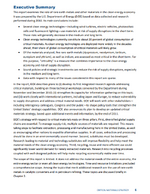
Please note the conclusions from 15 years ago:
Its main conclusions include:
• Several clean energy technologies—including wind turbines, electric vehicles, photovoltaiccells and fluorescent lighting—use materials at risk of supply disruptions in the short term. Those risks will generally decrease in the medium and long term.
• Clean energy technologies currently constitute about 20 percent of global consumption ofcritical materials. As clean energy technologies are deployed more widely in the decades ahead, their share of global consumption of critical materials will likely grow.
• Of the materials analyzed, five rare earth metals (dysprosium, neodymium, terbium,europium and yttrium), as well as indium, are assessed as most critical in the short term. Forth is purpose, “criticality” is a measure that combines importance to the clean energy economy and risk of supply disruption.
• Sound policies and strategic investments can reduce the risk of supply disruptions, especially in the medium and long term.