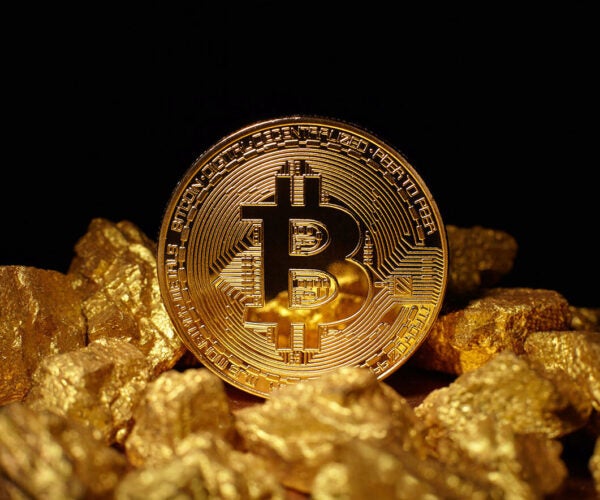
Bitcoin

Those emotions are shared by most folks on ANY volatile asset/stock/product.

Dumb retail money sitting on the side lines is relieved they didn’t buy when the price dumps. Then they regret not buying during the next run up.

Rinse/repeat.


Sent from my iPhone using Tapatalk
Yeah. My stomach doesn't like volatility like that. If I had bought in 2015 when the crazy hvac repairman was telling me to.... he is probably retired now lol.
 

Wharton School of Business came out with this article back in March. They are comparing BTC to gold as a store of value.

Their bottom line:
“The striking parallels between Bitcoin and MBS suggest that history may be repeating itself. In fact, the negative consequences of the analogy of Bitcoin to gold might be even more severe than the analogy of MBS to bonds. While most MBS at the end of the day were backed by real assets — mortgages on real houses — Bitcoin is not backed by any real assets.

If you are not in the business of speculation, steering clear of investing in Bitcoin — or for that matter any cryptocurrency — may be the best way to avoid the fallout from another misguided analogy.”
The similarities between bitcoin and mortgage-backed securities are superficial. Misguided investment in MBS created a bubble that burst…current Bitcoin investment appears (to some observers) to be misguided, possibly creating a bubble destined to burst. They are, however, fundamentally different, and attempting to equate them any further is a stretch IMO.

“Let’s think about where the great financial crisis of 2008 came from. Investors accepted the analogy of mortgage-backed securities (MBS) to bonds.”

The root cause of the 2008 financial crisis was the Fed’s loose money policy. The push for increased home ownership helped channel the loose money into MBS, but MBS themselves were not the root cause of the ensuing financial crisis.

“Analogies are powerful mechanisms to help people and organizations make sense of a new idea or innovation. However, they almost always carry the risk of masking features that could be fundamentally important in the role that the innovation plays with respect to its intended use”

Indeed, so how about you (the authors of the article) stop attempting to fabricate a flimsy analogy between bitcoin and MBS?

“Unlike Bitcoin, gold has physical properties as a precious metal that are attractive for many applications, including jewelry, electronics, and medicine.”

Bitcoin has digital properties as a transaction network and system of record that make it attractive for facilitating international commerce.

“While gold has a history of holding its value in times of societal cataclysms such as wars, it is not clear that Bitcoin could survive a major power grid failure.”

It’s also unclear how a major power grid failure could destroy Bitcoin. The Bitcoin network is widely distributed across the globe. If a global power failure were to occur, neither gold nor bitcoin would be anyone’s immediate concern.

“It has been estimated that a large majority of Bitcoins are owned by individual investors who own a small fraction of a single Bitcoin. This fragmentation and lack of transparency of ownership of a speculative asset presents systemic risk.”

The logic presented here is backward. Fragmented ownership reduces systemic risk by enlarging and diversifying the “system”; concentrated ownership would increase systemic risk.

“While most MBS at the end of the day were backed by real assets — mortgages on real houses — Bitcoin is not backed by any real assets.”

Bitcoin is the real asset. The fact that bitcoin is intangible does not preclude its ability to be a valuable asset.

 
I started DCAing in 2020. Took advantage of the "crypto winter" in 2022. Bought ETFs in the mid to high $40,000s in 2024.

Yeah timeframe makes all the difference. If only owning for one year then the swings will make you sea sick, but at three years your odds of being under water is almost zero and at four it’s basically zero. So the more time in the lower the risk.


Sent from my iPhone using Tapatalk
 
no matter how you slice it, it still has zero underlying value. ZERO. utilitarian use is just about zero as well. this isn't a crypto winter, it's a large scale realization crypto just might turn out to be the largest scam ever.
look at the reporting on the BTC market gyrations. The normal wording includes “crypto traders” and “leveraged longs/shorts”

BTC is evolving into a trading vehicle for the hedge funds
 
no matter how you slice it, it still has zero underlying value. ZERO. utilitarian use is just about zero as well. this isn't a crypto winter, it's a large scale realization crypto just might turn out to be the largest scam ever.

It’s funny how 'zero utility' somehow powers a multi-billion dollar global network that stays open 24/7, while my traditional bank still needs three business days and a signed note from my 3rd-grade teacher just to process a wire transfer. Then of course, there’s the fact that the likes of Fidelity, Blackrock, Grayscale and multiple sovereign nations are either in on the scam, or had the wool pulled over their eyes because they lacked the fiscal insights of one pacoalpacker.
 
look at the reporting on the BTC market gyrations. The normal wording includes “crypto traders” and “leveraged longs/shorts”

BTC is evolving into a trading vehicle for the hedge funds
This is because it is one of the few assets they can trade 24/7. We will likely see the entire stock market begin trading 24/7 this year. That will give the hedge funds plenty of other things to manipulate.

Key 24/7 & Near-24/7 Assets for Hedge Funds:

  • Cryptocurrencies (Bitcoin, Ethereum, etc.): The most prominent 24/7/365 markets due to their decentralized, global nature, attracting significant hedge fund interest.
  • Forex (Foreign Exchange): Operates nearly 24/5, rolling across major financial centers (London, Tokyo, Sydney, New York).
  • Crypto Futures: Most crypto futures markets run 24/7 with short weekly breaks, also allowing for constant trading.
  • Tokenized Stocks/ETFs: Digital versions of traditional securities that trade on blockchains 24/7, mimicking real assets.
Expanding 24/7 Access in Traditional Markets:

  • Extended-Hours Equities: Traditional stock markets are seeing platforms (like Robinhood, Schwab) offer extended sessions (e.g., 8 p.m. to 8 a.m. ET), creating a 24-hour trading environment for stocks, which hedge funds use to fill the overnight void.
In essence, while crypto is the quintessential 24/7 asset, the entire financial landscape is moving towards continuous operation, giving hedge funds more options beyond just Bitcoin for round-the-clock trading
 
It’s funny how 'zero utility' somehow powers a multi-billion dollar global network that stays open 24/7, while my traditional bank still needs three business days and a signed note from my 3rd-grade teacher just to process a wire transfer. Then of course, there’s the fact that the likes of Fidelity, Blackrock, Grayscale and multiple sovereign nations are either in on the scam, or had the wool pulled over their eyes because they lacked the fiscal insights of one pacoalpacker.
Well said.
 
I've stated it before in this thread, but the biggest concern any crypto individual should have is quantum computing. It's likely much closer than is being reported to the masses, and when it comes, crypto is toast, until a new crypto that can somehow combat quantum computing comes along. It's just another arms race.
 
I've stated it before in this thread, but the biggest concern any crypto individual should have is quantum computing. It's likely much closer than is being reported to the masses, and when it comes, crypto is toast, until a new crypto that can somehow combat quantum computing comes along. It's just another arms race.
You're worried about quantum computing hacking the most secure network in the world while your bank account is protected with a 4 digit pin. The Louvre was recently hacked and 102 million dollars in jewelry was stolen because their network password was "louvre". There's plenty of low hanging fruit. Yes it's possible that quantum computers could break Bitcoin's current cryptography but it's not an immediate threat, and would require massive, fault-tolerant machines likely years or decades away, with solutions like post-quantum cryptography (PQC) which is already in development.
 
You're worried about quantum computing hacking the most secure network in the world while your bank account is protected with a 4 digit pin. The Louvre was recently hacked and 102 million dollars in jewelry was stolen because their network password was "louvre". There's plenty of low hanging fruit. Yes it's possible that quantum computers could break Bitcoin's current cryptography but it's not an immediate threat, and would require massive, fault-tolerant machines likely years or decades away, with solutions like post-quantum cryptography (PQC) which is already in development.
We’re all screwed with quantum, no way around that. PQC is a pipe dream. BTC is tied to its cryptography, so a new form of crypto will be required that is separate from BTC when the time comes. It’s a fine speculative asset for the time being, but to treat it as an answer to the future is misguided.
 
Bitcoin is software. It can be upgraded. The threat of QC is not unique to Bitcoin: it applies to nuclear launch codes, banking swift systems, etc.

When QC becomes a credible threat, Bitcoin will undergo a Soft Fork or Hard Fork to implement Post-Quantum Cryptography.
 
Bitcoin is software. It can be upgraded. The threat of QC is not unique to Bitcoin: it applies to nuclear launch codes, banking swift systems, etc.

When QC becomes a credible threat, Bitcoin will undergo a Soft Fork or Hard Fork to implement Post-Quantum Cryptography.
Your description of bitcoin is accurate “Bitcoin is software”.

Think about that for a second…..bitcoin is software and owning bitcoin is to own software. It has no intrinsic value….its owning an algorithm.

Owning BTC, a software algorithm, may be very profitable in the short term. It also may be extremely profitable in leveraged trades.

But to bet the farm long term on BTC glory may end in tears.
 
It’s funny how 'zero utility' somehow powers a multi-billion dollar global network that stays open 24/7, while my traditional bank still needs three business days and a signed note from my 3rd-grade teacher just to process a wire transfer. Then of course, there’s the fact that the likes of Fidelity, Blackrock, Grayscale and multiple sovereign nations are either in on the scam, or had the wool pulled over their eyes because they lacked the fiscal insights of one pacoalpacker.
I would suggest checking into some other banks or credit unions. It sounds like yours hasn’t kept up with available technology.

I can log into my bank or credit union app on my phone to do wire transfers. The money is in the other persons account within 1 business day.

It would require the same amount of time & tech skill to complete the wire transfer as it took me to log into Rokslide and make this post.
 
I would suggest checking into some other banks or credit unions. It sounds like yours hasn’t kept up with available technology.

I can log into my bank or credit union app on my phone to do wire transfers. The money is in the other persons account within 1 business day.

It would require the same amount of time & tech skill to complete the wire transfer as it took me to log into Rokslide and make this post.

You handled a International wire transfer recently? Its clunky and involves intermediary banks.
 
Think about that for a second…..bitcoin is software and owning bitcoin is to own software. It has no intrinsic value….its owning an algorithm.
Would you say the same about the software that makes your phone work? Or the software that makes the Internet work? If algorithms cannot possess “intrinsic value”, why does the tech industry invest hundreds of billions of dollars annually developing software and why does anyone buy their products? I find great value in the software I own and use everyday…iOS, Microsoft Excel, Google Earth, AutoCAD, and many other bits of code that run in the background and I’m not even aware of.

I think you’re conflating “intrinsic” with “physical”. Bitcoin is indeed digital, not physical, but it has immense utility and value.
 
I would suggest checking into some other banks or credit unions. It sounds like yours hasn’t kept up with available technology.

I can log into my bank or credit union app on my phone and initiate to do wire transfers. The money is in the other persons account within 1 1 - 4 business days.

It would require the same amount of time & tech skill to initiate complete the wire transfer as it took me to log into Rokslide and make this post.
I dealt with multiple wire transfers, both sending and receiving nearly every business day for 15 years. Wire transfers aren't 24/7 because banks only process them on business days during specific hours (cut-off times), but you can often initiate them online anytime and schedule them but the actual processing depends on banks hours and holidays. You can expect delays if you miss the daily cut-off (usually 2 PM-5 PM depending on your time zone) or send on weekends/holidays; funds won't move until the next business day. Here's an example: You log in to your bank account and initiate a wire transfer Friday at 4:01 pm E. You've missed the "window" to send the wire out so it doesn't leave your bank until Monday at 9 am E. If Monday is a Federal holiday then the wire won't go out until Tuesday and the recipient won't receive it until Tuesday afternoon. You'd could have sent that payment via BTC and the recipient would have received it within minutes instead of the 4 days it took via wire.

International wire transfers take even more time.

Wire transfers will be as common as faxes in 2 years. Banks are developing their blockchain tech as we speak.
 
Back
Top