Bitcoin

There's no hypothetical "If forced to, I would...", its "I actually gave up 11% of value for freedom"

Now, of course, depending on how you define "freedom" there can actually be "freedom" in that, but it does cost you something.
Being forced to use a currency that is intentionally devalued doesn't sound like freedom.
 
Being forced to use a currency that is intentionally devalued doesn't sound like freedom.
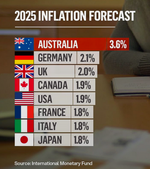
It's not just a US problem. Every Country with their own currency does it. The REAL inflation rate is much much higher when you include all goods and services and not an ever changing hand picked carefully curated list.
Screen Shot 2025-12-03 at 10.30.00 AM.png
 
It's not just a US problem. Every Country with their own currency does it. The REAL inflation rate is much much higher when you include all goods and services and not an ever changing hand picked carefully curated list.
View attachment 977998
I hearing you. Australia is a basket case really. We are a country blessed with natural resources which we essentially give away. We are shutting down coal fired power stations trying to chase a net zero dream while exporting coal so other countries can have cheap reliable power.
We are among the largest gas exporter while domestic gas prices are sky high. We are actually going to import gas.
Housing is insanity here.

We are in stagflation big time.
 
US money-market funds now have more than $8 trillion in assets under management. Currently the avg MM yield is 3.8%. The Fed will likely make a .25-.50% cut by Dec 9-10 and has signaled that it will likely make additional cuts in 2026. These cuts will bring MM yields down to the low 3's and eventually down to the 2's. I think a large percentage of that 8T sitting in MM's will move into equities/crypto chasing higher yields. Barring a Black Swan event the stock/crypto market should set records highs. Hopefully I've picked the right horse.
 

The Bitcoin Canary in the Coalmine?​

By Desmond Lachman


Interesting article speculating if we are in an AI and BTC bubble
@2531usmc Your link references their ideas page and me thinks you wanted to link the BTC article so HERE it is.

I did not read the article, but since BTC is traded 24x7, it can react immediately to any news (gas?).


Eddie
 
@2531usmc Your link references their ideas page and me thinks you wanted to link the BTC article so HERE it is.

I did not read the article, but since BTC is traded 24x7, it can react immediately to any news (gas?).


Eddie

I didn't read it either, but I had AI summarize and analyze:
The Core Thesis
Bitcoin’s recent 30% crash—plummeting from 124,000to124,000to85,000 in just two months—serves as a warning ("canary in the coalmine") that larger, more dangerous asset bubbles in Artificial Intelligence (AI) and Private Credit may be about to burst.

Key Points:

  • Bitcoin as a Failed Hedge: The crash wiped out 1trillioninwealthanddisprovedtheideathatBitcoinisa"storeofvalue"or"safehaven."Incontrast,Goldhasrisen501trillioninwealthanddisprovedtheideathatBitcoinisa"storeofvalue"or"safehaven."Incontrast,Goldhasrisen504,200/oz, remaining stable while crypto collapsed.
  • The Systemic Threat:While the crypto losses are economically manageable, a similar crash in AI or Private Credit would be catastrophic.
    • AI Dependency: The "Magnificent Seven" tech stocks now comprise 35% of the S&P 500, and AI investment has driven half of recent GDP growth.
    • Private Credit: This $1.5 trillion market is deeply intertwined with the broader financial system.
  • Evidence of a Bubble:Market valuations have detached from reality:
    • The S&P 500’s CAPE ratio is around 40 (double the average and near 2001 dot-com bubble levels).
    • Warren Buffett’s market-to-GDP indicator is 50% higher than its previous all-time peak.
    • Startups like OpenAI are valued at $500 billion despite lacking near-term profitability.
  • Policy Recommendation: The Federal Reserve cannot prevent bubbles that have already formed, but it should stop inflating them. Lachman advises the Fed to avoid cutting interest rates at their upcoming meeting to prevent further speculative mania.

    Analyze:
This is a fascinating piece of economic commentary because it is written from a future perspective (December 1, 2025). It serves as a "scenario projection"—predicting where current market trends (AI hype, Bitcoin adoption, and rate policy) might lead over the next 18 months.

Here is an analysis of Desmond Lachman’s argument, the economic theories he applies, and the underlying biases of the piece.

1. The Core Argument: The "Liquidity Canary"​

Lachman applies the "Greater Fool Theory" to the current market. His central thesis is that we are in an era of "everything bubbles" fueled by easy money (low interest rates).

  • The Mechanism: He argues that speculative assets (Bitcoin) are the most sensitive to liquidity changes. When the money dries up or sentiment shifts, the riskiest assets fall first.
  • The Canary: He posits that Bitcoin is not the cause of a wider crash, but the signal. Because Bitcoin has no cash flow or earnings to anchor it, it is pure sentiment. If Bitcoin cracks, it means sentiment has broken.

2. The Three-Layer Bubble​

Lachman identifies three distinct bubbles, ranked by their danger to the real economy:

  • Layer 1: Bitcoin (The Signal). He dismisses Bitcoin as an economic nothingburger (1Tlossismanageable).Heattacksitsutilityasa"StoreofValue,"contrastingitwithGold(whichheprojectswillskyrocketto1Tlossismanageable).Heattacksitsutilityasa"StoreofValue,"contrastingitwithGold(whichheprojectswillskyrocketto4,200/oz).
  • Layer 2: AI (The Stock Market Risk). This is the systemic risk. He highlights Market Concentration (Magnificent 7 = 35% of S&P 500) and Valuation Detachment (CAPE ratio at 40). He argues that AI valuations are pricing in perfection that cannot be delivered (e.g., OpenAI at $500B with no profit).
  • Layer 3: Private Credit (The Banking Risk). This is the most subtle but dangerous point. Private credit ($1.5T) is opaque and illiquid. If the tech bubble bursts, the loans backing those tech companies go bad, infecting the financial system.

3. Economic Indicators & Historical Parallels​

Lachman relies on classic bearish indicators to make his case:

  • CAPE Ratio (Shiller P/E): He notes it is at 40, nearing the 2001 Dot-com peak. This is a standard argument for "mean reversion"—markets eventually return to historical averages, usually violently.
  • The Buffett Indicator: Total Market Cap to GDP. Being 50% above the previous high suggests the stock market has completely detached from the actual economic output of the country.
  • Kindleberger’s Mania: He references Charles Kindleberger, a famous economic historian. This signals that Lachman views this through the lens of behavioral economics—this is a psychological mania, not a fundamental growth story.

4. The Policy Bias (The "Hawkish" Stance)​

The article is published by AEI (American Enterprise Institute), a center-right think tank. The conclusion reveals the ideological goal of the article:

  • The Goal: To argue against Federal Reserve rate cuts.
  • The Logic: Lachman believes the Fed is "inflating the bubble" with loose money. He is warning that if the Fed cuts rates to keep the party going, the eventual crash will be worse. He is advocating for a "Hard Landing" now to prevent a catastrophe later.

5. Critique of the Scenario​

Since this is a projection into late 2025, we must look at the assumptions he makes to see if they hold water:

  • The Gold vs. Bitcoin Divergence: He assumes Gold doubles (to $4,200) while Bitcoin crashes. This assumes that in a crisis, investors will flee digital assets for physical ones. This is a traditionalist view that conflicts with how Bitcoin behaved in early 2024 (rising alongside Gold).
  • AI Profitability: He assumes OpenAI and others will still be unprofitable in late 2025. If AI starts generating massive real-world revenue by then, his "bubble" argument collapses, and the high valuations would be justified.
  • The Price Anchoring: He sets the Bitcoin top at $124,000. This implies he believes the current bull run continues for another year before snapping.

Summary​

Lachman is writing a cautionary tale. He is telling the Federal Reserve: "Look at the specualtion in Bitcoin. That same speculation is propping up the Stock Market (AI) and the Loan Market (Private Credit). If you keep interest rates low, you are just pumping more gas into a car that is about to crash."

It is a classic "Sound Money" argument: The pain of a correction is necessary to cleanse the system of bad investments.
 

Summary​

Lachman is writing a cautionary tale. He is telling the Federal Reserve: "Look at the specualtion in Bitcoin. That same speculation is propping up the Stock Market (AI) and the Loan Market (Private Credit). If you keep interest rates low, you are just pumping more gas into a car that is about to crash."

It is a classic "Sound Money" argument: The pain of a correction is necessary to cleanse the system of bad investments.
Was Lachman saying this in Q3 of ‘17 or ‘21? Did he take the time to even glance at the long term BTC charts?
If he had, he’d see that BTC is following the 4 year cycle just as it’s done from inception.
At some point the cycle will likely break, but up until today it’s right on track. If this 30% “crash” is giving anyone heartburn, just wait until the coming spring/summer 😂
As far as the repercussions of QE, the AI bubble, ect…you don’t need to be an economist to figure out the piper WILL be paid at some point.
 
Back
Top