Argument against small caliber? Blood trail/exit wounds?

huntsd

WKR
Joined
Jun 20, 2020
Messages
947
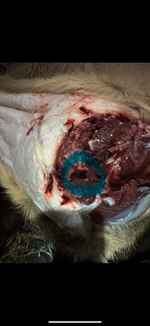
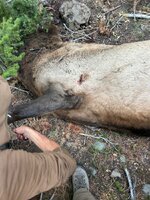
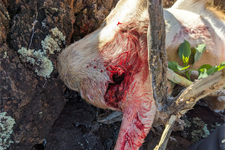
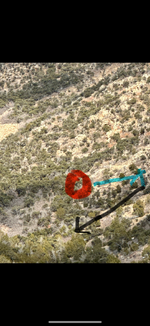
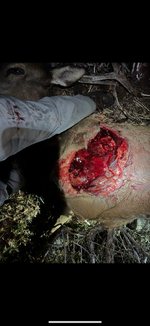
Used my 6.5 cm over the weekend to take a cow elk. Shooting 112 hammer hunter tipped with MV of 3154 and impact velo of 2270 fps. The bullet had what seems like great internal damage results and put her down within 50-60 yards or so. My complaint is blood trail (lack there of) and exit wound (none). Here is what happened. Spotted cow in the red circle on picture. It feed out to blue x. I shot and it ran downhill (long black arrow line) into thickness. I get over to about where I had shot her with about 40 min left of day light. Luckily there were a few patches of snow on the ground and I found a few tiny spots of blood where I had initially hit her, then maybe 20 yards down the hill a few more tiny specs of blood. About 5 min left before darkness I give up on finding more blood and head the direction I think she went into the thick brush. There she was piled up (light had faded so much I wasn’t sure if it was her or a log at first).

If she had ran further into the thick stuff, this story may have ended differently. My question is would use of a magnum rifle given me a better chance at an exit wound/better blood trial? Bullet problem?
 

Attachments

  • IMG_7323.png
    IMG_7323.png
    1.4 MB · Views: 113
  • IMG_7324.png
    IMG_7324.png
    1.2 MB · Views: 113
  • IMG_7325.png
    IMG_7325.png
    1 MB · Views: 112
Maybe, maybe not. What you experienced looks like excellent performance. When Hammers exit, it’s usually just the shank and they don’t leave much blood trail anyway.

Below is an exit from a 180 gr .308 hammer hunter shot from a .300wsm. Bull went 40 - 50 yards. The inside was destroyed.
 

Attachments

  • IMG_6766.jpeg
    IMG_6766.jpeg
    956.8 KB · Views: 47
It’s a give and take for rapid expansion / shedding VS mushroom expansion and exit hole

Once a bullet starts rapid expansion/shedding weight it’s momentum decreases and limits penetration and chances of an exit wound
 
Maybe, maybe not. What you experienced looks like excellent performance. When Hammers exit, it’s usually just the shank and they don’t leave much blood trail anyway.

Below is an exit from a 180 gr .308 hammer hunter shot from a .300wsm. Bull went 40 - 50 yards. The inside was destroyed.
No question on performance. I bring the scenario up because finding the animal seems like it could have been a problem
 
This isn’t an argument against caliber, but rather bullet selection and shot placement. It was a good shot and lethal, but hammer hunters leave a very small exit wound due to the shank being the only part the exits. The difference between a .264 sized exit hole and a .3” sized exit hole is negligible. The .036” difference in exit hole size would not have produced more blood. If you want an increased chance of a blood trail, you want to focus on punching through the heart/lung area, in the bottom 1/3 of the animal with a bullet that leaves a very large entry or exit wound (like golf ball sized) and positioned in such a manner that allows blood to pour out of the body cavity rather than fill up the chest area.

If you hit the heart or the main arteries right next to the heart, your chances of a good blood trailer go way up. If you shoot the rear of the lungs, especially high rear lung, a blood trail may be light.
 
The concern is valid, but this is a bullet and shot placement issue, not a caliber issue.

Edit - and that’s not a criticism of your shooting, your rifle, the range, etc. I often don’t get good blood trails with high lung shots, even with large exit wounds from good bullets. Hitting in the lower third of the vitals always gives me better results.

Edit #2 - for all that, you put that elk down in 50-60 yards, right? That’s not something about which I would complain. This deer left a beautiful blood trail, but his death sprint was about 90-100 yards. And he then tumbled, slid, and rolled another 50 yards down a hill into a ravine.
76fd76f99cffadaae932f79fac943442.jpg


72499d430024f929cb0f23ab3a719b71.jpg
 
I've had some pretty nonexistent blood trails off winter cow hunts, the thick winter coat makes it a much different scenario than shooting one in the usual fall hunting seasons. It can really cover up and absorb blood.

Plus, I think you get the aspect of it dying quickly. I've seen a lot of blood trails be sparse for the first few seconds of running, but then they open up once the animal's gone ~50 yards. I've always assumed it has to do with filling up the chest cavity before starting to really bleed externally. Especially with level shots higher in the chest cavity.

All that being said, yeah, the monos I've used do seem to leave pretty narrow exit wounds. I've only used the TTSX / LRX though, not the hammers.
 
Used my 6.5 cm over the weekend to take a cow elk. Shooting 112 hammer hunter tipped with MV of 3154 and impact velo of 2270 fps. The bullet had what seems like great internal damage results and put her down within 50-60 yards or so. My complaint is blood trail (lack there of) and exit wound (none). Here is what happened. Spotted cow in the red circle on picture. It feed out to blue x. I shot and it ran downhill (long black arrow line) into thickness. I get over to about where I had shot her with about 40 min left of day light. Luckily there were a few patches of snow on the ground and I found a few tiny spots of blood where I had initially hit her, then maybe 20 yards down the hill a few more tiny specs of blood. About 5 min left before darkness I give up on finding more blood and head the direction I think she went into the thick brush. There she was piled up (light had faded so much I wasn’t sure if it was her or a log at first).

If she had ran further into the thick stuff, this story may have ended differently. My question is would use of a magnum rifle given me a better chance at an exit wound/better blood trial? Bullet problem?

No the use of a magnum cartridge does not guarantee every time there will be an exit or quicker kill. A tougher bullet is more likely to give exits but an exit also does not guarantee a good blood trail.
It was a lethal shot that caused her to die within 60yards, good job.
If you are worried about tracking an animal then change your point of aim to a high shoulder shot.
 
Maybe, maybe not. What you experienced looks like excellent performance. When Hammers exit, it’s usually just the shank and they don’t leave much blood trail anyway.

Below is an exit from a 180 gr .308 hammer hunter shot from a .300. Bull went 40 yards.
No question on performance. I bring the scenario up because finding the animal seems like it could have been a problem
The only way to ensure of a DRT scenario is to disrupt CNS. And that’s regardless of cartridge/caliber used.
 
It looks like typical small caliber performance. Devastating inside but no blood trail to speak of.
I don't know how you fix it other than getting a bullet that will expand less but exit or shooting low in the heart/bottom of the lungs.
I had a bull this year that did the same as the OPs cow. Took the hit, ran 25-40yds then tumbled down into a thicket. I got worried when the blood trail stopped but I could see the torn up ground where the bull stumbled and fell. I followed all of that into a small reprod where he was piled up.
Perfect blood trails aren't guaranteed so all of the other aspects of tracking come into play.

I will add that many of my elk and other members of my party's shot with 30-06 and above suffer from the same sorts of blood trails. I think there's an attribute of this where people think "If I shot that in the same spot with a 300WM it would've had a faucet out the side". I don't know if that's true...

Sent from my SM-G975U using Tapatalk
 
It sounds like the bullet did its job, the way it generally does it's job.

Their are bullets that probably give you a better chance of getting an exit wound and potentially more blood trail. But it's just a better statistical chance, nothing is guaranteed, and generally asking for a higher probability of exit wound and blood trails come along with a smaller wound channel. Its all about trade offs.

Your also taking what I am assuming is something along the lines of a 450-500 yard shot, with daylight running out. It's clearly going to take you a few minutes or whatever to get to where the animal was hit, and you have to figure in your potentially gonna run out of light for track. Its something that you have to account for when deciding on your shot (not saying you were right or wrong, just saying you have to account for it.).

All in all, I would consider an elk going down 50/60 yards from where it was hit, on one shot, a pretty successful situation.

The rest is just part of it. You can go for a high shoulder type of shot which has a higher chance of "anchoring" the animal, but its a smaller target. You can shoot a bullet that is known to be a better penetrator to up the chances of a clean exit, but that doesn't mean your gonna get it, or get a better blood trail. You can shoot a heavier fragmenting bullet and go for more destruction and play the numbers that the animal won't go as far from a solid hit.....

Sometimes you just gotta roll with a medium/long range shot in close to fading light and know what your getting.
 
That looks pretty impressive internally. TBH I’ve never used solid copper before but I’ve cut up a couple of elk that had been shot with Barnes TTSX’s. Both in 7 PRC and both had the most impressively unimpressive internal damage to the lungs. So I’d say those hammers did a good job.
My first elk was with Nosler accubonds from a 300 WinMag. Right in the boiler room. No blood .
 
Honestly I see this as a bullet problem.

If you're going to insist on using monos, get a larger case to push them faster. I'm sure there will be exceptions but from what little I have seen (Barnes original X and TSX) they do best when driven way faster than typical cup and core bullets. Not saying that to be argumentative at all, they just seem to do better when pushed harder.

ETA: Also, elk are big long-haired hairy things. It's awfully hard to get good internal damage and an exit big enough to matter. I've shot two with .284/160 Accubonds and neither left much of a blood trail. A bullet that did more internal damage would have likely left even less of a trail, but I came to the conclusion I'd rather have the massive internal damage and no trail, than more moderate damage and a trail I couldn't follow anyway.
 
I have seen/done/guided folks using things as big and fast as 300 PRC and 375 H&H on elk and stags and not seen good blood trails even at short range. Sh!t happens when live critters and bullets meet.
One extreme example was a cow bison that was shot while about 5 feet outside of a trailer (she had torn down a fence, overturned a SxS, and was forced into a stock trailer using a couple of tractors) with a 375 H&H and Federal Trophy Bonded Bear Claw rounds, twice, at uber-close distance through both lungs. No exit, no blood trail. She just stomped around confused in a circle for maybe 60 seconds then fell over stone dead. Not a drop of blood was lost until she was dead then it came pouring out of her nose/mouth once she was lying on her side.
On the other hand, I have watched a 180 grain ELD-M out of a 7 PRC Bang!Flop! a very large water buffalo at sub-50 yards that gave an exit wound that was CSI episode worthy.
The point is that weird sh!t happens win live critters and bullets interact in the real world.

Change your bullets instead of complaining about the headstamp is the only advice I can give and even that is not fool proof. Thanks for a good post btw.
-Doc
 
As much as I’m a there’s no replacement for displacement guy… I’m a firm believer the right bullet in a 6mm is far superior to a larger caliber with a bad designed bullet. That being said in my experience with hammers or lrx style bullets I’ve had very minimal blood. Whether it’s a 125-170 copper bullet. 6.5-30 cal. I’ve had a few instances with a load of blood but more times than not with copper type bullets I’m getting very minimal. It’s bad enough that even though I’m thrilled with the results I am contemplating switching. in Theory though the larger bore diameter is still compounded when expansion or amount of material is dispersed in the animal. So it’s more than just .0__ bigger. Not to mention more material. Whether it’s a full copper, Eldm style or other bullets. Bigger calibers will still get the job done better? High bc bigger bullets should not be moved around as much in hunting distances do to wind right, Recoil sure but what you loose in recoil you gain in effective killing shots. We are talking percentages and Medal of Honor animals still throw a wrench at this theory. Shoot the biggest thing you can shoot comfortably with the right bullet for the type of shots you feel comfortable taking. Don’t forget to make sure you know what exactly that bullet does at those given impact velocity’s. Also each bullet has different levels of failure percentage at given velocities. Only if there was a way to track that.
 
Your also taking what I am assuming is something along the lines of a 450-500 yard shot, with daylight running out. It's clearly going to take you a few minutes or whatever to get to where the animal was hit, and you have to figure in your potentially gonna run out of light for track. Its something that you have to account for when deciding on your shot (not saying you were right or wrong, just saying you have to account for it.).
This is something people don't talk about enough IMO. It's one thing being able to make the shot, it's another figuring out how you're going to cover that distance and relocate the exact spot an animal was standing. Depending on the terrain and vegetation, that can be a real challenge even at 200 yards. Time of day, terrain, cover, it all factors in. A antelope in wide open country is very different than a buck in thick brush across a bad canyon.

Not to derail the thread, but there was a Phelps / Meateater episode a few years ago, they shoot an elk across a canyon at dusk at something like 500+ yards on a mixed timber hillside. Unsurprisingly, it runs into the trees. They decide that they can't get over there before dark, and won't find the blood trail in the dark, so they just leave and come back in the morning. To me, that's a pretty clear sign they shouldn't have taken the shot to begin with.
All in all, I would consider an elk going down 50/60 yards from where it was hit, on one shot, a pretty successful situation.
Totally. I've had a lot of very dead archery elk that make a single push of about 50-75 yards before tipping over, and they often have virtually no blood trail. But who cares, they dropped close enough to hear the crash.
 
it's another figuring out how you're going to cover that distance and relocate the exact spot an animal was standing.

Need to know the range and compass bearing. Then you can either mark yhe exact spot on your GPS before you go over there. Alternatively the old school way is to mark you location visibly (hang orange in a tree) and once you get to the opposite hillside, use compass to determine the right line to be on and if you have a rangefinder, range your shooting position. That'll be as close to exact as is possible.

The hard part is remembering the prep work before you move your feet after you shoot.
 
Back
Top