Q_Sertorius
WKR
- Joined
- Jun 1, 2024
- Messages
- 4,263
108 or 109? Just curious. Congrats as well.
I’m curious about that as well.
Follow along with the video below to see how to install our site as a web app on your home screen.
Note: This feature may not be available in some browsers.
108 or 109? Just curious. Congrats as well.
I tumble (wet or dry depending on the size of the batch) to clean sizing lube so i tumble every time.
That is very impressive. Congratulations! Looks like your freezer will be full!View attachment 1018024
View attachment 1018025
Got the opportunity to try the ELD-M’s on bison. The results were excellent. Both bulls were killed in the 375-400 yard range. One was a double lung shot, and the bison fell over and was dead within 20 seconds. The second bull took a neck shot and went right down.
As difficult as it may be for many to accept, you're not.I struggle to find any practical purpose for a typical hunter (0-600 yard range, let alone the more common 0-300 or 400 yard range) having a magnum, but it’s so simple I feel like I’m missing something.
Nah you’re not missing anything. The only thing I can really think of is POSSIBLY more potential for DRT’s when intentionally shoulder shooting animals in heavily forested terrain. There’s absolutely a visible impact difference between the small and large cartridges/calibers. But even then, sometimes they just soak them up and keep trucking. So it’s by no means a guarantee.Makes me wonder what’s the purpose of a magnum in today’s world of great bullets and a ballistic calculator in everyone’s pocket. Seems like it’s only needed for very niche use cases of carrying velocity out quite far. 50-100 years ago maybe there was a most justifiable need as a flatter trajectory compensated for lack of ballistic information.
Does this reasoning track or is it too reductive? I struggle to find any practical purpose for a typical hunter (0-600 yard range, let alone the more common 0-300 or 400 yard range) having a magnum, but it’s so simple I feel like I’m missing something.
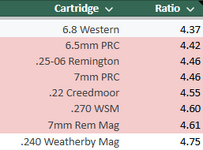
What is constituting that ratio number? Powder to bore ratio?FWIW .22 Creedmoor is a magnum:
View attachment 1019927
Case capacity in cubic inches (minus the neck) divided by the bore diameter (in inches) squared. It's a dimensionless number which can also be derived from ml and mm.What is constituting that ratio number? Powder to bore ratio?
Was this discussed on the Hornady podcast? I vaguely remember them presenting data like this along with the ensuing barrel life. Very cool.Case capacity in cubic inches (minus the neck) divided by the bore diameter (in inches) squared. It's a dimensionless number which can also be derived from ml and mm.
I would debate that. The creedmoor and the 25-06 do not utilize a magnum bolt face. Just because they are “over bore” doesn’t mean they are magnums.FWIW .22 Creedmoor is a magnum:
View attachment 1019927
Same concept, but they were using some other metric which I don't recall the details of. Ryan also did something similar using grains of WC, but it resulted in very small numbers (which are tied to the measurement units).Was this discussed on the Hornady podcast? I vaguely remember them presenting data like this along with the ensuing barrel life. Very cool.
OK, fair enough. I'm just looking to compare cartridges for practical uses and less concerned with building or buying actions.I would debate that. The creedmoor and the 25-06 do not utilize a magnum bolt face. Just because they are “over bore” doesn’t mean they are magnums.
No dog in this fight, you can go round and round on topics like this. But a 222 Magnum holds less powder than a 22 Creed. The term magnum came from wine bottles, and I beleive thr first cartridge to use it was the 357. So it really isnt a useful adjective sometimes.I would debate that. The creedmoor and the 25-06 do not utilize a magnum bolt face. Just because they are “over bore” doesn’t mean they are magnums.
Nah you’re not missing anything. The only thing I can really think of is POSSIBLY more potential for DRT’s when intentionally shoulder shooting animals in heavily forested terrain. There’s absolutely a visible impact difference between the small and large cartridges/calibers.


Weatherby and Lazzeroni missed the boat.The term magnum came from wine bottles, and I believe the first cartridge to use it was the 357
Nah. You shoulder shoot them, you effect the spine which drops them with anything. Beyond that, there are bullets in 6mm that create some of the largest wounds of any caliber and any bullet ever made to this point.
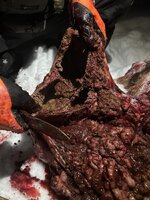
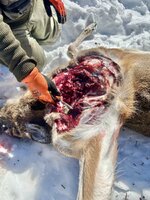
I’m pretty sure these have a visible impact. grin
From another thread-
Remember this is culling. Not hunting.
If you just hit ribs, it’s good- very effective.
If you hit bone, very likely you won’t like it.
2,100’ish FPS impacts. Photos and animals are unmodified.
Quartering too- shot entered center chest… How we walked up to it. A 9-10” wound.
![]()
![]()
![]()
Facing directly away. 2,105fps impact. Entered center of rear ham- 10+ inch hole. TC blew stomach out mid belly, bullet traveled all the way through the chest and through the heart. Everything inside body cavity was wrecked.
![]()
![]()
Heart-
![]()
116gr TMK, 2,105fps impact.
![]()
116gr TMK, 2,424fps impact.
![]()
View attachment 1019928
View attachment 1019929
View attachment 1019930

Do the 116’s produce a significantly larger wound channel than the 95 at the same velocity?
Hi highly prefer to use the term magnum-ness, I think it's THE most appropriate here.Case capacity in cubic inches (minus the neck) divided by the bore diameter (in inches) squared. It's a dimensionless number which can also be derived from ml and mm.
Call it overbore, magnum-ness, or whatever.