Follow along with the video below to see how to install our site as a web app on your home screen.
Note: This feature may not be available in some browsers.
80,000 psi 7mm Backcountry ammo didn't seem to bother any suppressors that I heard of. I don't foresee any issues for a magnum rated can under normal rates of fire.Maybe this has already been discussed, but will this new ammo cause issues with standard suppressors rated to 300 WM?
I'd be a tiny bit worried if I had a Scythe Ti but that's not the ammo's fault.80,000 psi 7mm Backcountry ammo didn't seem to bother any suppressors that I heard of. I don't foresee any issues for a magnum rated can under normal rates of fire.
Jay
I got a no go for my Jolene when I asked Resilient about using it ona 16” 7mm BC80,000 psi 7mm Backcountry ammo didn't seem to bother any suppressors that I heard of. I don't foresee any issues for a magnum rated can under normal rates of fire.
Jay
You've got me curious. What physics are you talking about?Media hype can't overcome Physics.
Is it rated for a 16" magnum cartridge? Most non Ti printed cans are rated for no less than 20" magnum cartridges. Both the Jolene L and Jolene S are rated for (22” – 300 PRC, 300 Win mag, 6.5 PRC, 270 Win, 7mm mag) as per Silencer Shop. I wouldn't expect that suppressor to get the nod for ANY magnum or long action cartridge in a 16" barrel based on that information.I got a no go for my Jolene when I asked Resilient about using it ona 16” 7mm BC
I mean, people have blown them up with a 223 so....I'd be a tiny bit worried if I had a Scythe Ti but that's not the ammo's fault.
Simply stated increased pressure is increased pressure. Everything has its limits.
Surely you can work that one out.Define "uncorking"
Define "uncorking"
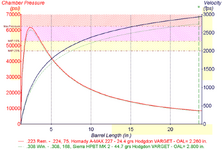
Yeah it’s interesting how suppressors have barrel length restrictions. It’s obviously more violent the shorter the barrel is, but I don’t really know why. It’s a metal tube, everything is coming out the end… no matter what the length is. So I don’t really understand all of it.If I remember correctly, and I may not,
Unknown mentioned much more violent muzzle exit pressures/characteristics for very overbore cartridges like 6um compared to even larger cartridges with more powder capacity due to the bore size compared to volume. I believe that’s the uncorking pressure referenced.
I’m unsure how that compares to higher chamber pressures, but I’d imagine it’s different
Unburned (i.e. still burning) powder is far harder on the suppressor than hot gases are.it’s interesting how suppressors have barrel length restrictions. It’s obviously more violent the shorter the barrel is, but I don’t really know why.
When the bullet leaves the barrel, the pressure may still be 10k psi+. Depends on barrel length and powder amount, and burn speed. A long barrel with little powder may be 3k. That pressure has to be contained by the can. I ran across some video of clear suppressors showing the flames inside upon firing. Quite violent. Showed why cans get eroded and can come apart.Yeah it’s interesting how suppressors have barrel length restrictions. It’s obviously more violent the shorter the barrel is, but I don’t really know why. It’s a metal tube, everything is coming out the end… no matter what the length is. So I don’t really understand all of it.
I see that.When the bullet leaves the barrel, the pressure may still be 10k psi+. Depends on barrel length and powder amount, and burn speed. A long barrel with little powder may be 3k. That pressure has to be contained by the can. I ran across some video of clear suppressors showing the flames inside upon firing. Quite violent. Showed why cans get eroded and can come apart.
I see that.
But if you think about it, all the pressure has to come out the end of the barrel. It has no where else to go.
So it must just come out slower with a longer barrel, stretching out the peak impulse.
No matter the length of a barrel, the exact same total amount of energy must come out the end of the barrel.
See what I’m saying?