Fixed -- thank you.SAAMI ammo specs, not chamber.

Navigation
Install the app
How to install the app on iOS
Follow along with the video below to see how to install our site as a web app on your home screen.
Note: This feature may not be available in some browsers.
More options
Style variation
You are using an out of date browser. It may not display this or other websites correctly.
You should upgrade or use an alternative browser.
You should upgrade or use an alternative browser.
.223 for bear, mountain goat, deer, elk, and moose.
- Thread starter PNWGATOR
- Start date
- Banned
- #11,262
You'd better factor in how much case capacity you lose by seating a long heavy bullet down into the shoulder on the 22-250 as well then if your gonna hold the higher volume neck against the 22gt. It's the same thing man........you're making it harder than it is.Grains of water includes the case neck. Neck lengths vary even across cartridges of the same caliber, but as total capacity goes up, the percentage of that capacity taken up by the neck decreases quite a bit. Capacities in the table are shown in cubic inches, and came from this.
I used 6mm GT capacity for the .22 GT line -- have yet to reverse engineer his work on that so I can arbitrarily include new cartridges. If I can find time this winter, the spreadsheet figures will be derived directly from published case drawings and thus easily tweaked to account for thicker brass, deeper bullet base incursions, etc.
The benefit of this from my perspective is the Ratio column: It' a dimensionless number -- you can start with inches or mm and get the same result.
Georgedubya
FNG
- Joined
- Nov 28, 2023
- Messages
- 39

wind gypsy
"DADDY"
- Joined
- Dec 30, 2014
- Messages
- 13,871
That's getting into reloading data, which was not my intent.
I wanted a way to compare cartridge designs that would enable my engineer brain to deconstruct vague terms like "more efficient", "overbore", "barrel burner" and the like.
This way of looking at it significantly skews the value of the results as evidenced in the 22-250 vs 22 GT comparison. Backfire's way of calculating case capacity contributes to error vs actual measured h20 capacity. Second, to discard neck volume but consider nose length is odd especially when the two are closely related in concert with COAL constraints. COAL constraints in the case of these two cartridges dont even exist because they are both well short of most any short action magazine configuration.
It's probably a pretty fair way to compare lots of cartridges but in the case of 22 gt and 22-250, it provides some misleading take aways.
C_chats_choots
FNG
- Joined
- Sep 1, 2025
- Messages
- 12

Been checking in on this thread for a while, so figured I’d join and post one. This is from 2020, but was Black Hills 77gr TMK from a 10.5” barrel. 90ish pound Louisiana whitetail, shot was at 50 yards, she ran hard and piled up after about 50 yards. Absolutely zero blood trail that I could find, but some blood around where she piled up. Looked like the core exited, and I found the jacket on the inside of the ribs of the far side. I never chrono’d this, but I’m figuring about 2300fps impact velocity based on figures I found on some other forums. I’ve worked up some TMK handloads and plan to primarily hunt with my 16” AR this year.
Sent from my iPhone using Tapatalk
C_chats_choots
FNG
- Joined
- Sep 1, 2025
- Messages
- 12
Gonna make a few more posts for some that I forgot about.
Same 10.5” as before, but with factory 62gr Barnes TSX-BT. Another Louisiana doe, but a little bigger than the last one, bout 50yds again, impact velocity of about 2400fps. Hit high and clipped spine, and was DRT. I remember there being good damage on the internals, and a definite pass through.

Sent from my iPhone using Tapatalk
Same 10.5” as before, but with factory 62gr Barnes TSX-BT. Another Louisiana doe, but a little bigger than the last one, bout 50yds again, impact velocity of about 2400fps. Hit high and clipped spine, and was DRT. I remember there being good damage on the internals, and a definite pass through.

Sent from my iPhone using Tapatalk
C_chats_choots
FNG
- Joined
- Sep 1, 2025
- Messages
- 12

Not as pertinent to the discussion, but some data on the Barnes on a smaller critter. 16” barrel with same factory 62gr Barnes. About 220yds, impact velocity around 2250. First shot was a little far back (due to my ignorance on coyote anatomy), spun biting at wound, sent a follow up shot as it came out of the spin, and DRT. I couldn’t find entrance or exit holes for either, but seems pretty obvious that it was hit.
Sent from my iPhone using Tapatalk

Got 3 deer and a grouse with the RSS and 77 TMK recently.
Neck shot entrance and exit.
Heart of one of the deer.

Aftermath of a follow-up shot on a deer that turned away after first shot. 200 yards, 16.5 inch barrel. The bulge in front of the testicles is abdominal contents that herniated through the abdominal wall and were only held in by the skin. 180 gr accubounds from a 30-06 at 25 yards did less damage than the little 77 TMK. Bullet center punched the femur.


Neck shot entrance and exit.
Heart of one of the deer.
Aftermath of a follow-up shot on a deer that turned away after first shot. 200 yards, 16.5 inch barrel. The bulge in front of the testicles is abdominal contents that herniated through the abdominal wall and were only held in by the skin. 180 gr accubounds from a 30-06 at 25 yards did less damage than the little 77 TMK. Bullet center punched the femur.
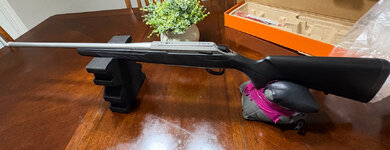
My 1in8 22-250 arrived. Now I am waiting on the rail and the scope. I wanted the 6x42 SWFA but it ain’t happening right now. I picked up Arken’s Japanese glass “lightweight” version online and hopefully it won’t take too long. I have a few recipes of H4350 and the 77 TMKs. Hopefully one of them will work out. I’ve never had an Arken. I usually use Leupold for my hunting rifles (a lot of VX3 2.5-8-36s) and Meopta Optima 6 scopes for more long distance fun. We will see how it turns out.
I recently bought (2) 4-16 EPL’s and they have done well for me so far.View attachment 931827
My 1in8 22-250 arrived. Now I am waiting on the rail and the scope. I wanted the 6x42 SWFA but it ain’t happening right now. I picked up Arken’s Japanese glass “lightweight” version online and hopefully it won’t take too long. I have a few recipes of H4350 and the 77 TMKs. Hopefully one of them will work out. I’ve never had an Arken. I usually use Leupold for my hunting rifles (a lot of VX3 2.5-8-36s) and Meopta Optima 6 scopes for more long distance fun. We will see how it turns out.
Not a lot of time on them but they have tracked and held zero so far.

Pharmseller
WKR
Just because I can do it doesn’t necessarily make it my best decision!
I moved off my 223 to a Ruger 22 Arc in a chassis man this thing really shoots like a laser but I decided against deer hunting with it this year. Only because my 6.5 Creedmoor is even better in every measurable except recoil.
Which elements are you measuring?
P
I did it. All 567 pages.
My scope and rail for my new 1 in 8 22-250 Tikka arrive tomorrow. Hopefully within the next three days I will be able to go to the range and test my loads and find a winner. In two weeks she is going hog hunting to test a few high velocity 77 TMKs.
My scope and rail for my new 1 in 8 22-250 Tikka arrive tomorrow. Hopefully within the next three days I will be able to go to the range and test my loads and find a winner. In two weeks she is going hog hunting to test a few high velocity 77 TMKs.
andrew_hood27
FNG
- Joined
- Jun 20, 2024
- Messages
- 64
Anyone ever use subsonic .223 for whitetail? I’m assuming the only reliable shot would be a head shot? Well, reliable as long as you are a good enough shot/limiting your range enough to reliably make the shot….
OR is there a .223 bullet out there specifically designed to expand at subsonic velocities?
OR is there a .223 bullet out there specifically designed to expand at subsonic velocities?
wind gypsy
"DADDY"
- Joined
- Dec 30, 2014
- Messages
- 13,871
Anyone ever use subsonic .223 for whitetail? I’m assuming the only reliable shot would be a head shot? Well, reliable as long as you are a good enough shot/limiting your range enough to reliably make the shot….
OR is there a .223 bullet out there specifically designed to expand at subsonic velocities?
Considering subsonic terminal reports on 300BO seem hit or miss and very bullet dependent, I'd think 223 would be pretty marginal.
What's the draw to subs? You hunting near a neighborhood?

- Joined
- Feb 12, 2021
- Messages
- 2,014
I mean you can shoot deer in the head with a 22LR which is basically what a subsonic 223 is. I don’t know anyone who chooses to shoot with subsonic 223.Anyone ever use subsonic .223 for whitetail? I’m assuming the only reliable shot would be a head shot? Well, reliable as long as you are a good enough shot/limiting your range enough to reliably make the shot….
OR is there a .223 bullet out there specifically designed to expand at subsonic velocities?
If shooting with subsonic is what you absolutely want - 338arc or 300 blackout. But even then - not my preference for hunting. Cool for shooting and plinking though.
Chris in TN
WKR
- Joined
- Jun 17, 2025
- Messages
- 1,933
No, and here's why:Anyone ever use subsonic .223 for whitetail? I’m assuming the only reliable shot would be a head shot? Well, reliable as long as you are a good enough shot/limiting your range enough to reliably make the shot….
OR is there a .223 bullet out there specifically designed to expand at subsonic velocities?
Some years back I found a buck fawn someone had attempted to poach with a .22lr. Deer was acting really weird, really weak, couldn't run, could barely stand, and I shot it in the head with my CCW at the time. At contact distance. Muzzle touching head.

Later when I skinned it (this was during season, we are allowed to kill multiple antlerless per day, I notified the local CO and he said just check it in as normal) I found a .22lr in its lungs. It was dying, from a tension pneumothorax. It wasn't pretty to watch happen. I relayed this info to the CO, for whatever that was worth.
(In fairness, the bullet had went into the back part of one lung and the very far rear tip of the other)
But here's the thing: That happened with a .22lr that probably was shooting a 40 grain bullet at near subsonic speeds, or possibly slightly supersonic. I think the same bullet in the heart would have likely killed it within seconds, but obviously there's zero margin for error there. As it is, a heavier .22 bullet at similar speed might have penetrated further, and might have put a slightly deeper hole through both lungs, but as it was, the hole that was there, wasn't enough to produce the desired effect. And a bullet that small that would have expanded, might have left a bigger hole in one lung but lacked the momentum needed to make any hole at all in the second lung.
I have killed deer with larger bore stuff at handgun speeds (.45 colt) and with zero expansion a typical .45' flat point will make a wound that causes rapid drop in BP and the resultant shock/death. A .22 caliber bullet with any sort of pointy point may not. It's just too easy to make a wound that is fatal but not rapidly so.
I shoot varmints around the farm with .22lr subs all the time, up to the size of coyotes/bobcats (trapped). A CCI SV in the noggin from 30 feet away will kill them faster than I can cycle the action and walk 30' to them. When I approach a trapped animal they usually get excited/agitated for a few seconds then stop to stare at me. I wait for the stop/stare and brain them.
I don't know *exactly* where the line is between a .22/77+ grain bullet at perhaps 1100'MV (that will hold 1000'+ for a long distance as velocity decay happens fairly slowly at subsonic speeds) and that same 22/77+ at the typical 1600-1800' impact speeds that most people strive for. But the thing is, I don't want to know, and I don't think you can really find that line without risking a few inhumane kills.
I personally do not think it is ethical to shoot a game animal with any .22 caliber subsonic projectile that I am aware of. The margin for error is just too small.
If I wanted to quietly kill things with subs I would buy a .350 Legend and shoot the 255 factory loads. I've shot those in my kids' single shot. I've also shot subsonic 358-200 rnfp over ~4 grains of 700-x. Even then I'd consider that to be the lower end floor of what would kill quickly. Handgun hunters 40-50 years ago used to argue over whether the .357 Magnum was enough. I think it is, up close, but I also think it's about the floor, and the .350 Legend with subs is about in that same ballpark.
YMMV, I'm no expert, but I hated watching that buck fawn suffer.
In the last decade(?) I think the shooting world has learned that the floor for ethical killing is much lower than we thought, but there is still a floor. I'd consider any subsonic .22 to be below it.

Matt5266
WKR
No, and subsonic hunting requires close shot distances. I think the easy button for that is 300 blackout
omicron1792
WKR
- Joined
- Feb 20, 2024
- Messages
- 1,825
I think the new easy button is 338arc. Throws a bullet about 50% heavier. Only variable you can control with subs.
andrew_hood27
FNG
- Joined
- Jun 20, 2024
- Messages
- 64
Thanks all, I appreciate the quick and informative replies. There is a chance I could be doing some hunting in a more suburban area and I’m just trying to weigh out my options (other than the obvious choice of just shooting a bow).
Similar threads


- Replies
- 37
- Views
- 3K



Featured Video
Latest Articles
- How to Kill Giant Bulls with Ryan Carter
- Kifaru Enters the Hunting Apparel Space: Review
- From Big Bucks to Bear Hunts: Catching Up with Jordan Budd
- Mule Deer Days Wildlife Conservation Mashup
- A Hidden Gem: Hunting Washington with Kari Thomas
- Prime Divide Bow Review
- Knowledge From Storms: Surviving and Thriving in the Backcountry with John Barklow
- DIY Wyoming Pronghorn Hunt
- Unlock Precision Shooting: Master Your Hunting Game with Competitive Insights
- Topo Topper Rincon Review