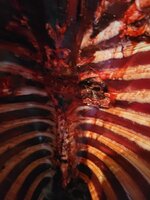
.223 for bear, mountain goat, deer, elk, and moose.

My 1-8" Howa loves the Hornady 75BTHPs.
I'd love to get even a dozen 69-77TMKs to test but they seem out of stock everywhere in New Zealand that I've looked.
 
Last edited:
Just spent a week reading through this thread in my spare time. What an education!

It occurs to me that this is like the scientific method. You have a question, you research existing data, you form a hypothesis, you design an experiment to test your hypothesis, the experimental results prove or disprove your hypothesis, you continue on your way better at life because of what you learned.

Now let's go through this as the typical Magnum-Fudd:

Question: What cartridge will allow me to recover the highest percentage of game animals?

Research:
*Bullets kill animals with magic energy. *The more magic energy, the quicker the kill.
*Bigger & faster bullets contain more magic energy than smaller or slower bullets, +20% bonus for "Mag" "RM" "WM" or "Wby" on the head stamp.
*If you make a poor shot, extra magic energy from a magnum will spill out from the bullet and flow toward the vitals.
*Shoulders can stop bullets, consuming at least half of the magic energy of any bullet that makes it through, so you need to choose a round with double the energy and use a controlled expansion bullet if there's any possibility of hitting a shoulder.


Experiment: (note, the Magnum-Fudd has no reason actually to test his hypothesis, because everyone in the cabelas ammo aisle already confirmed.)
*Read hundreds of first hand accounts and necropsy photos from the lowly 223.
*Learn that it is the disruption of heart & lung tissue within the wound channel that kills the animal by depriving the brain of oxygen.
*Learn that a heavy match style bullet in a baby cartridge like 223 creates as large or larger wound channel than a tough controlled expansion bullet from a big magnum.
*Learn that you can likely make more accurate hits with a 223 than a 338 and you can absolutely afford to practice more with 223 than 338.
*Observe that 223 TMK death runs are equal or shorter than magnum death runs.


Conclusion:
*223 allows you to place shots more accurately both because it is easier to shoot and it is cheaper and funner to practice with.

*With bullets such as the 77 TMK, 223 actually gives a GREATER margin of error because the wound channel is larger than a controlled expansion bullet from a magnum.
*Conclude that a small round like 223 may actually result in more animals successfully recovered than a more powerfull cartridge.
*Reject all of the irrefutable photographic evidence and instead continue to cling to your original fuddlore hypothesis.
*Tell stories about how the Viet Cong could use 556 ammo in their AKs because their bore size was larger than ours and 50bmg can kill without contact because of its shockwave instead of practicing shooting from field positions with your $4/round 338wm.

*Continue hunting with big guns you have not practiced with, topped with a scope that doesn't hold zero, wounding and losing more animals than the 223 guys.


I like big cartridges as much as the next guy. Of the last three deer I shot, two were with 375h&h and the other was 300wsm. I'm all for people using whatever cartridge makes them happy.

BUT what people seem to be doing is rejecting actual evidence that's clearly laid out in front of them and continuing to say a big cartridge gives them more "margin for error" or "shorter tracking job" or is "more ethical." These things are demonstrably false.

Back to the scientific method, it's like the experimental results have disproven the hypothesis, but the fudds decide to reject the results and cling to the hypothesis instead.

 
BUT what people seem to be doing is rejecting actual evidence that's clearly laid out in front of them and continuing to say a big cartridge gives them more "margin for error" or "shorter tracking job" or is "more ethical." These things are demonstrably false.

This is often the case. It often amazes me how people can reject photographic evidence, actual math, and proven physics because one time someone they know told them something different.
 
Just spent a week reading through this thread in my spare time. What an education!

It occurs to me that this is like the scientific method. You have a question, you research existing data, you form a hypothesis, you design an experiment to test your hypothesis, the experimental results prove or disprove your hypothesis, you continue on your way better at life because of what you learned.

Now let's go through this as the typical Magnum-Fudd:

Question: What cartridge will allow me to recover the highest percentage of game animals?

Research:
*Bullets kill animals with magic energy. *The more magic energy, the quicker the kill.
*Bigger & faster bullets contain more magic energy than smaller or slower bullets, +20% bonus for "Mag" "RM" "WM" or "Wby" on the head stamp.
*If you make a poor shot, extra magic energy from a magnum will spill out from the bullet and flow toward the vitals.
*Shoulders can stop bullets, consuming at least half of the magic energy of any bullet that makes it through, so you need to choose a round with double the energy and use a controlled expansion bullet if there's any possibility of hitting a shoulder.


Experiment: (note, the Magnum-Fudd has no reason actually to test his hypothesis, because everyone in the cabelas ammo aisle already confirmed.)
*Read hundreds of first hand accounts and necropsy photos from the lowly 223.
*Learn that it is the disruption of heart & lung tissue within the wound channel that kills the animal by depriving the brain of oxygen.
*Learn that a heavy match style bullet in a baby cartridge like 223 creates as large or larger wound channel than a tough controlled expansion bullet from a big magnum.
*Learn that you can likely make more accurate hits with a 223 than a 338 and you can absolutely afford to practice more with 223 than 338.
*Observe that 223 TMK death runs are equal or shorter than magnum death runs.


Conclusion:
*223 allows you to place shots more accurately both because it is easier to shoot and it is cheaper and funner to practice with.

*With bullets such as the 77 TMK, 223 actually gives a GREATER margin of error because the wound channel is larger than a controlled expansion bullet from a magnum.
*Conclude that a small round like 223 may actually result in more animals successfully recovered than a more powerfull cartridge.
*Reject all of the irrefutable photographic evidence and instead continue to cling to your original fuddlore hypothesis.
*Tell stories about how the Viet Cong could use 556 ammo in their AKs because their bore size was larger than ours and 50bmg can kill without contact because of its shockwave instead of practicing shooting from field positions with your $4/round 338wm.

*Continue hunting with big guns you have not practiced with, topped with a scope that doesn't hold zero, wounding and losing more animals than the 223 guys.


I like big cartridges as much as the next guy. Of the last three deer I shot, two were with 375h&h and the other was 300wsm. I'm all for people using whatever cartridge makes them happy.

BUT what people seem to be doing is rejecting actual evidence that's clearly laid out in front of them and continuing to say a big cartridge gives them more "margin for error" or "shorter tracking job" or is "more ethical." These things are demonstrably false.

Back to the scientific method, it's like the experimental results have disproven the hypothesis, but the fudds decide to reject the results and cling to the hypothesis instead.

Magnum people are collecting data on the performance of their guns, but are largely avoiding the question of how well they shoot them. All the stuff they’ve read tells them energy, excess penetration, and bullet weight retention are important variables. But none of those variable ultimately effect how a bullet kills normal big game. So they continue to shoot bigger, harder kicking guns with bullets that reduce their killing power. All the industry misinformation excludes the option of using a gun that is easier to shoot while simultaneously maximizing the damage that gun causes through bullet selection. This is circular logic that no application of the scientific method can help or resolve.
 
This may have been posted but there are a number of gel tests on YouTube.


Sent from my iPhone using Tapatalk
 
I think the argument is that a well designed 0.224 bullet at proper velocity is very sufficient at killing large game - with the 77 gr TMK and equivalents, we now have that. An equally well designed 0.308 bullet, for example, at the same velocity would cause greater - and thus more than necessary - damage on an NA big game animal. This is basic laws of physics.

I absolutely agree that those who own mags shoot far less than those who own lower recoil energy rifles - this is a basic function of pain tolerance and economics. 30 ft-lbs vs 5 and $3/shot vs $0.70. We would all tend to shoot a 300 WM just enough to check zero each year while want to fire off a few more 223s because it just brings a smile to our faces. And thus… shot placement and rifle proficiency. And this, I believe, is the most significant point of this whole topic. Those who shoot lower recoiling, more economic cartridges shoot more and are thus more proficient.

I’m a believer in 223 for deer - seen it first hand and believe the abundance of info here. Will I be trading my 300 wsm + 205 gr EH in for a 223 for western big game? Not just yet…
 
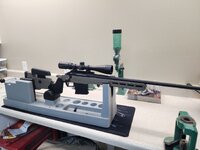
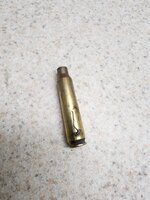
First time poster in this thread. Got the bug on this a couple years ago and bought this Ruger American Predator when Tikkas were non-existent. Shoots great and I am enjoying loading the TMK. That said, I did shoot some AAC 77gr TMKs yesterday, and as others have experienced, I had a case split. A little unnerving. Best grouping with them was around 1". I am under 1" with TAC and my own loads. Just thought I'd share my experience on them.
 

Attachments

  • 20231210_151418.jpg
    20231210_151418.jpg
    231.2 KB · Views: 149
  • 20231210_151440.jpg
    20231210_151440.jpg
    313.4 KB · Views: 149
First time poster in this thread. Got the bug on this a couple years ago and bought this Ruger American Predator when Tikkas were non-existent. Shoots great and I am enjoying loading the TMK. That said, I did shoot some AAC 77gr TMKs yesterday, and as others have experienced, I had a case split. A little unnerving. Best grouping with them was around 1". I am under 1" with TAC and my own loads. Just thought I'd share my experience on them.
Is that the MDT field stock? How do you like it?

Sent from my SM-G990U2 using Tapatalk
 
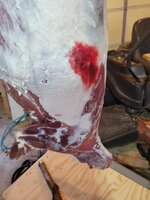
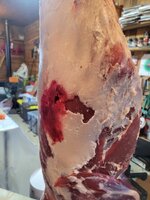
Entry
20231210_160738.jpg

Exit
20231210_160753.jpg

Chest cavity
20231210_160727.jpg

I'm not doing very well at detailed necropsies this year, but.....

Whitetail doe, 69 gr TMK, impact velocity 2750ish. She saw me, ran about 30 yds, and stopped to look. Shot was high shoulderish, although just a bit back from ideal placement. Bullet impacted bottom of the spine, and still caused a lot of trauma to the lungs. The deer dropped, tried to get up once, kicked a bit, and was done.

Very little meat loss with this one. Shot looks further back than it is because legs are fully forward from hanging head down.
 
Magnum people are collecting data on the performance of their guns, but are largely avoiding the question of how well they shoot them. All the stuff they’ve read tells them energy, excess penetration, and bullet weight retention are important variables. But none of those variable ultimately effect how a bullet kills normal big game. So they continue to shoot bigger, harder kicking guns with bullets that reduce their killing power. All the industry misinformation excludes the option of using a gun that is easier to shoot while simultaneously maximizing the damage that gun causes through bullet selection. This is circular logic that no application of the scientific method can help or resolve.

There are certainly people following that, but that’s a pretty broad brush. You make it sound as though the folks in the “small bore” (used for lack of a better collective term) threads are the only people using bullets like the tmk, Eldm, various bergers etc for hunting. This has been proliferating for quite some time now, following the growing popularity of long range shooting, even among those who don’t shoot long range. Many of the converts to smaller cartridges were likely already shooting those bullets. The industry has also been trumpeting the CM cartridges for a long time now as hunting rifles because of their shoot-ability compared to larger cartridges.


Sent from my iPhone using Tapatalk
 
There are certainly people following that, but that’s a pretty broad brush. You make it sound as though the folks in the “small bore” (used for lack of a better collective term) threads are the only people using bullets like the tmk, Eldm, various bergers etc for hunting. This has been proliferating for quite some time now, following the growing popularity of long range shooting, even among those who don’t shoot long range. Many of the converts to smaller cartridges were likely already shooting those bullets. The industry has also been trumpeting the CM cartridges for a long time now as hunting rifles because of their shoot-ability compared to larger cartridges.


Sent from my iPhone using Tapatalk
My intent wasn’t to represent everyone shooting small bores. But if you’re a 300 RUM aficionado considering switching over, you aren’t going to be happy with a 223 or 6 mm with monos or other controlled expansion bullets. You can get comparable wound channels with small bores, but only with fragmenting bullets like those you mentioned. That said, even to controlled expansion bullets and monos can kill in the small bores. You just have less margin for error on accuracy because the wound channels are smaller, less range due to higher minimum upset velocities, and the animals you shoot are likely to travel further before they die.
 
You can get comparable wound channels with small bores, but only with fragmenting bullets like those you mentioned. That said, even to controlled expansion bullets and monos can kill in the small bores. You just have less margin for error on accuracy because the wound channels are smaller, less range due to higher minimum upset velocities, and the animals you shoot are likely to travel further before they die.

I'm going to add "likely with a less reliable blood trail." The TMK, ELD-M, etc. cause massive damage because they're sending little, sharp pieces of copper and lead through a lot of tissue. I've seen similar from the ELD-X at higher impact velocities (in larger cartridges) as well. I wish my current area allowed something other than SG/MZ without going onto state land because I shoot a few thousand 75gr ELD-M a year and wouldn't mind giving this a try myself.

Sent from my SM-S918U using Tapatalk
 
Why gas gun over a bolt gun and what makes your gas gun different than the standard (I assume AR) AR? Trigger? Stock? Barrel?
I like the ergonomics and versatility of my AR better. I’ll also say that I’ve been carrying an AR for just over 25 years for work and it feels better for me. My gas gun is a proprietary build, which can have its own issues, but so far I’ve not experienced any.
 
Back
Top