22 Hornet for Deer

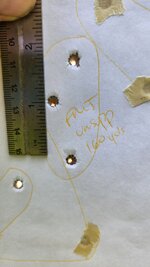
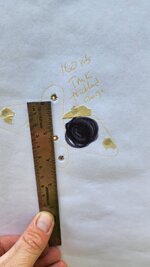
Strapped on a scope and shot at distance a little this morning. At 160 yards (my backyard range at the moment), I got several 3-shot groups at or under 1.5 MOA with both the 60 TMK as well as 55 FMJBT surplus pulled bullets. Not bad for this lil snack.
 
Think that group size will hold with a larger sample?

If you don’t mind, how does the stock attach? Does it seem easily customizable?
That's the big question. I'll get some 10-shot groups soon.

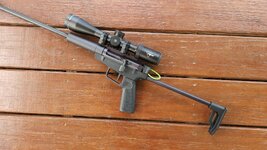
The stock rod is held in place by two screws in the receiver, and one screw holding the buttplate. Looks easily removable; I don't know what else you'd find to fit in it's place though.
 
That's the big question. I'll get some 10-shot groups soon.

The stock rod is held in place by two screws in the receiver, and one screw holding the buttplate. Looks easily removable; I don't know what else you'd find to fit in it's place though.
Thanks! I was wondering with adding a lighter and/or shorter rod in mind.
 
10 shot groups with 3 different loads are running 3-4 MOA at 160 yds. So a little worse than I would have hoped, probably limiting this to a 150 yd deer gun. Slightly disappointing, but I still look forward to trying it out this fall.

Think that group size will hold with a larger sample?

If you don’t mind, how does the stock attach? Does it seem easily customizable?
 
Last edited:
10 shot groups with 3 different loads are running 5-7 MOA at 160 yds. So a little worse than I would have hoped, probably limiting this to a 150 yd deer gun. Slightly disappointing, but I still look forward to trying it out this fall.
Bummer. I could handle a 3 MOA group at that distance but what you are seeing is a little over acceptable. Wonder if it is hold sensitive due to the design? Does it flex at all?

Jay
 
Sorry, corrected to 3-4 MOA at that distance. My mistake.

No flex, it all seems tight.

Bummer. I could handle a 3 MOA group at that distance but what you are seeing is a little over acceptable. Wonder if it is hold sensitive due to the design? Does it flex at all?

Jay
 
Head or spine shot only.

Not required. I’ve seen 20-30 deer shot with a 22 hornet with well placed lung shots that resulted in efficient kills. They seem to run about the same distance as deer I’ve shot through the lungs with various other calibers up to magnum cartridges. I’d be looking to keep shots under 200 yards but preferably under 150. I have a contender 22 k hornet I’m considering using for late season doe hunting in Wisconsin.


Sent from my iPhone using Tapatalk Pro
 
Sorry, corrected to 3-4 MOA at that distance. My mistake.

No flex, it all seems tight.

Do you think it is mainly due to the trigger, or is it just the overall platform that is causing the variability?

As to the comment that you need to limit the shot to head or spine (not the quoted part from the OP), clearly you haven't killed a lot of deer.
 
Do you think it is mainly due to the trigger, or is it just the overall platform that is causing the variability?

As to the comment that you need to limit the shot to head or spine (not the quoted part from the OP), clearly you haven't killed a lot of deer.
I'm not sure. I got the trigger cleaned up nicely, so it's kind of a mystery. The barrel appears to be made well also. Will keep playing with it.
 
This is pretty cool but i cant help but think it would be easier to just down load a 223
 
The OP specified a velocity range which means he is considering distance. There has been a lot of discussion on Rokslide about kinetic energy and bullet diameter with respect to killing efficiency. I get that there is a mathematical formula, but neither is a direct correlation to wound channel volume. The pictures above are evidence of that. There are plenty of 30-35 cal bullet and cartridge combos that would have resulted in smaller wound channels. What matters is bullet construction and whether or not that bullet is within the velocity range needed for the bullet to upset or fragment on impact. Would a 22 hornet be my first choice for deer hunting in the west? No, but the photos show what it can do with the right bullet at reasonable distances.

Edit: Reading comprehension moment… The photos cited above were not from a 22 hornet and I have no personal experience with the hornet.

The velocity range is only important because it is a huge factor in making sure there is enough energy to allow the bullet to perform.

At some point, it is irresponsible to hunt game with bullets that are very small going at marginal speed. The animals are precious and should not be wasted because the hunter does not want to use the proper tool for the job.

OP should just use a .223 or something faster.
 
The velocity range is only important because it is a huge factor in making sure there is enough energy to allow the bullet to perform.
This is factually incorrect. Energy has nothing to do with bullet performance or the production of wound channels. That has been well covered in multiple rokslide threads. Two bullets can have the same energy and produce markedly different wound channels. And two bullets of the same construction in different weights or calibers will produce markedly different energies, but may require the same velocity to upset or fragment.


At some point, it is irresponsible to hunt game with bullets that are very small going at marginal speed. The animals are precious and should not be wasted because the hunter does not want to use the proper tool for the job.

On the 22 Hornet, I don’t think anyone here is promoting it as a big game cartridge. But with the right bullet and under the right conditions (i.e. distance and shot selection limitations), I would be confident that it would cleanly and humanely kill deer. What that means is optimizing your bullet construction and impact velocity to produce a wound channel of sufficient depth and diameter to kill a deer.

So how exactly does that sound irresponsible to you? Honestly, I know a lot of people who think they are being responsible by arming themselves with guns they cannot accurately shoot that also fire bullets that are specifically designed to minimize wounding potential. Does that sound irresponsible to you? My definition of a responsible hunter is someone who puts in the time to make sure their equipment and ammunition is well chosen for the game, that it is functional and dependable, that they have practiced with that equipment to be able to use it well and understand its limitations, and that they stay within those limitations. What is your definition?

 
This is factually incorrect. Energy has nothing to do with bullet performance or the production of wound channels. That has been well covered in multiple rokslide threads. Two bullets can have the same energy and produce markedly different wound channels. And two bullets of the same construction in different weights or calibers will produce markedly different energies, but may require the same velocity to upset or fragment.


On the 22 Hornet, I don’t think anyone here is promoting it as a big game cartridge. But with the right bullet and under the right conditions (i.e. distance and shot selection limitations), I would be confident that it would cleanly and humanely kill deer. What that means is optimizing your bullet construction and impact velocity to produce a wound channel of sufficient depth and diameter to kill a deer.

So how exactly does that sound irresponsible to you? Honestly, I know a lot of people who think they are being responsible by arming themselves with guns they cannot accurately shoot that also fire bullets that are specifically designed to minimize wounding potential. Does that sound irresponsible to you? My definition of a responsible hunter is someone who puts in the time to make sure their equipment and ammunition is well chosen for the game, that it is functional and dependable, that they have practiced with that equipment to be able to use it well and understand its limitations, and that they stay within those limitations. What is your definition?

You entirely missed the point off my post. I did not state anyone needs a 300PRC (which they cannot shoot accurately) to kill a deer or elk.

My point was targeted at the various 22 caliber available to hunters.

With the exact same bullet:
- The 223 is objectively better than the 22 Hornet.
- The 22-250 and 22CM are objectively better than a 22 Hornet.

I have shot a 223 plenty of times. It barely kicks at all.
I have not shot the 22-250 or 22CM, but they are not known for their massive recoil.

If some cannot accurately shoot a rifle with any of those three cartridges because of recoil, they probably cannot shoot a 22 Hornet effectively either.
 
You entirely missed the point off my post. I did not state anyone needs a 300PRC (which they cannot shoot accurately) to kill a deer or elk.

My point was targeted at the various 22 caliber available to hunters.

With the exact same bullet:
- The 223 is objectively better than the 22 Hornet.
- The 22-250 and 22CM are objectively better than a 22 Hornet.

I have shot a 223 plenty of times. It barely kicks at all.
I have not shot the 22-250 or 22CM, but they are not known for their massive recoil.

If some cannot accurately shoot a rifle with any of those three cartridges because of recoil, they probably cannot shoot a 22 Hornet effectively either.
First, I want to start by saying that I am not trying to be argumentative here. And saying something is incorrect is not intended as a personal insult.

Now, I did get your point, and I disagreed with it. I stated that neither I nor any of the others were advocating for the use of 22 Hornet as a big game rifle. But my point (which I believe you didn’t understand) was about how we determine what is “objectively better”. The head stamp on the brass has little if anything to do with that. It’s about bullet construction and speed. A 22 CM with a Sierra match king is not objectively better than a 223 with a Sierra tipped match king. The bullet construction on the former often results in FMJ performance despite the fact that it’s a hollow point going at blistering speeds. While the slower 223 with the TMK will generally result in a hole through the vitals that is bigger than your fist at speeds even below 1800 fps. Therefore your statement that a given cartridge is objectively better is categorically incorrect. It is dogma that the firearms industry has spread for decades. As is the idea that a perfect mushroom with high weight retention is ideal bullet performance for hunting.

I know that your intentions are good. I know that you consider yourself to be an ethical hunter and that you wouldn’t be saying these things if you didn’t care about other hunters and wildlife. And I also know that getting into the details about how bullets destroy tissue with anyone is complicated. But it is also ethical to evaluate the things we think we know are “objectively better” and sometimes the answers aren’t what we expect.
 
The head stamp on the brass has little if anything to do with that. It’s about bullet construction and speed. A 22 CM with a Sierra match king is not objectively better than a 223 with a Sierra tipped match king. The bullet construction on the former often results in FMJ performance despite the fact that it’s a hollow point going at blistering speeds. While the slower 223 with the TMK will generally result in a hole through the vitals that is bigger than your fist at speeds even below 1800 fps. Therefore your statement that a given cartridge is objectively better is categorically incorrect. It is dogma that the firearms industry has spread for decades. As is the idea that a perfect mushroom with high weight retention is ideal bullet performance for hunting.

Wanted to highlight the idea behind the bold part for anyone following along, which I first truly understood when someone challenged me on why I would want to buy a 7-mag rather than a 7-08. At that time I thought the magnum was just objectively better but assuming the same bullet is used, the 7-08 at 0 yards is roughly the same as a 7-mag at about 200 yards based on the bullets velocity.

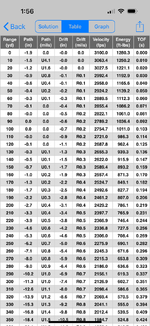
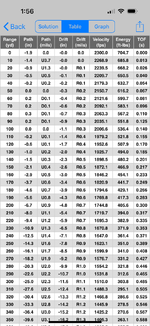
to illustrate this idea with 223 vs 22 hornet, I used shooter with a pre-built 60 grain bullet. Assuming the 223 is 3100 FPS and the hornet is 2300 FPS (as reported earlier with 60 TMK), the data is below. Basically the hornet at 0 yards is the 223 at ~250 yards. So if you beleive the 223 is good with that bullet out to 400 yards (the point where it reaches expansion velocity of 1800 FPS) then you also have to believe the hornet with the same bullet is good to ~175 yards, which is the point where it reaches 1800 FPS.

I hope that makes sense, it was quite a lightbulb moment for me when this finally clicked and I understood the concept of expansion velocity relative to various calibers with the same bore diameter.
 

Attachments

  • IMG_8972.png
    IMG_8972.png
    460.7 KB · Views: 13
  • IMG_8973.png
    IMG_8973.png
    460.1 KB · Views: 13
You entirely missed the point off my post. I did not state anyone needs a 300PRC (which they cannot shoot accurately) to kill a deer or elk.

My point was targeted at the various 22 caliber available to hunters.

With the exact same bullet:
- The 223 is objectively better than the 22 Hornet.
- The 22-250 and 22CM are objectively better than a 22 Hornet.

I have shot a 223 plenty of times. It barely kicks at all.
I have not shot the 22-250 or 22CM, but they are not known for their massive recoil.

If some cannot accurately shoot a rifle with any of those three cartridges because of recoil, they probably cannot shoot a 22 Hornet effectively either.


The reason I will use a 22 Hornet with good bullets is because the 223 with good bullets does too much tissue damage for food deer and antelope. I do not want to neuter the 223 by using a less than optimum bullet so that it damages less meat. I would rather go to a smaller cartridge and use a bullet that is optimized at those speeds.

A 60gr TMK above 1,800fps is going to create very good wounds and kill fine.
 
Form 5:56

“So do not fear the effects of the TMK, for I am with you; do not be dismayed, for I am your projectile. I will strengthen you and help you notch tags; no matter the cartridge, no matter the primer, I will perform with my righteous polymer tip and thin jacket. The steadfast penetration of the TMK never ceases; its mercies never come to an end above 1,800 fps.”
 
Back
Top