1911’s in general, 9mm versions specifically

@Formidilosus @RockAndSage

With all these new guns, would you guys be able to give a quick recommendation on tuning recoil spring weights for the 1911? Also thoughts on fixed vs variable spring rates?

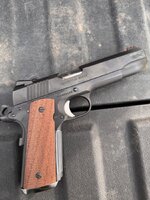
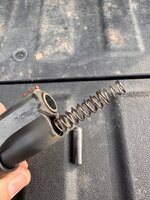
My new-to-me colt comes with 2 nested recoil springs (unknown round count, but assumed low). Wilson combat and oem colt extractors tuned without any hiccups. Standard PMC and Winchester 230 fmj is ejecting consistently but about 20-30ft. My impression is slide velocity is excessive, and I’m considering getting the Wolff spring kit.

Am I on the right track? Would you approach differently?

Can't remember the exact details of spring weights across the different chamberings and slide lengths, but you will generally get big benefits by trying to find a flat-wire recoil spring. Normal piano-wire recoil springs for 1911s in .45 get you about 3000 rounds before needing to be replaced, 5000 on the high side. Flat-wire ones seem to go at least 3x that, if not more.

This would be my first choice for a traditional spring setup: https://wilsoncombat.com/recoil-spring-kit-flat-wire-45-acp-full-size-17lb.html

Another option to consider is Sprinco's guide-rod system, which uses both the normal recoil spring and a heavy buffer-spring right at the very back of slide travel. The smack of the metal-on-metal with the slide whacking the frame is reduced quite a bit, but that energy also goes more into the buffer spring and is used to fling the slide forward again, rather than being wasted right into the frame and your hand. Longevity of the gun and the reliability of individual cycles increases. Only thing I'd ask in addition would be to have the recoil spring be a flat-wire one.

Regarding slide velocity and ejection patterns, it may be a bit on the excessive side, with 30' brass, but keep in mind a lot of what you hear about "tuning" 1911s with recoil springs is coming out of the competition world. A lot of those guys perceive things in recoil impulse that a normal shooter just wouldn't, and they're also tuning for very specific performance in very specific circumstances. They might want a heavier spring to soften up the recoil impulse, but that creates a narrower zone of reliability when the gun gets dirty and sluggish.

When a 1911 recoil spring starts wearing out, you get extended brass distances, but also failures to feed - the spring starts not having enough power to strip the next loaded round off the mag, and then overcome the various friction points involved in fully chambering it.

Excessively heavy recoil springs tend to have failures to eject, often with brass getting caught up in the ejection port, or the slide not going back far enough to catch the case head on the forward stroke, or fully chamber.

All this is being shared to say that, as long as your gun isn't having any failures to feed, it may have a bit larger zone of reliability than a narrowly tuned race gun. Go a little lighter and you might have failures to feed. Go a little heavier and it might soften up the recoil a bit, but go too far and you get different reliability problems.
 
Can't remember the exact details of spring weights across the different chamberings and slide lengths, but you will generally get big benefits by trying to find a flat-wire recoil spring. Normal piano-wire recoil springs for 1911s in .45 get you about 3000 rounds before needing to be replaced, 5000 on the high side. Flat-wire ones seem to go at least 3x that, if not more.

This would be my first choice for a traditional spring setup: https://wilsoncombat.com/recoil-spring-kit-flat-wire-45-acp-full-size-17lb.html

Another option to consider is Sprinco's guide-rod system, which uses both the normal recoil spring and a heavy buffer-spring right at the very back of slide travel. The smack of the metal-on-metal with the slide whacking the frame is reduced quite a bit, but that energy also goes more into the buffer spring and is used to fling the slide forward again, rather than being wasted right into the frame and your hand. Longevity of the gun and the reliability of individual cycles increases. Only thing I'd ask in addition would be to have the recoil spring be a flat-wire one.

Regarding slide velocity and ejection patterns, it may be a bit on the excessive side, with 30' brass, but keep in mind a lot of what you hear about "tuning" 1911s with recoil springs is coming out of the competition world. A lot of those guys perceive things in recoil impulse that a normal shooter just wouldn't, and they're also tuning for very specific performance in very specific circumstances. They might want a heavier spring to soften up the recoil impulse, but that creates a narrower zone of reliability when the gun gets dirty and sluggish.

When a 1911 recoil spring starts wearing out, you get extended brass distances, but also failures to feed - the spring starts not having enough power to strip the next loaded round off the mag, and then overcome the various friction points involved in fully chambering it.

Excessively heavy recoil springs tend to have failures to eject, often with brass getting caught up in the ejection port, or the slide not going back far enough to catch the case head on the forward stroke, or fully chamber.

All this is being shared to say that, as long as your gun isn't having any failures to feed, it may have a bit larger zone of reliability than a narrowly tuned race gun. Go a little lighter and you might have failures to feed. Go a little heavier and it might soften up the recoil a bit, but go too far and you get different reliability problems.
Thank you for taking the time to put all that down.

About once every 4-5 mags I will get a failure to go fully into battery, that then corrects when I bump the slide forward.
It definitely seems like a recoil spring replacement would be the fix.
 
@Formidilosus @RockAndSage

With all these new guns, would you guys be able to give a quick recommendation on tuning recoil spring weights for the 1911? Also thoughts on fixed vs variable spring rates?

My new-to-me colt comes with 2 nested recoil springs (unknown round count, but assumed low). Wilson combat and oem colt extractors tuned without any hiccups. Standard PMC and Winchester 230 fmj is ejecting consistently but about 20-30ft. My impression is slide velocity is excessive, and I’m considering getting the Wolff spring kit.

Am I on the right track? Would you approach differently?


45 auto? And what specific Colt?
 
Yep.
Colt “competition series”
45 Auto
View attachment 1013396

Here’s what I mean by “nested” recoil springs.
View attachment 1013397


Ok.


For all standard 5”, 45 auto 1911’s: Wolfe 18.5lb recoil spring, 23lb mainspring. That’s it. All the other stuff blah blah blah. That combo will prove over time with standard, full power 230gr 45 ammo to be the simplest, most reliable setup. A properly turned extracted, and Tripo Cobra mags, Wilson ETM, and Ed Brown mags- and you are on a good path.
I have done hellacious things with 1911’s to absurdly high round counts, and have consistently had the most reliable pistols everywhere I shoot- not just the most reliable 1911’s. Just do not have any issues with the above spring combinations.
 
Ok.


For all standard 5”, 45 auto 1911’s: Wolfe 18.5lb recoil spring, 23lb mainspring. That’s it. All the other stuff blah blah blah. That combo will prove over time with standard, full power 230gr 45 ammo to be the simplest, most reliable setup. A properly turned extracted, and Tripo Cobra mags, Wilson ETM, and Ed Brown mags- and you are on a good path.
I have done hellacious things with 1911’s to absurdly high round counts, and have consistently had the most reliable pistols everywhere I shoot- not just the most reliable 1911’s. Just do not have any issues with the above spring combinations.
Thank you sir
 
Ok.


For all standard 5”, 45 auto 1911’s: Wolfe 18.5lb recoil spring, 23lb mainspring. That’s it. All the other stuff blah blah blah. That combo will prove over time with standard, full power 230gr 45 ammo to be the simplest, most reliable setup. A properly turned extracted, and Tripo Cobra mags, Wilson ETM, and Ed Brown mags- and you are on a good path.
I have done hellacious things with 1911’s to absurdly high round counts, and have consistently had the most reliable pistols everywhere I shoot- not just the most reliable 1911’s. Just do not have any issues with the above spring combinations.

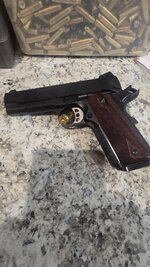
Any recommendations on a recoil/mainspring combo for a carry-comped 5"? Barrel is 4", overall slide comes to Gvn't length with the comp.
 
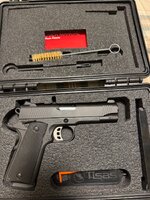
Picked up my P211 yesterday and mounted the red dot on it. I have absolutely zero idea how to evaluate the feel of a 2011 but the amount of slide wiggle is so small it's almost imperceptible. The trigger weight from the factory comes in at 3.5# as well so not horrible. It'll be a week or two until I can shoot it unfortunately. We have a snowstorm that will be shutting down the whole region for a few days and then I'm back to work.
 
Ok.


For all standard 5”, 45 auto 1911’s: Wolfe 18.5lb recoil spring, 23lb mainspring. That’s it. All the other stuff blah blah blah. That combo will prove over time with standard, full power 230gr 45 ammo to be the simplest, most reliable setup. A properly turned extracted, and Tripo Cobra mags, Wilson ETM, and Ed Brown mags- and you are on a good path.
I have done hellacious things with 1911’s to absurdly high round counts, and have consistently had the most reliable pistols everywhere I shoot- not just the most reliable 1911’s. Just do not have any issues with the above spring combinations.
Are there any 9mm 4.25” combos that you have found that work as well as the above?
 
Back
Top