1911’s in general, 9mm versions specifically

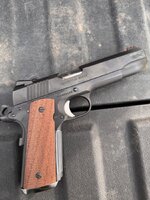
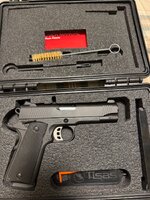
Just picked up this MAC 9 DS non-comp last week and got some parts in to create this abomination! I snagged it for $715 shipped.

Found a used Stac P grip, magwell, grip safety, mag release, mainspring housing, and trigger for $200(Springfield Prodigy grip, mag release and MSH for $50 would have been a better value) because the original texture was… well it wasn’t textured, I’ll put it that way. Also got this rmr07 used for $275. We’re wheelin and dealin baby!

Already broke it down, lightly sanded(mostly just got rid of high spots) and polished all the internals, as well as the frame rails. Slightly beveled and rounded the areas on the bottom of slide that were hanging on the disconnector, lubed it up and racked it a whole shit ton while watching TV. I suspect the extractor will need some tuning because it wouldn’t let go of a round no matter how much I shook the slide, and it feels pretty heavily sprung but gonna put 500 rounds through it before anything else. I can’t make it to the range until next week, but will report back with thoughts and findings.
Ordered the same gun this weekend for $770 shipped.

I'm a newb at 1911/2011 so any good videos or tutorials recommended for doing some at home tuning?
 
Ordered the same gun this weekend for $770 shipped.

I'm a newb at 1911/2011 so any good videos or tutorials recommended for doing some at home tuning?

Atlas Gunworks has some really good YouTube videos, and they're one of the more premium high-performance 2011 companies. A good middle-ground between gunsmith-level stuff, vs intro stuff. Just good, technical, how-to videos on things like triggers, tuning sear-springs, etc.
 
I'm a newb at 1911/2011 so any good videos or tutorials recommended for doing some at home tuning?
Best practice would be to throw some CLP on it, then go to the range and shoot at least 200 rounds first to check for any clear causes of malfunctions, or areas of improvement. Once you're home strip it down and look for anywhere the finish is wearing to see exactly what needs some more sanding/polishing. Gives you a good baseline idea anyways.

Here's a link to my personal compilations of 2011 tuning videos. It's a Youtube playlist mostly comprised of Engineer Armory, and Atlas Gun Works videos. The Engineer Armory channel goes into super deep-dive technical explanations, following TDP spec sheets and tolerances. He is an engineer by trade. His channel covers the why, and how. Atlas Gun works channel is more focused on the how. Their camera angles can kind of suck at showcasing what they're talking about sometimes.

I can't recommend the "Polishing firearm components for Beginners" video in that playlist enough. It's pretty lengthy but well worth it. The man even explains the science behind what friction is. I watched and followed along the entire video. The trigger, as well as disconnector hang up, felt significantly better afterwards. This video also helped a lot with the Turkish 2011 trademark disco hang-up. You can send in your MAC to those guys and they'll do everything for you for around $400 I think. But where's the fun in that?

Also I would call Springfield customer service and have them draft you up an invoice for a Prodigy grip, Mainspring Housing, and Mag Release for ~$50. If you tell them you're swapping the grip on a MAC 9 they should get you what you need. Dawson, and EGW make inexpensive magwells if you want. I'm going to the range this week and can report back with any insights and findings of how mine is after some light work.
 
FWIW/FYI - I went with the TT Gunleather Reinforced IWB (and belt). Tim responded the same day, twice, to my email questions. And the turnaround time is roughly 5 weeks compared to 50 for Milt Sparks. And it was less expensive.
 
FWIW/FYI - I went with the TY Gunleather Reinforced IWB (and belt). Tim responded the same day, twice, to my email questions. And the turnaround time is roughly 5 weeks compared to 50 for Milt Sparks. And it was less expensive.
Something to a nice leather belt... Depending on your build you may find that the buckle sticks way out w appendix carry, the Tenicor belt is worthy to try.
 
Something to a nice leather belt... Depending on your build you may find that the buckle sticks way out w appendix carry, the Tenicor belt is worthy to try.
Thanks. I carry my Milt Sparks at 3 and will probably carry the TT there or closer to 4/4:30, so no worries on the buckle.
 
Pretty much all colts that aren’t from the custom shop have the same issues. The base gun is good, they are usually decently reliable with an extractor tune, the fit is generally mediocre at best, and precision is often so-so.
Copy...thanks for the info.
 
IMG_1117.jpeg

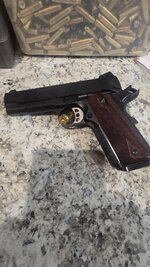
Just got back from the range, 500 rounds down the MACcatto. Almost right at 300 rounds the front fiber optic fell out. Nearing 400 it started to feel a little more sluggish, ejection was more erratic and I had a FTF. Re-lubed and marked the mag we’ll see if it comes back.

I shot it back to back with my m&p 2.0 carry comp and the difference in recoil impulse is impressive. Dot tracks much more straight up and down. I’m still working on improving my grip consistency. After drawing it starts to break down a little after 5 rounds when fired quickly unless I really focus on getting it locked in on the presentation. Slow is smooth. We’ll get there.
 
Picked
View attachment 1012765

Just got back from the range, 500 rounds down the MACcatto. Almost right at 300 rounds the front fiber optic fell out. Nearing 400 it started to feel a little more sluggish, ejection was more erratic and I had a FTF. Re-lubed and marked the mag we’ll see if it comes back.

I shot it back to back with my m&p 2.0 carry comp and the difference in recoil impulse is impressive. Dot tracks much more straight up and down. I’m still working on improving my grip consistency. After drawing it starts to break down a little after 5 rounds when fired quickly unless I really focus on getting it locked in on the presentation. Slow is smooth. We’ll get there.
Just picked up my Mac 9 from the LGS. Going to follow the advice to put 200 rnds through it and see how it goes. Trigger doesn't feel too heavy. Read some reviews that it can be over 6lbs... Hope I got a good one!
 
@Formidilosus @RockAndSage

With all these new guns, would you guys be able to give a quick recommendation on tuning recoil spring weights for the 1911? Also thoughts on fixed vs variable spring rates?

My new-to-me colt comes with 2 nested recoil springs (unknown round count, but assumed low). Wilson combat and oem colt extractors tuned without any hiccups. Standard PMC and Winchester 230 fmj is ejecting consistently but about 20-30ft. My impression is slide velocity is excessive, and I’m considering getting the Wolff spring kit.

Am I on the right track? Would you approach differently?
 
@Formidilosus @RockAndSage

With all these new guns, would you guys be able to give a quick recommendation on tuning recoil spring weights for the 1911? Also thoughts on fixed vs variable spring rates?

My new-to-me colt comes with 2 nested recoil springs (unknown round count, but assumed low). Wilson combat and oem colt extractors tuned without any hiccups. Standard PMC and Winchester 230 fmj is ejecting consistently but about 20-30ft. My impression is slide velocity is excessive, and I’m considering getting the Wolff spring kit.

Am I on the right track? Would you approach differently?

Can't remember the exact details of spring weights across the different chamberings and slide lengths, but you will generally get big benefits by trying to find a flat-wire recoil spring. Normal piano-wire recoil springs for 1911s in .45 get you about 3000 rounds before needing to be replaced, 5000 on the high side. Flat-wire ones seem to go at least 3x that, if not more.

This would be my first choice for a traditional spring setup: https://wilsoncombat.com/recoil-spring-kit-flat-wire-45-acp-full-size-17lb.html

Another option to consider is Sprinco's guide-rod system, which uses both the normal recoil spring and a heavy buffer-spring right at the very back of slide travel. The smack of the metal-on-metal with the slide whacking the frame is reduced quite a bit, but that energy also goes more into the buffer spring and is used to fling the slide forward again, rather than being wasted right into the frame and your hand. Longevity of the gun and the reliability of individual cycles increases. Only thing I'd ask in addition would be to have the recoil spring be a flat-wire one.

Regarding slide velocity and ejection patterns, it may be a bit on the excessive side, with 30' brass, but keep in mind a lot of what you hear about "tuning" 1911s with recoil springs is coming out of the competition world. A lot of those guys perceive things in recoil impulse that a normal shooter just wouldn't, and they're also tuning for very specific performance in very specific circumstances. They might want a heavier spring to soften up the recoil impulse, but that creates a narrower zone of reliability when the gun gets dirty and sluggish.

When a 1911 recoil spring starts wearing out, you get extended brass distances, but also failures to feed - the spring starts not having enough power to strip the next loaded round off the mag, and then overcome the various friction points involved in fully chambering it.

Excessively heavy recoil springs tend to have failures to eject, often with brass getting caught up in the ejection port, or the slide not going back far enough to catch the case head on the forward stroke, or fully chamber.

All this is being shared to say that, as long as your gun isn't having any failures to feed, it may have a bit larger zone of reliability than a narrowly tuned race gun. Go a little lighter and you might have failures to feed. Go a little heavier and it might soften up the recoil a bit, but go too far and you get different reliability problems.
 
Can't remember the exact details of spring weights across the different chamberings and slide lengths, but you will generally get big benefits by trying to find a flat-wire recoil spring. Normal piano-wire recoil springs for 1911s in .45 get you about 3000 rounds before needing to be replaced, 5000 on the high side. Flat-wire ones seem to go at least 3x that, if not more.

This would be my first choice for a traditional spring setup: https://wilsoncombat.com/recoil-spring-kit-flat-wire-45-acp-full-size-17lb.html

Another option to consider is Sprinco's guide-rod system, which uses both the normal recoil spring and a heavy buffer-spring right at the very back of slide travel. The smack of the metal-on-metal with the slide whacking the frame is reduced quite a bit, but that energy also goes more into the buffer spring and is used to fling the slide forward again, rather than being wasted right into the frame and your hand. Longevity of the gun and the reliability of individual cycles increases. Only thing I'd ask in addition would be to have the recoil spring be a flat-wire one.

Regarding slide velocity and ejection patterns, it may be a bit on the excessive side, with 30' brass, but keep in mind a lot of what you hear about "tuning" 1911s with recoil springs is coming out of the competition world. A lot of those guys perceive things in recoil impulse that a normal shooter just wouldn't, and they're also tuning for very specific performance in very specific circumstances. They might want a heavier spring to soften up the recoil impulse, but that creates a narrower zone of reliability when the gun gets dirty and sluggish.

When a 1911 recoil spring starts wearing out, you get extended brass distances, but also failures to feed - the spring starts not having enough power to strip the next loaded round off the mag, and then overcome the various friction points involved in fully chambering it.

Excessively heavy recoil springs tend to have failures to eject, often with brass getting caught up in the ejection port, or the slide not going back far enough to catch the case head on the forward stroke, or fully chamber.

All this is being shared to say that, as long as your gun isn't having any failures to feed, it may have a bit larger zone of reliability than a narrowly tuned race gun. Go a little lighter and you might have failures to feed. Go a little heavier and it might soften up the recoil a bit, but go too far and you get different reliability problems.
Thank you for taking the time to put all that down.

About once every 4-5 mags I will get a failure to go fully into battery, that then corrects when I bump the slide forward.
It definitely seems like a recoil spring replacement would be the fix.
 
@Formidilosus @RockAndSage

With all these new guns, would you guys be able to give a quick recommendation on tuning recoil spring weights for the 1911? Also thoughts on fixed vs variable spring rates?

My new-to-me colt comes with 2 nested recoil springs (unknown round count, but assumed low). Wilson combat and oem colt extractors tuned without any hiccups. Standard PMC and Winchester 230 fmj is ejecting consistently but about 20-30ft. My impression is slide velocity is excessive, and I’m considering getting the Wolff spring kit.

Am I on the right track? Would you approach differently?


45 auto? And what specific Colt?
 
Yep.
Colt “competition series”
45 Auto
View attachment 1013396

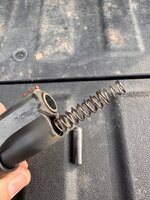
Here’s what I mean by “nested” recoil springs.
View attachment 1013397


Ok.


For all standard 5”, 45 auto 1911’s: Wolfe 18.5lb recoil spring, 23lb mainspring. That’s it. All the other stuff blah blah blah. That combo will prove over time with standard, full power 230gr 45 ammo to be the simplest, most reliable setup. A properly turned extracted, and Tripo Cobra mags, Wilson ETM, and Ed Brown mags- and you are on a good path.
I have done hellacious things with 1911’s to absurdly high round counts, and have consistently had the most reliable pistols everywhere I shoot- not just the most reliable 1911’s. Just do not have any issues with the above spring combinations.
 
Ok.


For all standard 5”, 45 auto 1911’s: Wolfe 18.5lb recoil spring, 23lb mainspring. That’s it. All the other stuff blah blah blah. That combo will prove over time with standard, full power 230gr 45 ammo to be the simplest, most reliable setup. A properly turned extracted, and Tripo Cobra mags, Wilson ETM, and Ed Brown mags- and you are on a good path.
I have done hellacious things with 1911’s to absurdly high round counts, and have consistently had the most reliable pistols everywhere I shoot- not just the most reliable 1911’s. Just do not have any issues with the above spring combinations.
Thank you sir
 
Back
Top