1911’s in general, 9mm versions specifically

Oooh ... another contender for a Rokslide t-shirt quote.

But I bet @Ryan Avery wouldn't do it ... perhaps we need to start in epic Rokslide quotes thread ...

Who's keen and has time - and wants the kudos for starting it? Paging @fwafwow - your 15 minutes of fame have arrived. I'm off to cook some wagyu ...
I’m out of time and probably would miss the epic contenders. And I need to focus/obsess on accessories. And post follow-up dumb threads about same. Top of mind, all subject lines starting with “Staccato owners”:
  1. What’s your preferred leather IWB (and how is TT Leather compared to Milt Sparks)!
  2. What are your favorite loads?
  3. Show us your Staccato swag in the field
  4. Triggers - how short is short enough?
  5. Epoxy - where, how much, and what color?
  6. Tape or not on your grip?
 
What are your favorite loads?

For practice, it's a volume game, so the cheapest I can find. Miwall and Ammunition Depot's Sportsman's Select come in about as cheap as possible, usually around 19 cents a round. If anyone has cheaper, I'd love to know. Shipping and taxes add up too. For defensive loads, Federal HST in 147 or 124.

Triggers - how short is short enough?

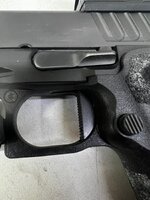
Hard to get too short, unless someone has abnormally long fingers and not a lot of meat to their hand. I went with a Red Dirt F1, their shortest. Got both the flat and the curved, currently trying the flat. Interestingly, it has just a slight bit of a backward angle to it that wasn't perceived in the photos, that I'm liking.

Tape or not on your grip?

Not on the Staccato C. It's got absolutely exceptional stippling, that was a very pleasant surprise. I am, however, in the middle of epoxying a patch of silicon carbide to the front-strap of my DWX Compact. Can't really see much need on the Staccato, at least not at a few thousand rounds.
 
Hard to get too short, unless someone has abnormally long fingers and not a lot of meat to their hand. I went with a Red Dirt F1, their shortest. Got both the flat and the curved, currently trying the flat. Interestingly, it has just a slight bit of a backward angle to it that wasn't perceived in the photos, that I'm liking.

Here's the Red Dirt trigger:

RD Trigger - Copy.jpeg
 
Oooh ... another contender for a Rokslide t-shirt quote.

But I bet @Ryan Avery wouldn't do it ... perhaps we need to start in epic Rokslide quotes thread ...

Who's keen and has time - and wants the kudos for starting it? Paging @fwafwow - your 15 minutes of fame have arrived. I'm off to cook some wagyu ...

“It only feels funny because you’ve been doing it wrong your whole life.”
 
Anyone have intel on the Remington r1 80 series? Good bad or ugly. Anything worth doing to it?
 
Would be interested to hear your pros and cons vs flat surfaces ...

Part personal opinion, part conjecture, part experience: it's 95% irrelevant/personal preference/aesthetics, and the 5% that can make a difference, won't be picked up by 99% of shooters. Length is, by far, what matters.

That said, this flat checkered face, with no curve or radius on the contact surface, does allow just a bit of perception advantage in making sure you're pressing straight-back. But you have to be paying attention to it to notice. The pointy bits and the 90-degree edge of the face make it more clear if you're not pressing evenly - it's more noticeable if one side of the pad of your finger is experiencing more pressure than the other.

It's a marginal thing, but a little useful if you want it to be, especially when learning a new gun or in really spending some time focusing on your trigger press, but should be background after a certain point.
 
Did you have to do any “fitting”?

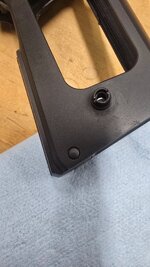
I did, but very little. The overall height of the bow was just a touch higher than the raceways for it cut into the grip, so it wasn't freely moving, and required an ounce or two of pressure to move. If you hold the frame nose-down, with just the trigger inserted, it should easily fall forward on its own weight after you press it back and let go. If a 1911/2011 trigger is physically too heavy, or there's too much friction in its movement, or the sear-spring returning the trigger is too light, you can get hammer-follow after a shot. So, it seemed necessary to fit it, even if the pressure needed to move it was so light.

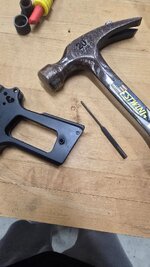
This was a super easy fitting - just took the height of the tabs on top of the bow down a little with a cratex bit. I didn't want there to be any vertical slop, so it took a few light passes on each side and checking each time, but overall it took less than 5 minutes to get that part of the fitting done. Maybe another 30 minutes to get the takeup and overtravel adjusted, given the need to reassemble and disassemble several times.

The quality of the trigger is excellent, btw - the metal in the bow is substantial, looks like machined steel rather than a stamping, and is fairly smooth, despite some visible machining marks. Various chamfering cuts on it as well, along with two set-screws on the front instead of just one. A lot of thought and quality went into these triggers - probably the nicest I've seen, though I don't have a large sample-size of ones being made the last few years.

Photos of the tabs on top of the bow that were polished down a bit:

Trigger Tabs - Copy.jpeg
 
All my triggers are medium length, sell me on short.

Long and medium "feel" better to me personally, in the feelsies category of handling a gun, but the longer a trigger is, the more you generally start seeing people send their shots left and low-left, especially when shooting at speed (for a right-handed shooter, they go right for a lefty).

My take on it, is that it's mostly an issue of geometry, between how the trigger-finger is oriented with the trigger - ideal orientation is 90-degrees at break. Slightly longer triggers have the pad of the finger pressing a bit more on the shooter's strong-side of the trigger, and a bit less on the weak-side - leading to a press that's not actually straight back to the nose. It's something that can be controlled for a bit in concentrated slow-fire, but when you speed things up and go fast, it tends to show up more.

I also suspect a short trigger makes things a bit more forgiving with your strong-hand grip when your trigger-finger isn't perfectly isolated from the rest of the muscles in your hand.

Overall though, shorter triggers tend to tighten groups up better, especially at speed. Best thing is to experiment and give it a hard go for a couple of cases of ammo.
 
Back
Top