Wyoming recovery

I heard the South West had almost no snow at Christmas. Does it affect Antelope that much? Or can they always find a drink somewhere? Fires will be an issue I suspect unless spring is wet. Sitting on 17 points, waiting for the perfect year lol.

No moisture, no feed.
 
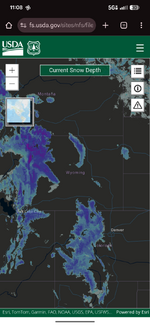
Screenshot_20260130-110847.png

There is essentially no snow off the mountains so far this winter. I'm sitting on ten points that I kind of want to use this year.
 
I just pulled my marten trap line this last Wednesday. Last year I would say they're was about 4' at 9,500' there might be a foot there right now. Even where there is moisture, is minimal.
 
I just pulled my marten trap line this last Wednesday. Last year I would say they're was about 4' at 9,500' there might be a foot there right now. Even where there is moisture, is minimal.
Can't be, I'm at 17 points! lol The North East seems to be doing ok, Sheridan and Gillette. But thats tough access on private land.
 
I heard the South West had almost no snow at Christmas. Does it affect Antelope that much? Or can they always find a drink somewhere? Fires will be an issue I suspect unless spring is wet. Sitting on 17 points, waiting for the perfect year lol.
Have you hunted antelope alot or just waiting for a 1 and done deal?
 
They could always recover, but it would take several years of favorable weather to do so. This winter is looking good for them, now we just need 3-4 more. I really wish they would just get rid of doe tags

They should definitely get rid of the doe tags if the population is down as much as the chart above shows.

Id love to be able to hunt antelope in Wyoming every 3 years as a nonresident, but right now it is looking more like once every 8 years.
 
We need a lot of spring rains and sum snow wouldn't hurt any. Antelope numbers in central Wyoming are still down and it will take a quite a few years if ever before they come back fully...
 
Unit I hunted last year had a lot of antelope in it in central Wyoming, can’t image what it was like 5 years ago. Drove through northwestern Colorado to/from the hunt and was shocked to see so few antelope.
 
I live in SE WY and we haven’t had hardly any snow this winter. It’s unseasonably warm. Everything is seriously dry. On Sunday we were warmer than Miami. It’s good the critters are having a mild winter but no moisture for vegetation is not good. Hopefully we’ll have a wet spring. Also just saw on the news they have spotted Yellowstone Grizzlies wandering around.

Did have a friend kill an 79” goat last year.
 
There are places like near Laramie where there are tons, they escaped the wrath of winter and disease. The. From there west, uff, wasteland.
I'm not sure I would say there are tons but the Laramie population is doing ok. They have experienced something else killing antelope over the last 10 years. Low fawn recruitment has hurt but there is a huntable population if guys can find the private permission. The HMAs are a $h!t show imo. But a guy can kill an antelope I guess...

If I was dead set on burning points for a tag this year, I would wait and watch the weather and make a decision in May. I still think we are 3-4 mild winters away from decent huntable populations through the middle of the state.
 
Laramie area is doing ok for antelope, watched several really nice bucks last year and this years are coming along nicely now.
Folks could get a nice buck without much effort if they tried.

On another note, talked with our local biologist, mule deer have a positive outlook. Good fawn recruitment and mature doe survival . Best outlook in the state he said. Our numbers are really above others in the region.
 
Laramie area is doing ok for antelope, watched several really nice bucks last year and this years are coming along nicely now.
Folks could get a nice buck without much effort if they tried.

On another note, talked with our local biologist, mule deer have a positive outlook. Good fawn recruitment and mature doe survival . Best outlook in the state he said. Our numbers are really above others in the region.

As mentioned previously, antelope in that area are doing well. The problem for me is that area is about as boring/ugly as it gets, and huge private land holdings. The points needed is not worth the trade off in my opinion for several reasons on top of the two already mentioned.
 
Moisture definitely helps but browse conditions across Wyo is in pretty horrible shape. Take a drive from Douglas north to Gillette and that entire region in Wyoming is inundated with dense cheatgrass that competes directly with native forb and shrub browse. The below study by University of Wyoming demonstrates the negative impact of cheatgrass to muledeer. My guess is that cheatgrass's negatively impacts antelope just as much or more than muledeer since antelope's diet is so highly dependent upon many of the same forb and shrub browse species!


When thin shoots of cheatgrass are the first plants to green up in the spring, mule deer might nibble the tops like any of us might idly crunch last week’s pretzels still sitting on our office desks.

Come early summer, though, that same cheatgrass turns into brown, leggy strands. At that point, mule deer want to eat it as much as we want to consume the cardboard box containing those stale pretzels. They just won’t do it.

In fact, they dislike cheatgrass so much that mule deer will avoid an area completely once it contains about 20% of the annual invasive grass, according to a study published in early September in the journal Rangeland Ecology and Management.

The study’s authors, all from the University of Wyoming, compared movement patterns from 115 GPS-collared mule deer with range maps showing variation in plant cover. They found that when cheatgrass covers less than 10% of an area, deer will still browse. When it covers 10-16%, they will begin to avoid an area. Anything above 20% is utterly unappealing.
1771164187819.png

Even more alarmingly, the study shows that as cheatgrass continues to spread in northeast Wyoming over the next couple decades, up to 50% of current good habitat could be rendered useless to mule deer.

The spread of cheatgrass likely won’t be the final nail in mule deer’s coffin, but it will be one of many contributing to their continued decline. Unlike many studies that focus exclusively on declines, however, this one carries a rather large kernel of hope. When treating cheatgrass with herbicides in a targeted and strategic way, land managers can start to win the fight and mule deer will also return.

 
Here is another interesting article about pronghorn diets. I've included some of points below on why pronghorn diets are so highly dependent on high nutrition browse and what impacts drought has on pronghorn.


Ultimately, body size is the most important factor in determining intake rate and diet quality in ruminant herbivores. As the smallest North American ruminant, pronghorns are concentrate selectors. The amount of air-dried forage needed to maintain an adult pronghorn averages just 2.5–3.0 lbs. per day, but their relatively small body size poses limitations for ingestion. The pronghorn’s relatively small rumen means they must choose wisely when ingesting forage and make food choices based heavily on nutritional quality to meet metabolic demands. The diet of pronghorns varies in two ways: botanically in the proportion of grasses, forbs and browse, and in digestibility. Because digestive space for small-bodied ruminants is at a premium, the most selective feeders tend to have the most botanically diverse diets and tend to avoid excessively fibrous vegetation.

When wet periods end, forbs lose moisture and senesce, thus greatly reducing their nutritional quality and availability across the rangeland. Dry periods result in resource limitation for the foraging pronghorn, who then must rely on woody shrubs, cacti, and grass that provide a large pool of relatively low-quality browse and high-energy mast. In the absence of forbs, woody shrubs and grass become a staple of pronghorn diets. This “forage switching” allows pronghorns to optimize their forage choices seasonally and ingest the most nutritious species from what is available; however, when pronghorns forage indiscriminately because high-quality forage is either not available or not accessible, then the potential to meet dietary requirements declines.

From a management perspective, small-bodied ruminants, such as pronghorns, are more vulnerable to environmental variation because they require higher quality forages compared to larger ruminants such as cattle or bison that can subsist on low-quality, high-fiber forage. Given the pronghorn’s forage requirements, population growth is sensitive to precipitation. For example, fawn survival is commonly related to short-term declines in precipitation, whereas declines in population abundance are more related to extended drought periods. Environmental variability pushes pronghorns to continually search for high-quality forage. In semi-arid regions such as the Trans-Pecos, they will travel across the rangeland following recent rainfall and the promise of forbs.
 
Laramie area is doing ok for antelope, watched several really nice bucks last year and this years are coming along nicely now.
Folks could get a nice buck without much effort if they tried.

On another note, talked with our local biologist, mule deer have a positive outlook. Good fawn recruitment and mature doe survival . Best outlook in the state he said. Our numbers are really above others in the region.
You think you are contributing and being nice by posting this but in reality you just bombed the draw odds for the guys who do enjoy hunting the area. Seriously.... Glad I don't hunt the valley anymore.

At least you should post the truth.
90% of those nice bucks live on private land. Without HMA access, most hunters will struggle to find a 70" buck. Those that do get HMA access will have a ton of company unless they hunt later after the bucks have been picked over. It isn't a great hunt for the 6 or 7 points it will now take.
 
I wasn't talking about the Laramie Valley actually, other areas in this part of the state.
No need to discourage folks when it's not needed.
There is access where I'm talking about, no lies here bud.
Folks just have to put in the time to find a mature buck.


You're putting out doom and gloom when it's not needed.
 
Back
Top