- Joined
- Jul 18, 2023
- Messages
- 1,614
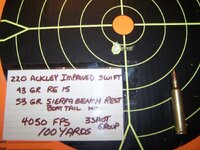
50 caliber. By golly I didn’t think if that1/2" MIL one shot groups cold bore first round pop? ALL of them!
Jay


Well, heck My 223 shoots half that!!

Follow along with the video below to see how to install our site as a web app on your home screen.
Note: This feature may not be available in some browsers.
50 caliber. By golly I didn’t think if that1/2" MIL one shot groups cold bore first round pop? ALL of them!
Jay

I don't remember when it has taken more than 1 shot to kill any of the antelope, deer or elk that I hunt, yep first pop. 1/2" MOA is my 3 shot groups all are within 1/2" of one another at 100 yards, 1" of each other at 200 yds and so on. My Dad taught me to shoot and not waste ammunition. Wait till you have your shot and take it.1/2" MIL one shot groups cold bore first round pop? ALL of them!
Jay

Movement starts slightly after the bullet starts moving. Before it leaves the barrel. We have the force acting on the bullet which can be calculated by the area of the bore x the pressure. The rifle experiences an equal force going the other way. The rifle weighs a lot more so the acceleration of the rifle is slow while the bullet is fast since it’s light. F=MA.I am trying to figure out if this is true. I would think that recoil only begins to occur after the bullet has left the barrel. if the bullet has left the barrel, how can gun movement effect where the bullet will hit?
I don't remember when it has taken more than 1 shot to kill any of the antelope, deer or elk that I hunt, yep first pop. 1/2" MOA is my 3 shot groups all are within 1/2" of one another at 100 yards, 1" of each other at 200 yds and so on. My Dad taught me to shoot and not waste ammunition. Wait till you have your shot and take it.
I only shoot 2 rifles on big game.....a 25-06 and a .300 Wby.


Every action has an equal and opposite reaction—the bullet has to push against something to begin moving—thats the gun. It starts pushing as it starts moving. It STOPS pushing +\- as it leaves the barrel.
Dont believe me, believe your own eyes. Here’s a fb link to applied ballistics high speed video showing a rifle barrel moving before bullet exits barrel.
That's the money right there. I am now starting to remember why i got a C in dynamics.Movement starts slightly after the bullet starts moving. Before it leaves the barrel. We have the force acting on the bullet which can be calculated by the area of the bore x the pressure. The rifle experiences an equal force going the other way. The rifle weighs a lot more so the acceleration of the rifle is slow while the bullet is fast since it’s light. F=MA.
My previous post was sarcasm and Terry got it. The issue with your quoted statement is that it is factually incorrect and an improper use of labels. You can have 1/2" groups or you can have 1/2 MOA groups but you are defining something with multiple units of measurement with one being your linear dispersion and one being your angular dispersion. One simply can not have one half of an inch of a minute of angle. Choose one and carry on with your excellent 3 shot groups.1/2" MOA
Cool story. There is no such thing as 1/2" MOA. Your continued reliance on "higher authority" doesn't change that fact regardless of your age or education. If you want to claim 1/2 MOA groups, stop adding the inch symbol as it infers both linear and angular measurements that can not be combined. Nothing more, nothing less.I was taught by target shooters and when I was in the Army over 60 years ago (probably before you were born) that minute of angle applies to all distances as a unit of measurement.

Cool story. There is no such thing as 1/2" MOA. Your continued reliance on "higher authority" doesn't change that fact regardless of your age or education. If you want to claim 1/2 MOA groups, stop adding the inch symbol as it infers both linear and angular measurements that can not be combined. Nothing more, nothing less.
Jay
What’s your rifle’s cone of fire?

That’s a rhetorical question right?Do you guys ever get tired of arguing about the same thing nonstop?

What's that in MRAD? You obviously don't understand what you are saying or why it is wrong. That's okay.Last comment for me......
Google "Minute of Angle in target shooting"
Rest my case!
I accept the fact you don't know what you're talking about!Just because you haven't shot a rifle that's 1/2" mil all day, doesn't mean people don't have them.What's that in MRAD? You obviously don't understand what you are saying or why it is wrong. That's okay.
Jay

I was taught by target shooters and when I was in the Army over 60 years ago (probably before you were born) that minute of angle applies to all distances as a unit of measurement.

seems reasonable, but can you explain how this derived? I'm guessing this is just trig where the base of the right triangle is 24" and the vertical component is 0.007" and the calculated angle is extended out to impact distance?I get what you're saying but the "vast majority" of movement isn't ALL of the movement and it's that movement that happens while the bullet is still in the barrel that's degrading accuracy.
To put it in perspective, with a 24" barrrel, the muzzle only has to move 0.007" to make a 1" change in impact at 100 yards. So that little extra torque as the bullet engages the rifling, that little anticipation of recoil, all those little things add up to make it increasingly difficult to hold the same level of accuracy as the amount of recoil goes up.
With hight a @ 0.007" and base b @ 24 inches, angle a is 0.0167⁰. With angle a @ 0.0167⁰ and base b @ 100 yards, hight a is 0.029147 yards. To convert yards to inches you multiply by 36 to get your hight a in inches. Hight a becomes 1.049292" at 100 yards with a barrel shift of 0.007" shifted from point of aim.seems reasonable, but can you explain how this derived? I'm guessing this is just trig where the base of the right triangle is 24" and the vertical component is 0.007" and the calculated angle is extended out to impact distance?





