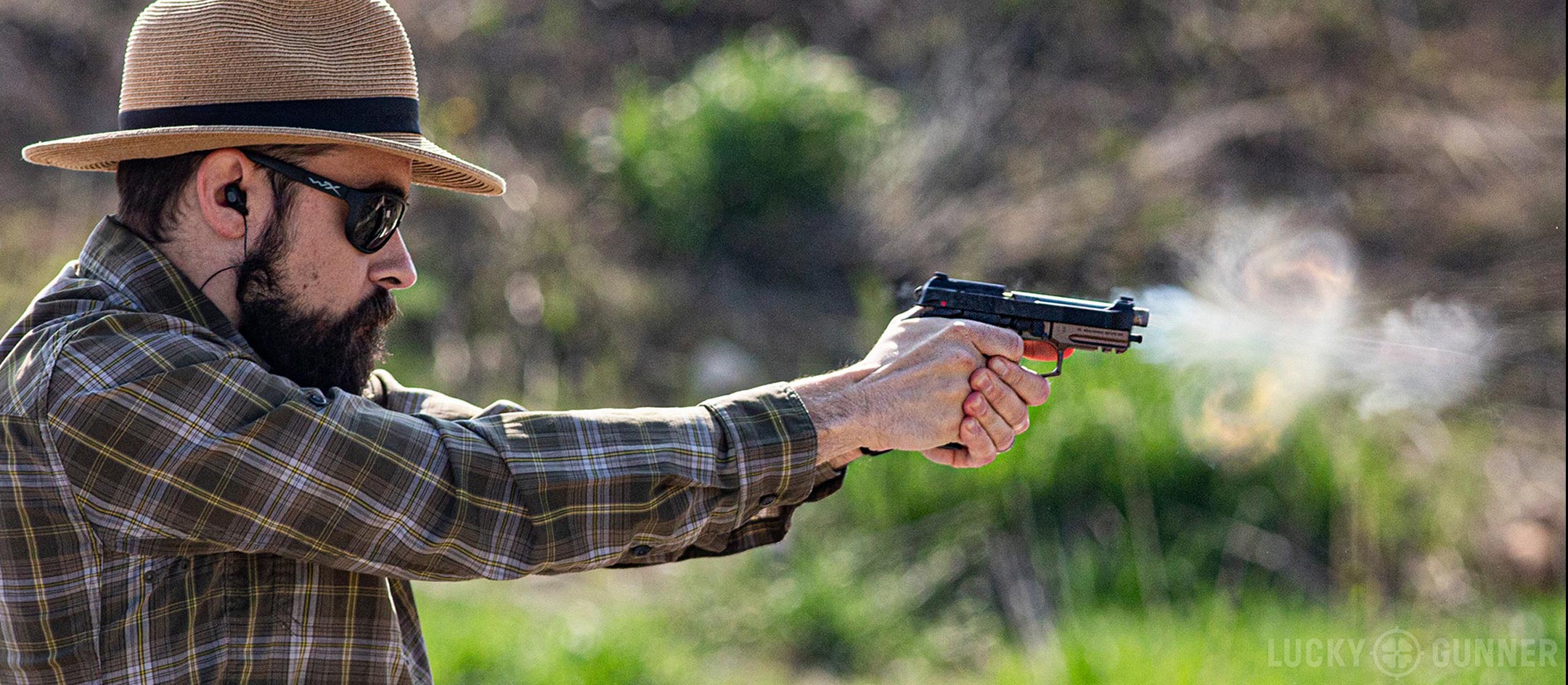
Why does magnum movement matter for rifle accuracy?

Haha I don’t own a computer , all my responses are on my phone and sometimes it tries to say what it thinks I’m thinking.

Apples to apples, no. I have 22 lever guns and 3030 lever guns and shoot both as accurately off hand as can be. Def slower firing rate w 3030.

I also have a 308 lever gun and as long as instead the shot my shots aren’t less accurate.

I have 22 bolt guns and 270, 300 bolt guns, and id be willing to bet my 22 and 300 first shots are gonna be as accurate. Follow ups will take more time w 300.

But I enjoy recoil, pain generally. Haha. You should see what I do for a living.

I will secede the fact that science is real, you can’t control large calibers as easily as yiy can lower recoil rounds, but shooting fundamentals don’t necessarily change much. First round hit should be sane w a 22 or 300 from a bench 1000% n off hand too if the weight of the larger rifle is able to be controlled
 
Shooting prone off an old Harris bipod with a backpack as a rear bag, I shoot my 25-284, 6.5 WSM, and 7-08 equally well. I use heavy for caliber bullets and near max charges for all of them. I also shoot all of them suppressed which makes a dramatic difference IMO. I also have the Tikka OEM triggers set as light as possible (jammed against the trigger group screw).

Fundamentally, I always make sure I'm as straight as possible behind the gun, my right hand is solid underneath the stock supporting the bag (lefty), and I deliberately control breathing. I mount my left hand with my thumb on the side of the stock pointing at the target, and I use the pad of my index finger to squeeze the trigger after taking a deep breath and letting half out. This is how Dad taught all us boys to shoot, and its more or less how he was taught in the army.

My best groups come when I'm steady on target, squeezing the trigger, and the rifle fires after the last bit of breath is gone.

I may notice more recoil from the 6.5 after shooting for a while, but in the heat of the moment, each shot feels the same. That being said, I consistently shoot 1" or better 10 shot groups at 100 yards with all 3 of these rifles.

The rifle I never enjoyed shooting as a young person was my Dad's 30-06 with 180 and especially 220 grain bullets. That thing kicked like a mule, akin to a 12 gauge slug.
 
How do they compare from positions other than prone? When this gets thrown around on here its always in relation to “field positions”, with prone being the position showing the least influence from recoil. When I did it I also am not sure I could see a difference prone other than time, but am pretty sure I could see a difference seated, offhand, kneeling, etc.
 
How do they compare from positions other than prone? When this gets thrown around on here its always in relation to “field positions”, with prone being the position showing the least influence from recoil. When I did it I also am not sure I could see a difference prone other than time, but am pretty sure I could see a difference seated, offhand, kneeling, etc.
I notice the difference seated on the bench. Kneeling and offhand not so much. It could be I'm just not shooting seated correctly, but its the least comfortable for me personally.
 
How do they compare from positions other than prone? When this gets thrown around on here its always in relation to “field positions”, with prone being the position showing the least influence from recoil. When I did it I also am not sure I could see a difference prone other than time, but am pretty sure I could see a difference seated, offhand, kneeling, etc.
I would say the first shot is the same and after recoil is controlled and energy stopped, the second shot would be the same if I took that much time w a small caliber. Foundation and fundamentals.
 
The "after recoil is controlled" makes me think think we're using different yardsticks as we talk about this.

The main issue I see is that achieving the same recoil management from various unfamiliar positions while under a time constraint is precisely the problem folks are talking about here. My assumption is that "field conditions" typically make this much more difficult becasue for most of us it breeds exactly the small errors in form that result in uneven recoil-management. So while having really good fundamentals and utilizing excellent NPOA can help make the recoil effects relatively repeatable, doing so "under duress" (ie "field conditions"=uneven, unfamiliar terrain, hasty improvised rest, time constraint, etc) is much more difficult, and also makes keeping eyes on the target and making a fast follow-up shot that much harder. If your hunting doesnt include those things, OK--lots of people do run into those things frequently.

That's where I have seen noticeable degradation, ie the circle drill is a positional drill using 4 positions on a set of pre-defined targets that incorparates a time constraint and a second shot while on the clock. To me it represents a great self-evaluation--its sort of a "kraft drill" for hunting that can be used to gauge your own progress across various positions.

I would be genuinely curious if many of the folks saying they dont see any degradation of accuracy with higher recoil have tried comparing a low and high-recoiling gun including both a variety of positions, and in combination with a time limit and a follow up shot. I'm pretty confidant that most people will have a hard time equaling their little-gun score with a big magnum in a drill like this, as at a minimum the higher recoiling gun will be much less forgiving of small errors (I think we can agree on that?).
 
The "after recoil is controlled" makes me think think we're using different yardsticks as we talk about this.

The main issue I see is that achieving the same recoil management from various unfamiliar positions while under a time constraint is precisely the problem folks are talking about here. My assumption is that "field conditions" typically make this much more difficult becasue for most of us it breeds exactly the small errors in form that result in uneven recoil-management. So while having really good fundamentals and utilizing excellent NPOA can help make the recoil effects relatively repeatable, doing so "under duress" (ie "field conditions"=uneven, unfamiliar terrain, hasty improvised rest, time constraint, etc) is much more difficult, and also makes keeping eyes on the target and making a fast follow-up shot that much harder. If your hunting doesnt include those things, OK--lots of people do run into those things frequently.

That's where I have seen noticeable degradation, ie the circle drill is a positional drill using 4 positions on a set of pre-defined targets that incorparates a time constraint and a second shot while on the clock. To me it represents a great self-evaluation--its sort of a "kraft drill" for hunting that can be used to gauge your own progress across various positions.

I would be genuinely curious if many of the folks saying they dont see any degradation of accuracy with higher recoil have tried comparing a low and high-recoiling gun including both a variety of positions, and in combination with a time limit and a follow up shot. I'm pretty confidant that most people will have a hard time equaling their little-gun score with a big magnum in a drill like this, as at a minimum the higher recoiling gun will be much less forgiving of small errors (I think we can agree on that?).
100% this.

We should have an annual circle drill challenge similar to the cold bore challenge.
 
Your opening words "Magnum rifles are less accurate" are not accurate! My magnum rifles are not less accurate, but sometimes I am. If I am tired, breathing hard or not have a good rest, I will be inaccurate with any of my rifles.

ALL of my hunting and target rifles shoot less than 1/2 inch MOA given the conditions are right. If they don't, I will makes changes so they will or they become a safe queen or they are gone. I have lots plinkers and fun to shoot guns that are not used for hunting or target shooting that I shoot that don't shoot like my hunting or target shooters.
 
Your opening words "Magnum rifles are less accurate" are not accurate! My magnum rifles are not less accurate, but sometimes I am. If I am tired, breathing hard or not have a good rest, I will be inaccurate with any of my rifles.

ALL of my hunting and target rifles shoot less than 1/2 inch MOA given the conditions are right. If they don't, I will makes changes so they will or they become a safe queen or they are gone. I have lots plinkers and fun to shoot guns that are not used for hunting or target shooting that I shoot that don't shoot like my hunting or target shooters.
Bigger cartridges move the gun more. The spirit of my initial question is getting lost. Assuming an alien species that doesn't anticipate recoil and can shoot any position equally well, outside of shootability concerns, "why do magnums move more, if it is reasonable to assume that any rifle movement, predominantly from recoil, is a non-factor after the bullet has exited the barrel?" It was said earlier in the thread, I think the answer is more powder and larger bullets moving in the internals of the weapon, even prior to the bullet and gasses exiting and thus recoil.
 
The "after recoil is controlled" makes me think think we're using different yardsticks as we talk about this.

The main issue I see is that achieving the same recoil management from various unfamiliar positions while under a time constraint is precisely the problem folks are talking about here. My assumption is that "field conditions" typically make this much more difficult becasue for most of us it breeds exactly the small errors in form that result in uneven recoil-management. So while having really good fundamentals and utilizing excellent NPOA can help make the recoil effects relatively repeatable, doing so "under duress" (ie "field conditions"=uneven, unfamiliar terrain, hasty improvised rest, time constraint, etc) is much more difficult, and also makes keeping eyes on the target and making a fast follow-up shot that much harder. If your hunting doesnt include those things, OK--lots of people do run into those things frequently.

That's where I have seen noticeable degradation, ie the circle drill is a positional drill using 4 positions on a set of pre-defined targets that incorparates a time constraint and a second shot while on the clock. To me it represents a great self-evaluation--its sort of a "kraft drill" for hunting that can be used to gauge your own progress across various positions.

I would be genuinely curious if many of the folks saying they dont see any degradation of accuracy with higher recoil have tried comparing a low and high-recoiling gun including both a variety of positions, and in combination with a time limit and a follow up shot. I'm pretty confidant that most people will have a hard time equaling their little-gun score with a big magnum in a drill like this, as at a minimum the higher recoiling gun will be much less forgiving of small errors (I think we can agree on that?).
Yea man I can’t disagree w what you’re saying. When I say I can shoot my 6lb 300 as accurately as I can shoot my m4 or my 22 for delta reasonings, I’m telling you I’m capable of it.

I’m also telling you the first round, in any position , rather any normal shooting position will be pretty damn close. My issue would be time back on target.

I’d say for the last 20 years, 90% of my training has been under self imposed duress and timed. Not to include hunting or fun plinking.
 
Bigger cartridges move the gun more. The spirit of my initial question is getting lost. Assuming an alien species that doesn't anticipate recoil and can shoot any position equally well, outside of shootability concerns, "why do magnums move more, if it is reasonable to assume that any rifle movement, predominantly from recoil, is a non-factor after the bullet has exited the barrel?" It was said earlier in the thread, I think the answer is more powder and larger bullets moving in the internals of the weapon, even prior to the bullet and gasses exiting and thus recoil.
If Im understanding what you are saying I dont think thats correct. Recoil—ie gun movement—happens from the moment the bullet leaves the brass and is still in the barrel. Dwell time? It doesnt have to be most of the movement, it simply has to be some
movement. Bigger recoil= more movement while the gun is still affecting where the bullet will hit.
If you can MANAGE that movement CONSISTENTLY then it can be accurate. The issue is that the more variables are added to a situation, the more likely small errors in form are to happen, which equates to inconsistency in recoil management. The more movement, the more this matters.
If someone like @K9kodi can consistently manage that, my hat’s off to them. I do not think that is a skill that very many people can claim.
 
  • Like
Reactions: RME
Bigger recoil= more movement while the gun is still affecting where the bullet will hit
I am trying to figure out if this is true. I would think that recoil only begins to occur after the bullet has left the barrel. if the bullet has left the barrel, how can gun movement effect where the bullet will hit?
 
I am trying to figure out if this is true. I would think that recoil only begins to occur after the bullet has left the barrel. if the bullet has left the barrel, how can gun movement effect where the bullet will hit?
How can recoil occur if the bullet has left the barrel? It no longer shares a physical relationship with the barrel.

Powder plays a role, to be sure, but not the only role.
 
… I would think that recoil only begins to occur after the bullet has left the barrel.
This is not correct. Recoil bigins before the bullet leaves the barrel. Some quick googling will show lots of resources showing this to be false. A quick example here with some
high speed video and stills from the video. scroll to the revolver section:


Back
Top