
Navigation
Install the app
How to install the app on iOS
Follow along with the video below to see how to install our site as a web app on your home screen.
Note: This feature may not be available in some browsers.
More options
Style variation
You are using an out of date browser. It may not display this or other websites correctly.
You should upgrade or use an alternative browser.
You should upgrade or use an alternative browser.
What’s your ‘angle’?
- Thread starter cnelk
- Start date

Coveyleader
WKR
- Joined
- Nov 27, 2013
- Messages
- 2,334
I don't even waste my time on knives anymore. Not saying that's a good thing, but I haven't found any elk that will slow down my havalon baracuta. One blade will get me through an elk quick. 6 blades will last me a long, long time.
https://www.cabelas.com/shop/en/hav...aoppR2r-BA2LDYDzA9RoCISUQAvD_BwE&gclsrc=aw.ds
https://www.cabelas.com/shop/en/hav...aoppR2r-BA2LDYDzA9RoCISUQAvD_BwE&gclsrc=aw.ds

Then you don’t have much to contribute to the angle discussion I guess.I don't even waste my time on knives anymore. Not saying that's a good thing, but I haven't found any elk that will slow down my havalon baracuta. One blade will get me through an elk quick. 6 blades will last me a long, long time.
https://www.cabelas.com/shop/en/havalon-knives-barracuta-blaze-replacement-blade?ds_e=GOOGLE&ds_c=Nb|Generic|CatchAll|DSA&gclid=CjwKCAjw4KyJBhAbEiwAaAQbEzqZUyBOQGECYXqR74WQwPfDWjZ_pVzT57OaoppR2r-BA2LDYDzA9RoCISUQAvD_BwE&gclsrc=aw.ds
Coveyleader
WKR
- Joined
- Nov 27, 2013
- Messages
- 2,334
Then you don’t have much to contribute to the angle discussion I guess.
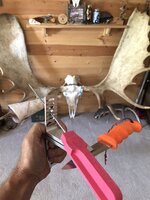
Whatever angle this is............
https://www.lancasterarchery.com/lansky-broadhead-sharpener-w-wrench.html

Mike Islander
WKR
17 on my Bugout work EDC. Axes and hatchets 25 - 30. I use VAP 3 blade broadheads, so must be 30 degrees. Just strop on sandpaper over glass for a perfect edge, two edges at a time.
If I am the one using it I'll push it to 15 degrees. If it's for someone else I'll go 17-20 ish degrees. I use a Tormek style Grizzly wet wheel sharpener.
A lower edge angle will increase edge holding for slicing. Of course it is easier to chip out or roll the edge too.
I can see the advantage of the replaceable blades but I make the knives that I take hunting, so I couldn't bring myself to go there.
A lower edge angle will increase edge holding for slicing. Of course it is easier to chip out or roll the edge too.
I can see the advantage of the replaceable blades but I make the knives that I take hunting, so I couldn't bring myself to go there.
Mike Islander
WKR
Good policy. Even though Bugout is S30V, I haven't had any chips at 17 degrees. I cut open 50 lb. bags of salt all day and put it through countless trials. Run it over a ceramic steel each day and she holds a great edge.If I am the one using it I'll push it to 15 degrees. If it's for someone else I'll go 17-20 ish degrees. I use a Tormek style Grizzly wet wheel sharpener.
A lower edge angle will increase edge holding for slicing. Of course it is easier to chip out or roll the edge too.
I can see the advantage of the replaceable blades but I make the knives that I take hunting, so I couldn't bring myself to go there.

sndmn11
“Daddy Zoltar”
17.5

Ucsdryder
WKR
- Joined
- Jan 24, 2015
- Messages
- 7,869
17 on hunting knives. 15 on fillets.
Ucsdryder
WKR
- Joined
- Jan 24, 2015
- Messages
- 7,869
I use a Havalon too but you can not beat a good fixed blade. My benchmade is 2-3x faster than a Havalon and 3/4 of the way through and elk the Havalon isn’t sharp anymore. It’ll do a whole elk but it won’t be even close to as sharp at the end as it is in the beginning. A good fixed will hold it’s edge, won’t dull, won’t snap and has a much more comfortable handle.I don't even waste my time on knives anymore. Not saying that's a good thing, but I haven't found any elk that will slow down my havalon baracuta. One blade will get me through an elk quick. 6 blades will last me a long, long time.
https://www.cabelas.com/shop/en/havalon-knives-barracuta-blaze-replacement-blade?ds_e=GOOGLE&ds_c=Nb|Generic|CatchAll|DSA&gclid=CjwKCAjw4KyJBhAbEiwAaAQbEzqZUyBOQGECYXqR74WQwPfDWjZ_pVzT57OaoppR2r-BA2LDYDzA9RoCISUQAvD_BwE&gclsrc=aw.ds
Coveyleader
WKR
- Joined
- Nov 27, 2013
- Messages
- 2,334
The only animal I wished I had more knife on was a moose. All my elk are killed in August September and the hides aren't thick at all. I've never been on the back en of an elk shot late October, November. I would bet as that winter hide comes into play, "more knife" would be nice.
I will say the Havalon Baracuta is a monster on early season elk. I've never tried the shorter versions. I started using them when I switched from my go to fillet knife as they're lighter.
I will say the Havalon Baracuta is a monster on early season elk. I've never tried the shorter versions. I started using them when I switched from my go to fillet knife as they're lighter.

EastMT
WKR
I like a flat grind blade, thin, flexible, 17-19 deg.
I sharpen them on an old school butcher shop 3 sided stone. I use a 4” victorinox rabbit knife (#40811) for deer sized game, small light stroper to touch up. It stays plenty sharp for one whole animal, but I like a fresh strop once in awhile whether I need it or not!
I use my knife for cutting through the pelvis, put it in the rib cage and pull hard to cut through the brisket all the way to the neck, remove entire rib cage by hitting the cartilage seam near the spine at top of the curvature. A razor blade doesn’t work for me either. As a lifelong butcher, my grandpa would roll in his grave if I was swapping blades!
I sharpen them on an old school butcher shop 3 sided stone. I use a 4” victorinox rabbit knife (#40811) for deer sized game, small light stroper to touch up. It stays plenty sharp for one whole animal, but I like a fresh strop once in awhile whether I need it or not!
I use my knife for cutting through the pelvis, put it in the rib cage and pull hard to cut through the brisket all the way to the neck, remove entire rib cage by hitting the cartilage seam near the spine at top of the curvature. A razor blade doesn’t work for me either. As a lifelong butcher, my grandpa would roll in his grave if I was swapping blades!


I use the Wicked edge sharpening system. I'm usually in that 18-22 range pending what knife. Just did my white river caper knive at 19 yesterday. It's also s30v and it holds edge like crazy.
Last edited:
Here is some info about sharpening angles
Under 10 Degree Angles
The lowest angles are reserved for edges that are typically cutting softer materials. In this case, the edges are not subject to abuse so the lower angle can be maintained without damage or edge failure. The lowest angles that we typically see are on straight edge razors. These are sharpened to an angle which is roughly 7 to 8 degrees (although the back of the blade is used as a guide so knowing the angle isn’t important and it is not adjustable). A straight razor has a very delicate edge that is very easy to damage. In proper usage, a straight razor would never see the type of use that would damage the edge.10 to 17 Degrees Angles
A sharpening angle of 10 to 17 degrees is still quite low for most knives. With a total angle of 20 to 34 degrees, this is still a very fine edge. This edge is typically too weak for any knife that might be used in any type of chopping motion. Also consider that harder steels are also more susceptible to impact damage because they are more brittle. If your knife is used for cutting soft items or slicing meats, this lower angle can hold up and provide a very smooth cutting action.17 to 22 Degree Angles
A 17 to 20 degree angle covers most kitchen knives. Some knives (typically Japanese manufacturers) will sharpen their knives to roughly 17 degrees. Most western knives are roughly 20 degrees. It is our experience that kitchen knives sharpened to 15 to 20 degrees cut very well and are still durable. These angles are still not highly durable as a total angle under 40 degrees will not respond well to rougher treatment in harder materials.22 to 30 Degree Angles
In this range, the knife edges are considerably more durable. A pocket knife or a hunting knife will inevitably see abuse not seen by knives meant primarily for slicing or chopping softer materials. While the edge may not ultimately cut as well (but you may not notice a difference) it will be considerably more durable.Over 30 Degrees Angles
Any edged tool or knife that is sharpened past 30 degrees will be very durable. Its cutting ability will be noticeably reduced. This durability has an advantage because more force can be used to make the cut. While the majority of knives won’t benefit from this sharpening angle, an edged tool like a machete, cleaver or axe must be durable as the typical cutting action of these tools would damage other edges.My higher end steel blades (S90V and ZDP-189) I keep at 17, and my stainless blades are at 20. The 420 stainless Kershaw does well at 17 for meat, but won't hold it long in the field for hide and deboning. My hunting knives don't see abuse, camping, or EDC use. They are for taking apart game and that is it.
I've tried the replacement blade knifes, and just don't like them. I was changing blades more often than I sharpen with the above knives which is never. They will all take care of most elk without any touch up. That said, a wallowed up dirty bull and I'll have to touch up after skinning.
Jeremy
I've tried the replacement blade knifes, and just don't like them. I was changing blades more often than I sharpen with the above knives which is never. They will all take care of most elk without any touch up. That said, a wallowed up dirty bull and I'll have to touch up after skinning.
Jeremy
Similar threads

- Replies
- 22
- Views
- 1K


Featured Video
Latest Articles
- Mastering New Zealand’s Mountain Hunts: Challenges and Rewards
- Iron Will Turkey Broadhead Review
- Nevada Mule Deer & The Trade-Offs in Wildlife Management
- Spartan SpringBok Bipod Review
- All About Pronghorn & Hunting Big Ones with Chance Marshall
- Bill Vanderheyden Debunks Myths About Long-Distance Accuracy
- What Do Elk Eat? Elk Nutrition, Habitat, and Finding More Elk with Luke Schultz
- Patagonia Nano Air Ultralight Hoody Review
- CWD: Progress and Hope in Wyoming?
- Zeiss Conquest Apia 20-50×65 Spotting Scope Review