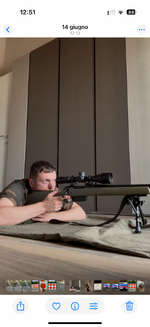
What do you think about the weird behaviour of my custom rifle?

Yeah, cheek weld could definitely be a factor or the main one. If you have a lot of input in one position and next to none in another especially. I've gone to higher mounted scopes and hardly any contact on the comb. I think Form and others do differently so not saying it's the right or only way but I like the more upright head position and not worrying about height of comb much.
shoudn't the cheek/chin contact with the stock be useful to stabilize the system and reduce the variability caused by positional changes?

is your rufle very heavy? in which caliber is it? do also your family members have this approach to cheekweld?
 
I have an X Bolt 7mm08 that shoots just OK at paper. However I have first round impacts on MOA size steel out to 910 yards consistently. So I hardly ever shoot it at paper unless to re zero or check a load. I killed a mile deer DRT at 648 this year.

Sent from my SM-S931U using Tapatalk
how is it possible that the gun is more accurate in the field than in range conditions? MOA size steel at 910 yards is very impressive, i wouldn't ever be able to hit it reliably just because of enviromentals..
 
how is it possible that the gun is more accurate in the field than in range conditions? MOA size steel at 910 yards is very impressive, i wouldn't ever be able to hit it reliably just because of enviromentals..
At 910 it's because I have a good spotter calling my wind. Im good by myself out to around 600. I never said the gun was lore accurate in field conditions. The shots I am referring to are prone with a bipod or pack and rear bag.

Sent from my SM-S931U using Tapatalk
 
shoudn't the cheek/chin contact with the stock be useful to stabilize the system and reduce the variability caused by positional changes?
Nah, i dont like using my face to stabilize a rifle. Front support, back support, and firing hand is plenty.

is your rufle very heavy? in which caliber is it? do also your family members have this approach to cheekweld?
All rifles. 223 to 300 mag sporter hunting rifles and heavy comp guns. It's common practice in competitive precision shooting circles. If you look up natural point of aim there should be some stuff from rifle kraft/chris way, frank galli, calen wojcek, Phil velayo, etc.
 
…the question is: how much shooter error gives how much shift in POI?
Form can answer directly. And there’s all sorts of opinions here. BUT I think most will agree that the more a gun recoils, the more potential poi shift is possible as a result. You already said this gun recoils significantly more than your others, ergo there is more potential for a poi shift caused by recoil management, and a greater potential shift in poi.

If you are contorting your body to see thru the scope as you said, at least for me, it makes it much harder to be consistent in my gun inputs, especially during recoil and for a subsequent shot. Try some 1/4” hard foam taped to the comb and see if it makes a difference. If it does, either lower rings or a permanent comb riser might just fix it for you. Or at least make it easier to do the practice that will fix it for you. Some of this may not be “proper” (cheek vs chin weld, depending on who you ask) but if you already have decades of muscle memory doing it one way and a pile of guns set up for that, it may be easier to run with it.

The drill mentioned earlier is helpful for seeing your field performance from various positions so that you can practice your weaknesses and see improvements, and make comparisons. Because as pointed out, range conditions are not reality. Its the “Form drill” or “hunting rifle drill”. I think of it as a field-focused version of a kraft drill. If you search it on this site you’ll find it eventually.
 
Nah, i dont like using my face to stabilize a rifle. Front support, back support, and firing hand is plenty.


All rifles. 223 to 300 mag sporter hunting rifles and heavy comp guns. It's common practice in competitive precision shooting circles. If you look up natural point of aim there should be some stuff from rifle kraft/chris way, frank galli, calen wojcek, Phil velayo, etc.
so maybe i don't need a cheek rest to make my position better but i should just take some pressure off from it?
it wouldn't feel very natural tough.

i have seen different reccomendations about this, from people saying the same as you to people suggesting to rest the weight of the head on the buttstock.

How to know which is the correct way?
 
At 910 it's because I have a good spotter calling my wind. Im good by myself out to around 600. I never said the gun was lore accurate in field conditions. The shots I am referring to are prone with a bipod or pack and rear bag.

Sent from my SM-S931U using Tapatalk
i was shooting pretty easily steel targets (torso sized) at 400 meters (450 yards) with my M4 with a aimpoint comp m3, after figuring out where to hold.. That's why it seems crazy that i am struggling with this rifle with all this well tought out setup, good scope, etc..
it is so frustrating not understanding what the f is happening
 
Form can answer directly. And there’s all sorts of opinions here. BUT I think most will agree that the more a gun recoils, the more potential poi shift is possible as a result. You already said this gun recoils significantly more than your others, ergo there is more potential for a poi shift caused by recoil management, and a greater potential shift in poi.

If you are contorting your body to see thru the scope as you said, at least for me, it makes it much harder to be consistent in my gun inputs, especially during recoil and for a subsequent shot. Try some 1/4” hard foam taped to the comb and see if it makes a difference. If it does, either lower rings or a permanent comb riser might just fix it for you. Or at least make it easier to do the practice that will fix it for you. Some of this may not be “proper” (cheek vs chin weld, depending on who you ask) but if you already have decades of muscle memory doing it one way and a pile of guns set up for that, it may be easier to run with it.

The drill mentioned earlier is helpful for seeing your field performance from various positions so that you can practice your weaknesses and see improvements, and make comparisons. Because as pointed out, range conditions are not reality. Its the “Form drill” or “hunting rifle drill”. I think of it as a field-focused version of a kraft drill. If you search it on this site you’ll find it eventually.
interesting points. The amount of recoil could be higher due to the system being more rigid/stiff because of the carbon fiber stock and tighter tolkerances or a rifle recoil is almost exclusively dependent on load and weight of the rifle itself?

i laready tried with two socks and some duct tape and i was much more comfortable behind the rifle. I just didn't think this could make all this difference. With that rudimental setup i was leaning behind the rifle naturally with closed eyes and, when i opened my eyes, i had a good sight picture. With the current setup i end up being almost 1 cm lower than were i should to have a good sight picture when i open the eyes. This is valid if i want a cheekweld, for a chin weld (which implies neck muscles to be used to keep the head straight and less consistency on the weight applied to the stock) it is good, if i open my eyes i am on spot (this because i carefully adjusted the position of the scope to be at the right distance from my eye. The setup with the increased heught of the comb felt more natural, for sure. That said, with my old rifle i used to have a chin weld but a biut lower and i was pushing left with my head on the stock, compensating with a slight torsion with my right hand holding the grip. This worked for me for years in which i never witnessed positional induced poi shifts while training and hunting. It is also true that that rifle was shooting lower recoil rounds (308 780 m/s vs 820 m/s, both 165 grainers)
 
interesting points. The amount of recoil could be higher due to the system being more rigid/stiff because of the carbon fiber stock and tighter tolkerances or a rifle recoil is almost exclusively dependent on load and weight of the rifle itself?

i laready tried with two socks and some duct tape and i was much more comfortable behind the rifle. I just didn't think this could make all this difference. With that rudimental setup i was leaning behind the rifle naturally with closed eyes and, when i opened my eyes, i had a good sight picture. With the current setup i end up being almost 1 cm lower than were i should to have a good sight picture when i open the eyes. This is valid if i want a cheekweld, for a chin weld (which implies neck muscles to be used to keep the head straight and less consistency on the weight applied to the stock) it is good, if i open my eyes i am on spot (this because i carefully adjusted the position of the scope to be at the right distance from my eye. The setup with the increased heught of the comb felt more natural, for sure. That said, with my old rifle i used to have a chin weld but a biut lower and i was pushing left with my head on the stock, compensating with a slight torsion with my right hand holding the grip. This worked for me for years in which i never witnessed positional induced poi shifts while training and hunting. It is also true that that rifle was shooting lower recoil rounds (308 780 m/s vs 820 m/s, both 165 grainers)
@BAKPAKR (sorry if it wasn’t you) made a cheek riser out of cardboard, sort of made his stock into a rokstock. He seemed to think it made a difference if I remember correctly. You could try something like that or search for his thread on that.
 
@BAKPAKR (sorry if it wasn’t you) made a cheek riser out of cardboard, sort of made his stock into a rokstock. He seemed to think it made a difference if I remember correctly. You could try something like that or search for his thread on that.
i am a bit confused because many say that it is better to have a chin weld instead of a cheek weld, thus influencing less the recoil dynamic of the rifle.. so maybe i don't have a too light of a chin weld but an inconsistent one? but this way if i shoot uphill or with the bipod canted how can i "direct/control" the dynamics of recoil?
 
@BAKPAKR (sorry if it wasn’t you) made a cheek riser out of cardboard, sort of made his stock into a rokstock. He seemed to think it made a difference if I remember correctly. You could try something like that or search for his thread on that.

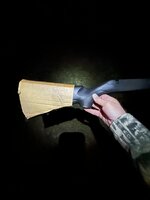
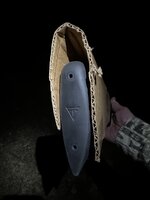
I just did a mock up with a piece of cardboard to see what the above the bore heel and negative comb felt like. The photos are at post 608 in the Rokstok thread.


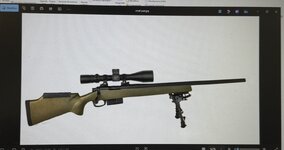
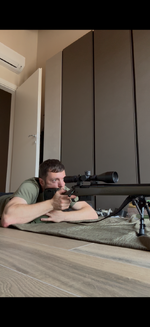
@ssimo, if you would post a few photos of your rifle, someone might spot something that is not obvious from your description.
 
My wife is 5'2" and I'm 6'6". There have been times when she has shot groups 4 to 6 inches away from the the point of aim when she would shoot a rifle sighted in for me. Same point of aim but drastically different point of impact with the same mean group size. Once we recognized this happened, I found good loads for her and got the rifle on paper. She then shoots the rifle and sights it in for herself. We then do groups from the bench, from prone, and from other field positions to verify no POI shift. If we are getting shift we look at stock fitment, scope fitment, and other things to make it shoot better for her. Same for my son's rifles as he always shoots higher than POA by several inches vs my zero. My daughter shoots closer to my POI. We can easily share a gun w/o changing scope zero.

Jay
My hunting partner is 5'3", and I am 6', with very different builds. We have both been trained to shoot rifles neutrally, and there is no POI difference between us with the same rifle/same zero.

The rifle does not know or care who is shooting it.
 
I just did a mock up with a piece of cardboard to see what the above the bore heel and negative comb felt like. The photos are at post 608 in the Rokstok thread.


@ssimo, if you would post a few photos of your rifle, someone might spot something that is not obvious from your description.
The pic with the olive camp t shirt is the one with the higher home Made cheekpad, the one with the woodlamd camo shirt is the standard configuration.. the other one is the only pic i have of the complete rifle on this phone and it was the homemade rende ring i did when i was doing the project before ordering the rifle!

Maybe the Montecarlo stock ends up too low against my “shoulder” thus making the rifle jump more?
 

Attachments

  • IMG_8664.jpeg
    IMG_8664.jpeg
    124.2 KB · Views: 27
  • IMG_5709.png
    IMG_5709.png
    1.3 MB · Views: 28
  • IMG_5704.png
    IMG_5704.png
    1.3 MB · Views: 28
My hunting partner is 5'3", and I am 6', with very different builds. We have both been trained to shoot rifles neutrally, and there is no POI difference between us with the same rifle/same zero.

The rifle does not know or care who is shooting it.
I would pay to see someone explaining how to shoot neutral
 
Nope, between the integral rail of the defiance action, the rem style boot throw and the 50 mm bell of the scope 4.5 cm is the lowest height I could get
I didn’t think about the bolt. I was just looking at the space between the objective and the barrel.

I think the drop at heel on that particular stock is pretty low for a relatively high mounted scope.
 
I didn’t think about the bolt. I was just looking at the space between the objective and the barrel.

I think the drop at heel on that particular stock is pretty low for a relatively high mounted scope.
i thought about it as well. I am already using low hawins rings and the clearance between scope and bolt when open is not big, maybe i could get away with a scope 0.1 or 0.15 inches lower.. maybe

if this is the issue (it could be), 1) the smith who planned this rifle with me should have told me 2) i need to change the stock as a whole (in this case i would buy an adjustable cheek piece one directly

ort just ditch the custom rifle and buy a factory one.. the fact is that i would like a sako but i really don't like the new ultra modern aesthetics of their current offering XD
 
Watch this video. A lot of Phil's stuff is PRS specific but this video can help you with the principals of how you should be on the gun, and how you shouldn't be.

Applying a lot of pressure through a cheek weld will absolutely affect point of impact and your ability to spot impacts.


Sent from my SM-S931U using Tapatalk
 
Back
Top