Ear pro only offers so much protection. If a guns 170, a single protector only gets you to 140 ish, double gets you to 120 which is theoretically safe for 100 shots in a day. Adding a can that drops that 170 to 150, adds 900+ safe shots per day. So yes, it still matters.Is the 7prc a competition or straight range toy? If it's called "NHS" for a reason.......why ditch brake if you still need ear pro? I understand the competition and range side of things, as I still wear ear pro in those situation weather hearing safe can or not. But the whole point of a supressor is to not need ear pro hunting in my opinion.

Navigation
Install the app
How to install the app on iOS
Follow along with the video below to see how to install our site as a web app on your home screen.
Note: This feature may not be available in some browsers.
More options
Style variation
You are using an out of date browser. It may not display this or other websites correctly.
You should upgrade or use an alternative browser.
You should upgrade or use an alternative browser.
Unknown Suppressors Updates
- Thread starter Unknown Suppressors
- Start date

- Joined
- Oct 22, 2014
- Messages
- 15,260
Is the 7prc a competition or straight range toy? If it's called "NHS" for a reason.......why ditch brake if you still need ear pro? I understand the competition and range side of things, as I still wear ear pro in those situation weather hearing safe can or not. But the whole point of a supressor is to not need ear pro hunting in my opinion.
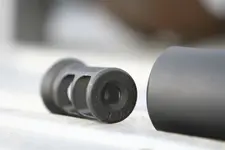
A braked rifle is somewhere around 170-175 dB. It also has produces massive concussion that is only now starting to be realized how bad it is for you. With 170dB, you need more than 30dB reduction to fire one shot without “damage”. Plugs and muffs will get you to about 30-35dB of reduction. Therefor one cannot fire a brake rifle multiple times a day without some level of damage. That’s without even considering the concussive blast.
The NHS brings it down to 145-148dB, with almost no concussion. With double ear pro, that rifle is now 115-120dB and can be shot for an entire day without known effects, and no headaches.
- Banned
- #103
- Joined
- Oct 22, 2014
- Messages
- 15,260
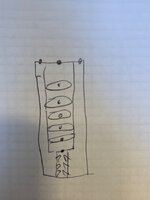
Physics aren’t my strong suit, but would an internal brake with gas flowing around suppression baffles and out the front work?
Well, that’s functionally a flow through can. They kind of suck as suppressors and suck as brakes.
Physics aren’t my strong suit, but would an internal brake with gas flowing around suppression baffles and out the front work?
A lot cans already have an internal brake that the can screws over. It’s pretty useless with the can on since the gas’s are still being redirected inside. Serves more as a blast baffle I think. Since I don’t know why anyone would pull their can off to shoot through the loud brake.

No. Without getting too complicated, perhaps these examples will help explain it.Physics aren’t my strong suit, but would an internal brake with gas flowing around suppression baffles and out the front work?
If you mount jet engine inside an unclosed box, will the box move forward when the engine is fired?
Or, think of it as grabbing your feet and trying to pick yourself up. Doesn't matter that I can deadlift more than my body weight, no matter how hard I try, nothing happens.
Makes sense what about the one on the left, assuming drawing on the right is currently how they work . Ports facing rear , a good portion of gas wouldn’t be “suppressed”, but slowed. I’m bored and stuck in place…No. Without getting too complicated, perhaps these examples will help explain it.
If you mount jet engine inside an unclosed box, will the box move forward when the engine is fired?
Or, think of it as grabbing your feet and trying to pick yourself up. Doesn't matter that I can deadlift more than my body weight, no matter how hard I try, nothing happens.
Attachments
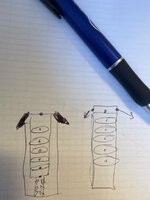
Makes sense what about the one on the left, assuming drawing on the right is currently how they work . Ports facing rear , a good portion of gas wouldn’t be “suppressed”, but slowed. I’m bored and stuck in place…
Or forgive the preschool drawings… blast chamber into helical baffles, gas exiting reward.
Attachments
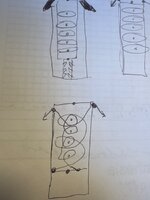
Not sure I understand the drawing on the left.Makes sense what about the one on the left, assuming drawing on the right is currently how they work . Ports facing rear , a good portion of gas wouldn’t be “suppressed”, but slowed. I’m bored and stuck in place…
A suppressor can only mitigate the portion of the recoil from gas (charge weight on a recoil calculator). Better designs will do a better job.
A break actively redirects force, thus it can also cancel out the recoil from the bullet weight and velocity. The higher pressure the gas, the more effectively it can do this.
If you are having gas hit something attached to the gun, then the forces cancel out and the redirection doesn't occur and the only benefit is slowing down gas (like in a suppressor).
Not sure I understand the drawing on the left.
A suppressor can only mitigate the portion of the recoil from gas (charge weight on a recoil calculator). Better designs will do a better job.
A break actively redirects force, thus it can also cancel out the recoil from the bullet weight and velocity. The higher pressure the gas, the more effectively it can do this.
If you are having gas hit something attached to the gun, then the forces cancel out and the redirection doesn't occur and the only benefit is slowing down gas (like in a suppressor).
Spliitting off gas in blast chamber for “muzzle brake” effect rather than at the end on the suppressor.
Attachments
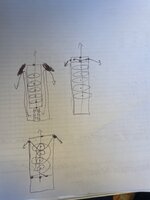
It would give higher gas velocity, so a more effective break, but less effective suppressor. Beyond than supposition, I don't know.Spliitting off gas in blast chamber for “muzzle brake” effect rather than at the end on the suppressor.

longrange13
WKR
- Joined
- Jun 25, 2023
- Messages
- 324
It’s a hunting rig. With my brake I’ve been about 50/50 on whether I have time to get ear plugs in before shooting or risk loosing the opportunity.Is the 7prc a competition or straight range toy? If it's called "NHS" for a reason.......why ditch brake if you still need ear pro? I understand the competition and range side of things, as I still wear ear pro in those situation weather hearing safe can or not. But the whole point of a supressor is to not need ear pro hunting in my opinion.
If I can get something that is almost hearing safe and still has great recoil reduction I figure that’s better than blowing my ears out completely 50% of the time. I’ve tried a few hearing safe suppressors on it and it’s just a little more push than I want.
It’s a hunting rig. With my brake I’ve been about 50/50 on whether I have time to get ear plugs in before shooting or risk loosing the opportunity.
If I can get something that is almost hearing safe and still has great recoil reduction I figure that’s better than blowing my ears out completely 50% of the time. I’ve tried a few hearing safe suppressors on it and it’s just a little more push than I want.
I say this as someone who has significant hearing damage from shooting w a brake sans ear pro on 2 animals, just don’t do it. I didn’t learn my lesson the first time, second time was fewer shots, but measurable decrease in hearing.
- Banned
- #115
I did it one time, def made my already apparent hearing loss and tinnitus noticeably worse. Left ear gas 25% more loss than right, pretty sure due to that one shot.I say this as someone who has significant hearing damage from shooting w a brake sans ear pro on 2 animals, just don’t do it. I didn’t learn my lesson the first time, second time was fewer shots, but measurable decrease in hearing.
With the high quality electronic in ear protection available now, I used to wear them all day hunting and recharge over night. There was no haste to get ear pro when shot was offered, you just got on the gun and went. I still wear these at matches, and if guys are shooting brakes and it's tight confinemtns on the firing line, I'll put my sordins on over the top.
buckleyboy
FNG
I need to FAFO with the Reaper on the 300 Win Mag first before adding the brake. You know, for science.Well, go use it!
For better or worse, life has put a major constraint on my fun time here lately. So it goes.

sndmn11
“Daddy Zoltar”
I finally ordered a suppressor for myself and the Reaper shipped out today. I might be in no man's land for the other steps and the Jan 1 thing.I need to FAFO with the Reaper on the 300 Win Mag first before adding the brake. You know, for science.
For better or worse, life has put a major constraint on my fun time here lately. So it goes.
I figured I would screw around with it on a 30-06 without the brake for a bit, and then go from there. I'm also semi-excited about the reflex add on.

What was the process to add the reflex? And $? Might be intriguing enough to sway me away from the ZG30 that only exists in my imagination.I finally ordered a suppressor for myself and the Reaper shipped out today. I might be in no man's land for the other steps and the Jan 1 thing.
I figured I would screw around with it on a 30-06 without the brake for a bit, and then go from there. I'm also semi-excited about the reflex add on.
Ah , I see. Had me excited thinking you had a reflexed reaper headed to town.There isn't one yet, so, I don't know. @ID-Muley can add whatever info he wants.
Similar threads


- Replies
- 63
- Views
- 6K


- Replies
- 6
- Views
- 806


Featured Video
Latest Articles
- How to Kill Giant Bulls with Ryan Carter
- Kifaru Enters the Hunting Apparel Space: Review
- From Big Bucks to Bear Hunts: Catching Up with Jordan Budd
- Mule Deer Days Wildlife Conservation Mashup
- A Hidden Gem: Hunting Washington with Kari Thomas
- Prime Divide Bow Review
- Knowledge From Storms: Surviving and Thriving in the Backcountry with John Barklow
- DIY Wyoming Pronghorn Hunt
- Unlock Precision Shooting: Master Your Hunting Game with Competitive Insights
- Topo Topper Rincon Review