
Weighted hikes around week 5, but the ME specific work in week 20.
Edit, didn't realize I hit send. Week 5 starts loaded hikes, and ME work begins week 20 and ends week 27.
Thanks guys! That’s pretty close to what I’ve been doing (10 weeks out)


Follow along with the video below to see how to install our site as a web app on your home screen.
Note: This feature may not be available in some browsers.
Weighted hikes around week 5, but the ME specific work in week 20.
Edit, didn't realize I hit send. Week 5 starts loaded hikes, and ME work begins week 20 and ends week 27.
Straight down the fall line, arms flailing?great podcast.. I am more of a downhill athlete.
Yes, it would be past a conversational pace. Unless you normally have to take two deep breaths between short sentences.I've got another question guys, this one concerning a conversational pace. I've been running on the treadmill at the gym, and I wasn't going to try it there.
It was asked the other day if my pace was conversational when I did the drift test, so I wanted to try that when I got back on the roads.
So today I ran harder than I usually do. Legs felt good, temp was around 20*. I just felt good overall.
I just repeated the sentence "My heart rate is ***, and I'm still conversational" with whatever heart rate I was running.
This was pretty easy up to about 145 or 146, but I'd have to take two good breaths before I could repeat the sentence.
Would that be considered past a conversational pace?
I'm just trying to dial my training in. Maybe I'm looking into it too much.
Thanks. That gives me a good reference point.Yes, it would be past a conversational pace. Unless you normally have to take two deep breaths between short sentences.
I've got another question guys, this one concerning a conversational pace. I've been running on the treadmill at the gym, and I wasn't going to try it there.
It was asked the other day if my pace was conversational when I did the drift test, so I wanted to try that when I got back on the roads.
So today I ran harder than I usually do. Legs felt good, temp was around 20*. I just felt good overall.
I just repeated the sentence "My heart rate is ***, and I'm still conversational" with whatever heart rate I was running.
This was pretty easy up to about 145 or 146, but I'd have to take two good breaths before I could repeat the sentence.
Would that be considered past a conversational pace?
I'm just trying to dial my training in. Maybe I'm looking into it too much.
My caveat (and you did say often, so perhaps just adding emphasis) is there can be large individual variation. Which is why the drift test is best.Based on the training load, other stresses and your body’s recovery rate there will be some variance with your HR range, but often a HR between 139-141 will be the ballpark of the upper limit of Z2.
My caveat (and you did say often, so perhaps just adding emphasis) is there can be large individual variation. Which is why the drift test is best.
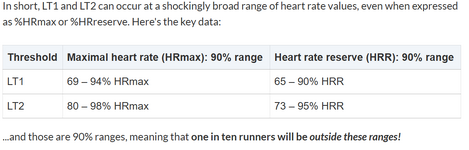
To use myself as an example, my tested anaerobic (lactate) threshold is higher than the formula says my max HR should be, and I've seen my HR past 200 bpm. That is not good or bad, it just is what it is. But, if I estimated my zones based on the general population, I would spend all my time in the bottom os Z1 or below.
To add even more emphasis on how much individual variation there is:My caveat (and you did say often, so perhaps just adding emphasis) is there can be large individual variation. Which is why the drift test is best.

Good feedback and good to hear it from someone with a similar background.I have a similar background as you and then found training for the new alpinism in 2017.
Incorporating zone 2 was massively beneficial and I felt like the thing that had been missing from my training.
I also believe the tactical games are more zone 2 than people realize because you will need to control your breathing and shooting. You just also need to be strong.
Scott has a podcast with a guy who won the best ranger competition, that might be helpful for you to check out.

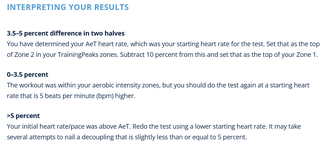
I think Steve House and Scott Johnston say if within 3.5-5%, the HR you leveled out at after warm up is your aerobic threshold.When doing the HR drift test, how much drift is acceptable?
Couple of questions:
When doing the HR drift test, how much drift is acceptable?
The way that this Z2 training is talked about, it’s almost as if you’d think there is 0 benefit if you drift 1 heart beat over the line into Z3. I have to believe that you’re still getting SOME benefit, albeit on a sliding scale, even when flirting with or going over that line just a bit, no?
These are just different proxies for a complex physiological phenomena. The question (imho) seeks a degree of precision that does not exist, and that is not necessary to attain the desired adaptations.Sorry to keep beating this horse to death, just trying to better understand this conventional pace.
Few more runs in just seeing where a "conversational pace" is for myself.
Comparing my drift test and "conversational pace", I find that a truly "conversational pace" for me ends at the bottom end of my zone 2.
Above that bottom couple beats of Z2, it's pretty much the same from there up into the upper 140's.
How do my findings compare with other folks? Do you guys find all of Z2 conversational? Lastly, should I stay in those bottom few beats of Z2, or is work above a conversational pace but below the top end of Z2 ok?
Perfectly put. I've spent a lot of time trying to "accurately" find my aerobic threshold (AeT/LT1), but at the end of the day they can be a moving target based on many factors (fatigue, hydration, temperature, etc..).These are just different proxies for a complex physiological phenomena. The question (imho) seeks a degree of precision that does not exist, and that is not necessary to attain the desired adaptations.


