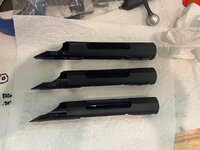
I went down the nitride rabbit hole 5 or 6 years ago.
As far as barrels, I chose not to based on cost/benefit to expected outcome.
Gordy Gritters and his F class circle tried before and after tests where several "ringer" barrels shot worse after nitride.
Not to muddy the waters here because as hunters, I doubt 99.9% can legitimately shoot the difference. The F class guys have to shoot ¼ MOA @ 1000 to be competitive.
The idea was to "preserve" the accuracy of a good barrel for longer. From what ive gathered, nitriding a barrel may extend its life some but ,its not going to triple its life with hotter cartridges. Throat erosion is not entirely from abrasion. The high heat AND abrasion will overcome the nitride and eventually fire cracking deeper than the nitride layer. But, that's not what nitride is primarily for anyway.
For me, it would just be money spent for no real gain.
I'm very interested to see how
@Nine Banger fairs with his barrels.
As far as actions and making them weaker. I believe it's a lot of speculation over nothing.
To substantially change the characteristics of the steel rifles are made of, they have to be heated to 1600 degrees-ISH or higher. Then how the steel is cooled determines whether it is harder or softer after, quenched or annealed.
Lots of parts are silver soldered like Rem 700 bolt handles. Silver solder has a melting point of about 1400 iirc and Nitride does not affect silver solder. (previously stated around 1050 degrees)
Also consider barrel recoil lugs on safari type rifles. They are silver soldered in place which heats the barrel to a bright red/orange (1400-1500) to achieve the solder joint. They are perfectly safe and accurate after doing so.
my 2 cents anyway