Spotting your shot, most import factors.

but blinking AFTER recoil impulse wouldn’t fall under the category of anticipation to me. Involuntary- definitely. Most blinking is - and of course is a reaction meant to protect one’s eyes.

Blinking is also a tell of mental loading - it's used as an indicator of deception in interrogation for that very reason. Blinking after a shot may simply be indicating a slower, more controlled discharge of that anticipatory energy.
 
I think the firing pin is loud enough that I blink when it goes off even dry firing and knowing it’s empty. But if I keep going I can over come the blink in that context.
 

Blinking is also a tell of mental loading - it's used as an indicator of deception in interrogation for that very reason. Blinking after a shot may simply be indicating a slower, more controlled discharge of that anticipatory energy.
Maybe - it could be for sure. But maybe also an indication of a normal human reaction to an explosion occurring nearby…
 
I want a solid cheekweld during recoil with friction not hard pressure. A cheek pad of some type helps with that.
Stock design matters far more than I would ever have imagined.

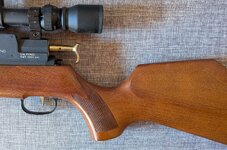
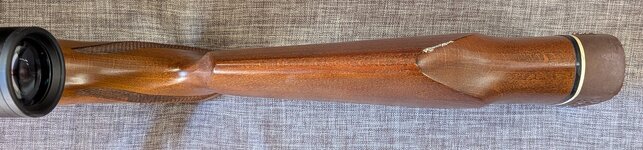
Here's a British sporter on a .22 PCP air rifle I've owned for 20+ years. It has a 14-1/2" LOP and about 2-1/8" trigger reach. The comb, while negative, forces me to cock my head upward a few degrees to get in the scope (which is really uncomfortable for any extended period of time), and the trigger is a bit of a stretch:PXL_20251206_190944468.jpg

It's ambidextrous, so no cheek swell -- and reliably results in a ~10° left cant if I shoulder it with my eyes closed:PXL_20251210_222642511.jpg

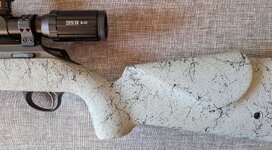
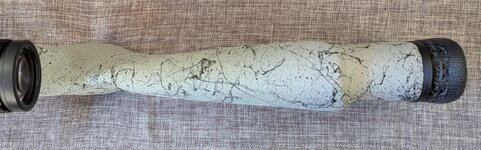
Here's the Pendleton LRH I chose for my T3x build. 14" LOP and roughly 1-3/4" trigger reach:
PXL_20251206_191307538.jpg

I really like the fact that Wayne's stocks are handed (not ambidextrous) and include a cheek swell that results (for me) in an NPoA that doesn't cant the rifle:
PXL_20251210_222726570.jpg
 
Maybe - it could be for sure. But maybe also an indication of a normal human reaction to an explosion occurring nearby…

Still...sensory loading, like I mentioned a couple of posts up.

There are another couple of ways to chill this mind-body reaction out.

One, which can be difficult to make happen, is full-auto training, especially with a shoulder-mounted belt-fed. Not joking. You might blink with the first round or two, but there will be little to zero anticipation after a few hundred rounds of 5-7 round bursts...because all of that energy is just dumped out of you, and you're only focusing on the here and now, staying exactly in the moment and focused on the targets.

Another way is a recoil-management drill you can do with a handgun. It works especially well with a red-dot sight. Just load up a full mag or five (the higher the capacity the better), and stay focused on the exact spot on the target you want to burn a ragged hole into. Fire all 15-20 rounds as rapidly as you can keep that sight bouncing on the target, keeping absolutely locked-on visually to that tiny spot on the target. As with the full-auto, the first couple of rounds might have a blink, but then you're staying in the moment and not blinking in the slightest.

It really is about mental loading, and finding ways to keep it from accumulating, and discharging it as you can without it influencing the gun and shot.
 
It’s great from benchrest. And that’s where it originated, and PRS has continued it- as PRS is as much barricaded BR as it is anything else.


The reason to actually grip a rifle is “control”. Free recoil means zero control of a gun- that’s doesn’t work in field shooting on live things and/or dynamic shooting. It’s not a death grip- it’s controlled neutral grip.


The goal is to keep the rifle and your body- head eyes, hands, shoulder; as one unit for the entire shot process. Yes real cheekweld does help with recoil/sight movement, but it also keep the whole shooting platform stable and together.
I agree with the criticism of PRS as barricade benchrest. There are many things that do not translate. It doesn’t mean there’s nothing of use from it…

Unlike PRS where the gun’s weight allows for virtually no input, for hunters with lighter rifles, control of the rifle is required.

We have to use our bodies to control the rifle because our rifles doesn’t weigh 20 pounds. It’s about man and machine becoming one…

All of the input from our body to the rifle requires measured and increasing control (in the right directions in anticipation of recoil) until we go too far induce torque, wobble, etc.

The trigger hand traps the rifle to the shoulder, holding firmly.

The cheek/jaw has pressure to connect the face to the rifle in a positive manner to keep eye centered. I do not think the friction to keep the rifle from moving is the main reason. I think it is just enough contact/friction to be a repeatable index/anchor point, without disrupting the rifle or creating tension in the man/machine system.

Done in a balanced way, the rifle can be put in the shoulder pocket or medially, IMO. For shooting that includes a lot of offhand, the shoulder pocket is best and the rifle stock longer. For lots of tripod/bipod shooting medial with a shorter stock works.

I think the argument is much more about hunting/shooting style and technique than right/wrong.

Personally, I want to be able to do both competently. I need to work on the style Form a lot. And, get a stock set up for that style.
 
Still...sensory loading, like I mentioned a couple of posts up.

There are another couple of ways to chill this mind-body reaction out.

One, which can be difficult to make happen, is full-auto training, especially with a shoulder-mounted belt-fed. Not joking. You might blink with the first round or two, but there will be little to zero anticipation after a few hundred rounds of 5-7 round bursts...because all of that energy is just dumped out of you, and you're only focusing on the here and now, staying exactly in the moment and focused on the targets.

Another way is a recoil-management drill you can do with a handgun. It works especially well with a red-dot sight. Just load up a full mag or five (the higher the capacity the better), and stay focused on the exact spot on the target you want to burn a ragged hole into. Fire all 15-20 rounds as rapidly as you can keep that sight bouncing on the target, keeping absolutely locked-on visually to that tiny spot on the target. As with the full-auto, the first couple of rounds might have a blink, but then you're staying in the moment and not blinking in the slightest.

It really is about mental loading, and finding ways to keep it from accumulating, and discharging it as you can without it influencing the gun and shot.
Thanks - this is the best suggestion I have heard so far I think. The full auto makes a ton of sense. I could do the pistol version. though I wonder if it would translate over to the different context of the bolt gun?
 
You are the one asking for input/help. If you cannot fire a gun demand without blinking (while wearing ear protection)- you ARE anticipating.
Yes I am! But we disagree on the issue I guess, so it’s slightly frustrating since I think the solution needs to be different. To my mind it’s the surprise nature that is actually the issue to some extent. The way the full auto idea would work to remove the blinking as I see it is because after enough it’s not a surprise anymore and my brain knows my eyes are fine. I don’t really wanna burn up this barrel but I wonder what firing the bolt gun as fast as I could repeatedly would do. I do have a 22LR bolt gun incoming so maybe that will also be a good training tool for it.
 
You are the one asking for input/help. If you cannot fire a gun demand without blinking (while wearing ear protection)- you ARE anticipating.
Also I am really not trying to be snarky— blinking really is a normal human reaction to loud noises and things moving towards our face right?
 
Thanks - this is the best suggestion I have heard so far I think. The full auto makes a ton of sense. I could do the pistol version. though I wonder if it would translate over to the different context of the bolt gun?

You're welcome, hope it helps. The only difference really, is that the bolt gun just gives you more time to mentally load up.

Something I've been working pretty hard on lately with pistol, is giving myself zero time to fine-tune the shot, and just press the trigger the absolute instant I perceive the dot crossing onto the target. The more I do this, the more I'm discovering just how much bull$h*t and wasted time and ammo I've spent on single, precise, slow, well-aimed shots over the decades. All it does is create mental loading. You're on target or not, and your mind can recognize that far faster than you can say so.

I did this, at 5 yards, 10 shots, two per spot, in about 17ish seconds a month or two back. It's a modified Dalton Drill, for 2 shots per spot. The original drill is 1 shot on each spot on a 6 of diamonds/hearts, etc, because it was set up originally for revolvers. The thing is, I saw the 6-shot drill done about 30 years ago in less than 3 seconds by an instructor with irons, with no misses, from low-ready. So, much less than a second per spot. He was shooting a .45 1911, so the larger bore has a bit of an advantage over 9mm in this photo, but it was less than a half second per shot. It was f'ing mind-altering to see done. I've shaved about 3-5 seconds off my time with just going fast and getting almost this accuracy below, just not giving any time to mental loading, but there's a long way to go still. The majority of the targets don't look this good.

Overall though, I think that's what the difference is, and why I haven't cracked 15 seconds on this drill before in the last 30 years - mental loading. Just shoot. Don't think, just press when on target and go. The faster you can train your brain to recognize dot/target intersection and just send it, the more accurate you'll be.

Counterintuitive, but true to the best of my knowledge.


image0 - Copy.jpeg
 
Something I've been working pretty hard on lately with pistol, is giving myself zero time to fine-tune the shot, and just press the trigger the absolute instant I perceive the dot crossing onto the target.

That is a 100% guaranteed way to introduce snatching and flinching.


The more I do this, the more I'm discovering just how much bull$h*t and wasted time and ammo I've spent on single, precise, slow, well-aimed shots over the decades. All it does is create mental loading.

No.


You're on target or not, and your mind can recognize that far faster than you can say so.

Yes- and it also sends the signal to jerk the trigger and push down faster than you can say so.

You should have absolute control of the shot at all times. If you want to press the trigger constantly without stopping the trigger movement for 15 seconds before it goes off- you should be able to do that. If you want to press a trigger in .25 seconds- you should be able to do that.


Absolute control of the shot. Not “DOTS ON GO!!!”


Overall though, I think that's what the difference is, and why I haven't cracked 15 seconds on this drill before in the last 30 years - mental loading. Just shoot. Don't think, just press when on target and go. The faster you can train your brain to recognize dot/target intersection and just send it, the more accurate you'll be.


It’s not mental loading- it’s lack of control.
 
Yes I am! But we disagree on the issue I guess, so it’s slightly frustrating since I think the solution needs to be different.

What shooting experience leads you to believe that?


To my mind it’s the surprise nature that is actually the issue to some extent.

Ok. How so? How does- “I’m pulling a trigger” and then that trigger releasing become a “surprise” and causes you to blink?


The way the full auto idea would work to remove the blinking as I see it is because after enough it’s not a surprise anymore and my brain knows my eyes are fine.

Have you shot much full-auto?


I don’t really wanna burn up this barrel but I wonder what firing the bolt gun as fast as I could repeatedly would do.

Make your flinch and anticipation worse.
 
The semantics of flinching are unclean- but blinking AFTER recoil impulse wouldn’t fall under the category of anticipation to me. Involuntary- definitely. Most blinking is - and of course is a reaction meant to protect one’s eyes. I am quite certain it’s not affecting my groups, especially after taking some videos of myself. But it would obviously better to have my eyes open for those nearer range impacts!


That trigger reset is terrible


I had not watched the videos until now. You are commanding the gun to go off by popping the trigger- that’s the reason the finger shoots off the trigger as soon as the gun fires.

Blinking at the shot and reflexively snatching your finger off the trigger= anticipation, flinching, bracing, whatever you want to call it.


This is what no anticipation and no flinching looks like.

 
That is a 100% guaranteed way to introduce snatching and flinching.


No.


Yes- and it also sends the signal to jerk the trigger and push down faster than you can say so.

You should have absolute control of the shot at all times. If you want to press the trigger constantly without stopping the trigger movement for 15 seconds before it goes off- you should be able to do that. If you want to press a trigger in .25 seconds- you should be able to do that.


Absolute control of the shot. Not “DOTS ON GO!!!”


It’s not mental loading- it’s lack of control.


If I were to have seen this exact same convo about 2 months ago, I'd 100% agree with you and what you're saying.

Yet, I've just experienced the single biggest performance leap I've had in 25 years. Slashing my times by over 20% and accelerating, while at about 95%ish the same accuracy, and also getting better. Rapidly.

All that said, I absolutely would have to concede that I'm not a beginner, and this may not be the right approach for a beginner. For exactly the reasons you said. I also mix in up to 50% snap-caps for some of my evolutions specifically to monitor flinch, and spent 30 years attempting to master trigger control on single, precision, well-aimed shots. So the fundamentals are absolutely sound. Then I just went fast.

And the results are speaking for themselves. I'd definitely encourage you to let loose and give it a go. In a way, it similar to the first time someone tells you not to focus on the front sight, but to focus on the target.

My experience, thus far, is that the snatching, flinching, jerking, etc, are coming from too much time. Again, it's counter-intuitive, and counter-cultural. But nobody jerks the mouse button when they get the cursor on the icon - they don't even think about it. Point, click. It's anticipation and mental loading, through too much time, that were holding me back.

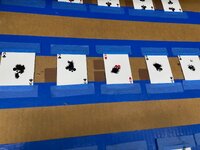
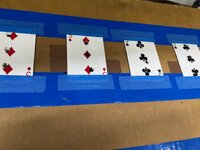
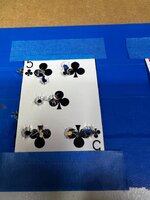
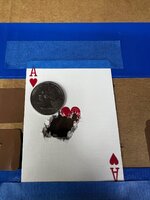
This morning's shooting:

All the aces were 10 rounds under 10 seconds (they're easier), the 5s were slower at about 12-15 seconds. The 3s were all right at just about 3 seconds. All from low-ready:image1 - Copy (2).jpegimage2 - Copy.jpegimage3 - Copy.jpegimage0 - Copy (2).jpegQuarter - Copy.jpeg
 
-Slow bullets (relative) make it easier. Fast bullets make it harder. 2700-2800 much easier to get back to area of interest. 3000+ and the bullet is already at the target by the time you’re done riding out the recoil swell.


I’ve noticed this as well and is why I sold
my 22-250. Nearly identical rifles. 22-250 was approx 8.5-9lbs while my 6.5cm is 9.5-10lbs. The 22-250 had considerably less recoil but my ability to spot shots at 400+ was about the same due the 22-250 running 3050+ while the 6.5cm is around 2500


Sent from my iPhone using Tapatalk
 
Something I've been working pretty hard on lately with pistol, is giving myself zero time to fine-tune the shot, and just press the trigger the absolute instant I perceive the dot crossing onto the target. folks call this active trigger control and I like it for all shooting. It’s much like training the brain to set the hook fly fishing - it’s quick and automatic.
I think what you’re talking about some call active trigger control, and learning it over weaving all over the target until the trigger breaks randomly has resulted in a quick jump in my personal scores. Anything that is quicker and cuts group size is hard to argue against.

What was a surprise to me is it takes a couple tenths of a second for the brain to move the trigger finger, so we’re actually trying to fire slightly before we’re on target. Some try to fire as the crosshairs pause on the target, and this is just trying to find a way to pause for that fraction of a second of reaction time, but that or firing as the crosshairs are almost on target both have been shown to be correct. Both are anticipating and trying to move the finger before the shot to allow the shot to connect. There’s a video mapping Olympic shooters sight picture on target with trigger pull showing different personal variations and no one way was dominant, other than good shooters have consistency.

 
What shooting experience leads you to believe that?


Ok. How so? How does- “I’m pulling a trigger” and then that trigger releasing become a “surprise” and causes you to blink?


Have you shot much full-auto?


Make your flinch and anticipation worse.
I imagine different people have weaker or stronger reflex blink pathways. Maybe folks with less reflex blinking can’t relate and not blinking is easy (unless they develop a flinch) you note about “with hearing pro” supports this - would you blink if you fired a breaker gun without hearing pro do you think? (Genuinely asking)

To me it clear that this is a subconscious REACTION (reflex blink) to the noise and or recoil. (an unsurpassed 22LR might help define if the noise or recoil is of greater stimuli to me since it will still be noisy but without recoil)

If I imagine a thought experiment where a 100 people who have never seen or fired a gun are asked to do so without any knowledge of what will happen, I think nearly all would blink after the shot. It’s the normal human response and has to be conditioned out through desensitization. Maybe folks like you that have fired so dang many rounds have Long since done that.

I have never fired full auto anything and don’t anticipate such an opportunity. But it stands to reason that one might stop blinking during a long sustained rapid firing sequence as you become desensitized to it.
 
Back
Top