I had to go on a bit of a scavenger hunt this afternoon through my hard drive. I happened to see this and set it aside. It's an article I wrote a while ago, to be more precise probably 8ish years ago. Don't hold me to this exact time line it could have been 7 or 9?
Anyway, it's a short bit of research I did to help folks coming to Africa to hunt with me solve some of the insect paranoia they had. Maybe more detail then needed for you, probably most folks already know this anyway. But hey its worth what you're paying for it!
Here is a copy of a magazine article I wrote. It pretty much covers the types of repellents and clothing treatments available, it is a fitting subject for this booklet.
How many times have you tried to remain motionless with big game staring your direction and a Mosquito is boring a hole into your forehead? *You have to wonder how many animals you have spooked while swatting at flying and buzzing insects around your head as well. What is the best Insect repellent, and what are the ways to use insect repellents to get the best use of their research and development?
*Are they safe to use? *What amounts are safe to use for extended periods? *What is the best carrier or base to use? Lotion, aerosol, or oil based? I am sure that like me, many of you just squirt the Bug dope of choice on your hands, rub it all over your skin and figure that is good enough. Of course it must be safe, it has been tested, and certainly the government would never allow anything unsafe for the consumer to purchase. *
I hunt in Africa each year with groups of hunters I put together from the USA, Europe and even the Middle East. *
Africa may not have the worst bugs by volume that I have ever experienced but they do have some of the most dangerous insects around. Malaria and tick fever are common problems, which can be deadly. *Even though I have been under full attack by so many Mosquito's in Alaska that I was inhaling them while breathing, at least ( at the time) they did not carry a deadly strain of a virus!
I tested several brands of insect repellent and insect killer while I was there for my hunting groups this spring. *I also did quite a bit of research on this before I left the states to base my findings on with the various products I tested.
There are lots of different brands of bug repellents on the market. However there are only two basic types. Those that repel insects, and those that kill insects. The most common chemical used to repel insects is N,N-diethyl-m-toluamide. Otherwise known as Deet. This is the current day "buzz word" in insect repellents. Used in various strengths from 5-10% all the way to 100%. Deet has been so well studied that I have too much information to repeat here on the subject. I can tell you that it is universally agreed that concentrations over 35-40% deet give little to no additional benefit in protection to the user. There is a point of diminishing returns beyond 35%. Billions of people have used Deet since 1954 with no known long-term problems. There has been some concern over Deet being absorbed through the skin. *During all of the testing done by the EPA it was found that no trace of Deet could be found in the body after 72 hours of using it.
Where did Deet come from?
Deet was developed by the U.S. Department of Agriculture and patented in 1946 by the U.S. Army. The general public approved it for use in 1957. The EPA estimates that more then 38% of the population use a Deet based insect repellent. Worldwide usage exceeds 200 million people annually. I think if we were going to have a problem with a product containing Deet, we would have seen it by now. *
Is there a down side of using Deet? Some people have sensitive skin and could see a rash with prolonged use. There is however no evidence that it promotes skin sensitivity or allergic reactions. Deet can damage plastics, synthetic fabrics, leather, and painted or varnished materials. Deet does not damage any natural fibers such as wool and cotton, and has no effect on nylon.
How does Deet work? Moisture, warmth, carbon dioxide and odors produced by humans attract mosquitoes, ticks and flies. Deet works by blocking the receptors on the insect's antenna. To be effective all exposed skin must be covered.
Insects will easily find any exposed and untreated skin to bite, burrow into, or suck blood from. So we positively have to cover all of the exposed skin, but what kind of base is best for the application of Deet? Aerosol spray is probably the most common and is often in an alcohol base. This media will quickly evaporate and reduce the effective duration of its use. Alcohol also promotes opening of skin pores, which increases the absorption rate by the body. The oil based formulas usually packaged in a small squeeze bottle work much better and last longer but to me they are uncomfortable to use. I hate the greasy oily sticky feeling I have with these kinds of products. The cream lotion feels the best to me, it is the longest lasting formula, is the least absorbed by the body, and can be applied to the places you need it easily.
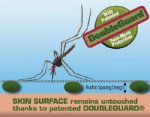
In 1998 a new development came about called Sub-micron Encapsulation, this is a big fancy word. What it means is that it contains the longest lasting and most advanced delivery system available. This is a product that is 50% more effective and much more gentle to the skin.
What is Permethrin? *Permethrin is an insect killer not a repellent. It is the same kind of chemical used to kill head lice in children. Again, as with Deet, this was the result of the U.S. Military needing a clothing treatment. The research and testing on the current product exceeded everyone's expectations. Permethrin is a clothing treatment that will kill insects that crawl across as little as ten inches of the material once treated.
Permethrin is a synthetic insecticide, which mimics the form a natural Pyrethrin found in the Chrysanthemum family of plants. It has two very desirable features. It is a very effective insecticide, and it is broken down into non-active compounds by ultra violet light. During development the Permethrin was enhanced to prolong it's use in sunlight or to prevent the breakdown by UV rays for several weeks. It was enhanced to bond better to fabrics, be completely odorless when dry, and to withstand at least two detergent washings.
While I was in Africa we hunted quite a bit from blinds near water holes while sitting on the ground. The past year in much of northern South Africa there has been an 80-year record for rainfall. What this means in the very warm climate of South Africa is that there is a lot of insect breeding grounds with the puddles of water everyplace you go. Several evenings while sitting up at these water holes while I was with clients or other Professional hunters I would watch them pick off ticks for 2 hours straight, swatting at the relentless mosquito's buzzing just out of reach.
With my permethrin treated clothing and the lotion based 35% Deet I did not get a single tick bite in nearly 6 weeks of hunting in these conditions every single day. *I think I probably had half dozen-mosquito bites during the entire trip, which was probably from lack of effort on my part. Not the fault of the Deet or the permethrin I was using. The correct use of these products comes with each one you buy. However they do not come with instructions to work together as a system.
For your benefit I will tell you what I found to work the best for me.
I treated 4 pair of pants, 4 shirts my jacket, vest, two hats, and every pair of socks I brought with me. Using the permethrin. I was doing this on a bed sheet spread on the floor of my garage to keep out of the breeze. I did one side of the clothing at a time exactly to the directions. After drying I turned them over and did the other side. Several times while checking them I noticed dead ants, spiders, moths, and flies, on the clothes and the bead sheet. Clearly this stuff was working already! When all the clothes were completely dry I folded everything up and put them inside of black plastic lawn and leaf bag to keep them out of direct light. So much for the preparation of my clothing, that was easy.
When hunting I use the cream based repellent of 35% Deet on my wrists neck and face especially around my ears. Plenty was on my hands while applying it too. *I only did my legs from my knees to my ankles. I also used it around my waist as this is the primary location ticks like to dig into. Another common location is under the elastic of your socks. However with the permethrin treated socks I was not too worried. I did get some bites in my scalp but nothing serious and I am not sure how to solve that except with a hat and head net. With long pants and a long sleeve shirt using this system of applying these insect repellents and insecticides I was able to live for six weeks in a very hostile insect environment with less then a dozen bites. Those were in my scalp, which could have been avoided by the continuous use of a treated hat or head net.
The others on this trip had as many as 20 tick bites and uncountable mosquito bites in total.
With a little preplanning and some attention to the details you can avoid things like tick fever and lime disease here in the USA as well. Remember to keep your treated and unused clothing out of light. Once treated keep them in a black plastic bag. Also remember spraying your clothing with insect repellent (Deet) will not keep bugs off of you or your skin the insects want your blood and have no interest in your clothing. The trick is to fool their receptors, which you cannot do by spraying your clothing. On the other hand spraying the insecticide (Permethrin) on your skin will not help you either. The two different products must be used within the exact design they were intended or you will be bitten up and feel the Permethrin and Deet did not work for you.
In closing I will say that Permethrin has no downside with the exception of the cost. Deet is the most effective insect repellent known. It is completely safe when used in proper concentrations and with common sense. Also keep in mind that the cream lotion is going to be the longest lasting repellent and the percentage of Deet has a diminishing return when you go over 35-40%.