Sierra Heavy TMK 6MM Testing

Those twist rate calculators are best-estimates off very basic formulas. They're great to get you in the ballpark or let you know if you might have a problem. I definitely wouldn't take it as gospel and build a rifle/bullet system based off the calculator saying your SG is 1.05 and you're good-to-go and "moderately stable" with just lowering BC.

There are plenty of variables not captured in those basic formulas that affect stability (center of gravity, center of pressure, moment of inertia) as well as environmental factors like a stiff cross wind that can push a "moderately stable" bullet over to "unstable". I'm personally less concerned with the BC reduction, but the increased dispersion and erratic flight of "unstable" bullets are the deal-breaker for me.

If I have am shooting a rifle/bullet with a calculator output under 1.3, I'm definitely going to investigate stability with fired data.

Agreed on the sentiment that the 108 class bullets are the safer bet for an 8 twist at zero or negative density altitudes.
Absolutely. I would call the model a coarse approximation, not a "best-estimate", but yeah, I agree with you that, while it has practical utility, it's not a perfect model. It's a great tool for planning purposes, however, even though your actual results may vary when you get close to the theoretical extremes. If the theoretical stability of the bullet is under an SG value of 1.3, I don't even bother testing for instability. Instead, I stick to bullets with an SG value of 1.5 or greater to make sure I'm not working with a BC value that depends on atmospheric conditions. In reality, I build the rifle to achieve an SG value of >1.5 with the bullet I want to shoot in the most dense air I plan to shoot in.

Of course unstable bullets are the biggest issue, but my point was that even if the bullet is "moderately stable" according to the calculator, that doesn't mean you check the "stable" box on your list, and move on. The degree of stability matters and affects BC.
 
There are plenty of variables not captured in those basic formulas that affect stability (center of gravity, center of pressure, moment of inertia) as well as environmental factors like a stiff cross wind that can push a "moderately stable" bullet over to "unstable".
Hence, 4DOF and AB CDMs.
 
Well, not exactly. Those apps likely use the exact same model for stability. They add additional degrees of freedom to more precisely model trajectory than some other apps, but stability is generally calculated the same way among the various different calculators.
Interesting, and not my particular area of expertise.

That said, if I'm already doing (relatively) expensive 4/5/6 DOF math, why not derive SG directly instead of applying a simplified formula to previously derived results?
 
I’m sure it’s been mentioned somewhere in the 85 pages on this thread but in hopes of not having to scroll through all of them…

I just got a 6 creed 20” 1:8 twist. I wanted to run the 108eldm, but the 107 and 116 tmk have my attention after the latest exo podcast with Form. I’ll be going anywhere from 9,000+ elevation down to sea level on Kodiak and I’m on the fence if my 1:8 twist will stabilize the 116 at the lower elevations effectively?

I want to go with the 116 if it’s possible for an across the board bullet in my setup. Does anyone want to point me in the direction of one bullet in particular? Any experience with this same setup at these elevations?

Thank you!
Just run 107tmk, they're 100% stable in an 8tw. Doubt you'll see much terminal difference.
 
Interesting, and not my particular area of expertise.

That said, if I'm already doing (relatively) expensive 4/5/6 DOF math, why not derive SG directly instead of applying a simplified formula to previously derived results?
After looking a bit deeper, Hornady's 4DOF does appear to derive stability from it's high-dimensional model, but it's the only one I'm aware of that does that. Other than Hornady's 4DOF model, most calculators compute SG based on the Miller formula which is an adaptation of the Greenhill formula.

Why don't others use 4/5/6 DOF models to calculate stability? Because those 4/5/6 degrees of freedom are independent variables (6 degrees of freedom include all three translational dimensions plus all three rotational dimensions as state variables) used in trajectory calculations, which are non-trivially based on a set of coupled non-linear differential equations. Stability is a different sub-problem with a different set of dependencies, which can be derived from a higher-degree model like 4DOF, but something like the AB CDM doesn't model the motional degrees of freedom to do that, AFAIK, and instead uses traditional models like the Miller formula to calculate SG.
 
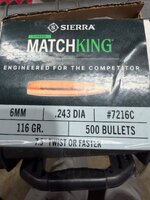
Eh, I don't know about ass-covering. It says 7.5T on the box, and 99% of people won't have an issue with 7.5T, but it gives us something to argue about on forums.

IMG_8895.jpeg
 
Back
Top