Kimber7man
WKR
Best and worst if it only takes one shot to kill it.....Which one tells you what size target you can actually hit on demand?
As stated, hunting is “worst shot”- not “average of best”.

Follow along with the video below to see how to install our site as a web app on your home screen.
Note: This feature may not be available in some browsers.
Best and worst if it only takes one shot to kill it.....Which one tells you what size target you can actually hit on demand?
As stated, hunting is “worst shot”- not “average of best”.
BT: 43.5How many grains of 4831?

That is not correct. You and every one else will zero off the cluster of shots, ignore the “flyer”, and then that flyer- is way off POA and falls outside the expected cone.
ES people zero off the center of all rounds, and all shots fall within the expected cone.
You are math dorking for the sake of math dorking. I have long history with this well before the last couple of years where certain groups are pushing it. There is “the math says…” And then there is- “reality on target in the field, shows…”.
I don’t have to math dork, I don’t have to convert, I don’t have to guess, or anything else. Shoot 20-30 shots, zero to center of all shots. Done. And at the same that 30 rounds tells me the 95% probability in MOA. 30 shot 2 MOA ES, at a base if I am missing 2 MOA targets- it is me, not the gun.
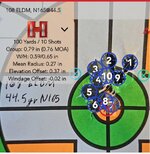
I agree that this is practically a great approach. I would like to point out what started this exchange was a discussion on ES versus MR for choosing between different loads in my original post it was about which bullet to choose from. in the context of distinguishing between loads. Asking which bullet is going to be better i.e. more precise. Can you agree that MR is more insightful than ES especially for evaluating precision of different loads . all of this is a little bit silly because if you shoot a group that’s at least 10 or bigger. The one with the biggest ES will basically always have a bigger MR. My claim is that MR is still better than ES and evaluating precision as a single number dor determining which load to choose from .I don’t have to math dork, I don’t have to convert, I don’t have to guess, or anything else. Shoot 20-30 shots, zero to center of all shots. Done. And at the same that 30 rounds tells me the 95% probability in MOA. 30 shot 2 MOA ES, at a base if I am missing 2 MOA targets- it is me, not the gun.
specifically, I just let the 4dof tell me what the center of the group is and dial zero in accordingpeople zero off the center of all rounds
Both ES and MR are metrics that aim to quantify the dispersion of your system. As Form points out, ES is better for getting a quick measurement in the field to have a simple and practical way to gauge the limits of your system given a big enough group. MR, in terms of what it tells you about your system, is better than ES. It is using all the information from your group to represent the underlying distribution (the Rayleigh probability density function), so you can do a lot more with it than ES and have more confidence in your estimates.Honestly trying to understand the difference here, and admittedly need to read more into ES and MR... but if I shoot 100 rounds in a 2moa group, my ES is 2moa, and I know I have a 100% chance of hitting a 2moa target (excluding outliers like weather, ammo lots, etc). If I shot 100 rounds with 95 of them inside 2moa, and 5 of them outside of, say 2.5moa... then I have a 95% chance of hitting a 2moa target.
Isn't the ES telling me what I can hit with 100% certainty the more valuable metric in the field as a hunter?
Just trying to see both sides here.
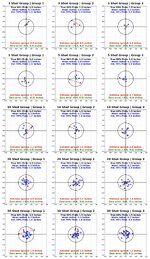
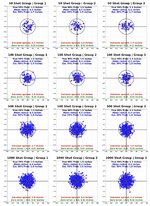
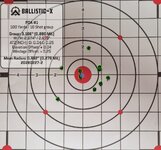
You my sir win king nerd for the day . I value your contribution here. Would love to see 2 decimal places on the Mr values just for curiositysome other neat stuff in the plots
Nice! What are details of the build?Does it still count as a Tikka for this thread if the only thing left made by Tikka is the action and bolt?
View attachment 1025120
-PVA Osprey 0.75 tapperless in 6 CreedmoorNice! What are details of the build?
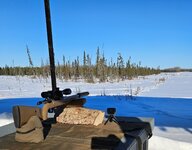

I think the OEM tikka portion of this thread went way out the window many moons ago.Does it still count as a Tikka for this thread if the only thing left made by Tikka is the action and bolt?
View attachment 1025120
Thanks. Unfortunately not all my groups look that nice. The rest of today's are in the post linked below.I think the OEM tikka portion of this thread went way out the window many moons ago.
nice shooting, and sweet build
Neither do mine, but it is nice every once and awhile to see a combo stack.Thanks. Unfortunately not all my groups look that nice. The rest of today's are in the post linked below.
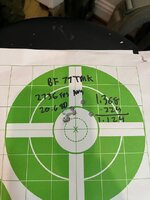
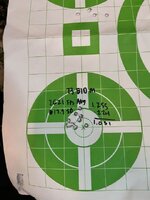
Well, interesting results. Looks like the 95 TMKs might be usable after all at 1.68 MOA for 10. Need to confirm with a 30 round group.
I changed COAL from 2.647" to 2.689" (backed the seating stem out one full turn) in addition to switching powders.
Weather was a touch hostile to good shooting, about 20 F, 10-25 mph wind coming from 11 to 2 o'clock (measured 20+ mph on Kestrel, stronger gusts than that were dragging my mat with firewood on it).
I shot groups of 10 starting at top left and working down to bottom right. Conditions were worse for groups 3 to 5 and I could see the wind...


I don't throw out fliers. But even using the ES method, you don't zero to the center of the extreme spread, you use the weighted center of the group, right?You and every one else will zero off the cluster of shots, ignore the “flyer”, and then that flyer- is way off POA and falls outside the expected cone.
I take issue with this criticism. An appreciation for statistics is why Tikkas, Nightforces, Toyotas, etc are so much better than their competitors. It's also why the methods you and many others preach end up beating the fudd-lore and dogma over and over again so reliably. Yes for this case, 20-30 shot ES is about as good as shot radius method, but it's definitely not better, and for doing comparisons with fewer rounds shot radius is provably better.You are math dorking

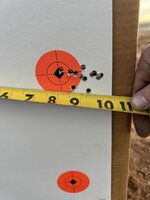
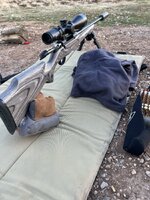
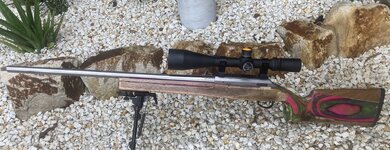
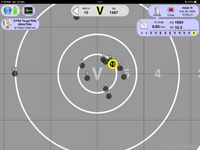 700 yards
Oh it can definitely be ammo. I have a barrel on a gasser that will shotgun pattern PMC FMJ ammo about 10", and then put a string of Hornady V-Max into about 1". The first time I shot it was so bad I thought the barrel was loose or something. Try a different ammo for sure!I'm just getting started...
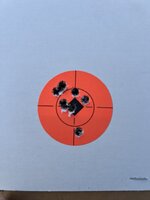
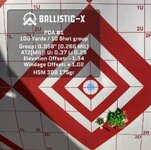
This is a 10 round group with 556 Frontier 55 gr FMJ through a Tikka 223.
Can I blame any of the spread on the ammo or do I just stink?