Seating depth - does it even matter?

I originally started cleaning my match gun every 500 rounds. Cleaning the baked on carbon was quite the process and took hours. Then I started cleaning every 300 rounds. It became much less involved. Now I do 10-20 passes every 100 rounds. It takes a couple minutes and seems to work for me in a match setting.
Did you notice any degradation in accuracy or migration in velocity to prompt cleaning after 500?
 
This I don't do. Haven't had issues in 1000s of rds without cleaning. At most a dry patch if there is literal junk in the bore like pine needles or visible crud from carrying in the field. Otherwise nothing.

Edit: I'll add that for some guns, abrasive cleaning with JB/Kroil has helped their accuracy a lot. In these cases they were new barrels that were behaving inconsistently, and I'm guessing had burrs or sharp edges that the abrasive clean fixed. But it's usually a one time thing. If I were to ever clean, it would be a deep clean with abrasives back to bare metal, with the intention of shooting for 100s of rds after.


I don't mess with it personally, I use standard Redding resizing dies which typically yield 0.002-0.003" of tension. I want the bullets to be securely held but I don't want to grab too hard or have any weirdness with seating/galling. So standard dies it is. Plus they are much cheaper.

Please share your examples if you have them, I'm always eager to see data.

I think neck resizing ONLY is a big mistake for any type of shooting period.


This makes intuitive sense. Also, measuring "jam" is not a perfect art. I've seen and done at least 4 methods, none of which are perfectly precise or repeatable. So in some cases what you think is slight jump is actually jam, or vice-versa. I always start 0.020-0.030" away from lands or more.


Did he by chance demonstrate this with 3-5 shot groups?
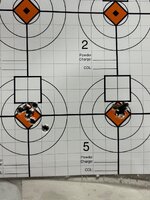
I have the target at the house, I’ll post them up when I get home. Admittedly the the more sporadic group was really light NT, because I intended to shoot 195’s which sat much deeper in the neck (more surface area in contact). But decided to test 180’s instead. Which only go about 1/2 into the neck. They shot okay, but not how they normally shoot. Figured it was the unplanned low NT. Sized the necks down another .002 and it put 8 shots into a .4.

Groups are side by side and it looks pretty compelling lol.
 
Did you notice any degradation in accuracy or migration in velocity to prompt cleaning after 500?
Just picked a random number of 500 to start. Velocity would creep up as I got close to 500. The bigger issue was that I could never clean all the carbon out of the bore. Then after the next 500 there was still a pretty good layer in the bore.

After a few cleanings the barrel acted “shot out” and I would pull it.

Now I get much greater barrel life by keeping up on the carbon and not letting it get out of control.

For my hunting stuff, The dont even keep track and clean when the gun gets wet or stuff gets in the bore.
 
Just googled Alex Wheeler neck tension and found a thread on accurate shooter of him "tuning" a 300 PRC and I think I'm going to catch alzheimers if I read too much of this stuff:

The next combo I tried was H1000 and 230 Berger hybrids .020 off.
77-2907
77-2901
77.4-2923
77.8-2946
78.6-2950
79-2958
79.4-2971
79.8-3002
80.2-3000
80.6-3036
This ladder looked great, 2 obvious nodes, 2901-2923 held .658" of vertical at 600yds, 2971-3002 held .714". 3 shots in each node. This is the combo this barrel is going to like, 3 shot groups around each node at 1k is the next step. Then fine seating and hopefully its done.

Ran the upper node at 1k at -9 this am. Forgot the ammo in my truck last night so I did my best to warm it up. When things get this cold they start to fight you a bit. ES was a little higher than it has been which I think accounted for the one dropped shot, mirage was pretty bad too so who knows. Even still it shot 2 groups in the 3s for vertical, one in the 1s, and one in the 5s. It seemed to run about 10 fps higher this time out. My aim dot is 4".

One thing to note which may help some of you guys is that this thing required a total re tune once I fired the brass. Different seating depth and powder charge. I have seen this before in other cartridges especially magnums. Even the node itself moved. Most of the time we don't have to deal with this because we are playing with cartridges that require fire forming so you never actually shoot new brass. Just fyi.


Absolute horror show of small sample testing, drawing shapes on targets, eliminating fliers, making assumptions, finding different behaviors when testing again and coming up with elaborate theories to explain it away. The replies and comments are even worse. I seriously don't understand how anyone reads this and believes it.


Yeah man, that is the path to insanity!

Trusting results from single shots and then thinking your powder charge, seating depth, neck tension, 1x more firing on brass, and on and on are the cause of why a single shot went somewhere that wasn't ideal. Insanity. Screw that noise.
 
Did he by chance demonstrate this with 3-5 shot groups?
Taking the results with a grain of salt, but when I was digging into his info posted in the past he had posted multiple ladder tests looking for "powder nodes", and in many examples the vertical dispersion was much tighter on the tests with higher neck tension.

Just googled Alex Wheeler neck tension and found a thread on accurate shooter of him "tuning" a 300 PRC and I think I'm going to catch alzheimers if I read too much of this stuff:
Haha I agree, I stopped reading all the rest of his tuning stuff for the same reason.
 
I'd argue that no test is ever "complete", you just have to pick a criteria to satisfy or not. I'm not asking anyone to do a proof of a physical phenomenon to 5-9s confidence like we're in a university lab or something. Again, the engineer in me always wins over the physicist, and I think there are extremely useful tests that can be run with 10s-100s of rds, which in the long run will actually SAVE far more rds than that due to killing the myth of "tuning".


Even this is a test procedure with an established (liking what you see in 10rds) criteria. You left off the part about what to do if you DON'T like what you see, which is also very important IMO.

There is a lot to be learned on how to actually test well, control variables, and shoot consistently enough to do a meaningful test, so I think there is additional value there. I encourage everyone to test it for themselves so they can have the same firsthand breakthroughs I did.

It's annoying we even have to "disprove" this stuff, but these myths and arcane practices are so entrenched and widely accepted. People on this forum always complain about the repetitive threads where FNGs come in and present this dogma and get in a longwinded argument just to eventually disappear or give in. But I consider this the face of progress, we are literally changing people's minds one shooter at a time. Maybe when my kids bring a new rifle to the range they won't have to listen to some idiot telling them about powder nodes and barrel harmonics.
If you dont like what you see change bullet try again but so far I have not had to do this. And when I say like what you see im talking pressure signs velocity etc.
 
This was that neck tension difference I was referring to.

Left group is like .001 NT. Right group is .003 NT.

8 shots in each group

View attachment 986554


With really light neck tension, you can cause runout just loading them. I haven’t done a big structured thing for it- but that group is looks like what happens with bullets that get runout.
 
This was that neck tension difference I was referring to.

Left group is like .001 NT. Right group is .003 NT.

8 shots in each group

View attachment 986554
Definitely a real difference there. Agreed the light neck tension and only a half of the neck "engaged" on the bearing surface (which I think you mentioned for this load) could cause problems with runout.

The most extreme version of neck tension would be a crimp, which I've also never messed with in my reloading. However, I would love for my ammo to be completely waterproof and impossible for the bullet to move around, so I can see why it's done.
 
Definitely a real difference there. Agreed the light neck tension and only a half of the neck "engaged" on the bearing surface (which I think you mentioned for this load) could cause problems with runout.

The most extreme version of neck tension would be a crimp, which I've also never messed with in my reloading. However, I would love for my ammo to be completely waterproof and impossible for the bullet to move around, so I can see why it's done.

What’s the downside to more or too much neck tension?

Is there a practical limit that reduces the issues with too little neck tension, but doesn’t go too far the other way?
 
What’s the downside to more or too much neck tension?

Is there a practical limit that reduces the issues with too little neck tension, but doesn’t go too far the other way?
You can possibly deform the bullet or dent the nose of the bullet with the seating stem.

But as far as accuracy, you have to shoot it to see if it matters.

I started using lighter NT when I started shooting ELDM’s. Berger’s would slide right in on a .003 NT case and ELDM’s would take much more force to seat into the same case, and also shoot substantially worse.

So I’d open the necks up until the ELDM took about the same amount of force to seat into the case, and the groups basically shrunk in half.

But just initially seating them I could tell something was off. They either have a harder jacket, or a “stickier” type of copper jacket than the Berger’s. Because they all measured the same OD of bullet caliber. Of course still had to shoot them to see. These were 225 & 180 ELDM’s. 80 ELDM’s in a 22CM, didn’t seem to matter. Just those bigger cases with bigger bullets and more surface area I guess
 
What’s the downside to more or too much neck tension?

Is there a practical limit that reduces the issues with too little neck tension, but doesn’t go too far the other way?
With too much tension I'd be worried about damaging the jacket, deforming the case, or imprinting the seating stem into the bullet.

Again, 0.002-0.003" NT has been pretty "standard" from any non-bushing Redding dies I've used. That's with quality brass typically 0.013-0.015" neck wall thickness.

Because they all measured the same OD of bullet caliber.
You would probably need to measure with a micrometer to the tenths to actually see the difference in diameter.

A year or two ago I started chucking a brass brush in a drill and just quickly running it down in the neck of each case after trim and resize and before loading to remove any uneven carbon deposits, literal dirt or crud, burrs from trimming, any lube the might have worked it's way in there, etc. I *think* it made all my seating more uniform, but that's just a feel/perception thing and may not be real. The biggest thing for uniform seating for me was getting a really consistent inside and outside chamfer on the case. The small lead in and lack of a sharp edge or burr on the inside lip is really noticeable in terms of seating force/uniformity. I want the lip of the case neck to look like this in cross section:

1765984947952.png
 
Another comment on using neck bushing dies and neck tension. I think it's far superior to do the final sizing of the neck from the inside of the neck rather than the outside. This means that your neck will always have the same round ID and force any thickness imperfections to the OD. If you use a bushing to size the neck from the OD, you are now pushing any thickness variations to the ID of the case and the bullet, and making your seating force consistency and concentricity worse. This can be solved by over sizing with a bushing and then opening up with a mandrel, but that's an additional step and at that point you might as well just use a normal die and remove the expander ball. All in all, I think you gain nothing or straight up make your ammo worse if you use a neck bushing only. And if you want to pay more for that die, then correct the problem it creates with yet another expensive die and another step in your reloading, be my guest, but it's not my choice haha.
 
You would probably need to measure with a micrometer to the tenths to actually see the difference in diameter.
Oh I agree, but 1/10’s wouldn’t equate to the difference in seating force I was experiencing. Just measured them to the nearest .0005. They’re close enough that it was for sure something with the jacket.
 
Another comment on using neck bushing dies and neck tension. I think it's far superior to do the final sizing of the neck from the inside of the neck rather than the outside. This means that your neck will always have the same round ID and force any thickness imperfections to the OD. If you use a bushing to size the neck from the OD, you are now pushing any thickness variations to the ID of the case and the bullet, and making your seating force consistency and concentricity worse. This can be solved by over sizing with a bushing and then opening up with a mandrel, but that's an additional step and at that point you might as well just use a normal die and remove the expander ball. All in all, I think you gain nothing or straight up make your ammo worse if you use a neck bushing only. And if you want to pay more for that die, then correct the problem it creates with yet another expensive die and another step in your reloading, be my guest, but it's not my choice haha.
I use the SAC bushing die with expander mandrel. It works great doing exactly what you are talking about, and saves time from having to do two seperate operations. The cost is up there but for high volume reloading the time saved is worth it.

Chamfering like you drew above is an absolute must to avoid scoring the jacket.
 
I only used a neck bushing with my Nosler stw brass, wall thickness variations were less than 5 tenths and the "bushing only" provided good results. I settled on .004 NT after trying 2 and 3.
I bought 200 pcs of ADG 7prc brass for the new cartridge and it's almost .002 variation on the wall thickness. At that point I was forced to use a "mandrel" so I bought some 30 cal expanders and turned them down on the lathe. I use a .2795 polished expander now after the sac neck/shoulder bushing and results are good. At some point I'll do the same as 207 and add the sac mandrel to the bushing die and do it all in one shot.
 
I only used a neck bushing with my Nosler stw brass, wall thickness variations were less than 5 tenths and the "bushing only" provided good results. I settled on .004 NT after trying 2 and 3.
I bought 200 pcs of ADG 7prc brass for the new cartridge and it's almost .002 variation on the wall thickness. At that point I was forced to use a "mandrel" so I bought some 30 cal expanders and turned them down on the lathe. I use a .2795 polished expander now after the sac neck/shoulder bushing and results are good. At some point I'll do the same as 207 and add the sac mandrel to the bushing die and do it all in one shot.
My ADG 7 PRC brass is inconsistent as well. Also .003 neck thickness differences between lots. Junk lol.

I have 500 pieces of Lapua pre-ordered when it drops early next year.
 
My ADG 7 PRC brass is inconsistent as well. Also .003 neck thickness differences between lots. Junk lol.

I have 500 pieces of Lapua pre-ordered when it drops early next year.
I've had some weird results with ADG as well. Lapua or bust honestly. Just hard to get these days but it's worth the trouble. Another Finnish standout.
 
I only used a neck bushing with my Nosler stw brass, wall thickness variations were less than 5 tenths and the "bushing only" provided good results. I settled on .004 NT after trying 2 and 3.
I bought 200 pcs of ADG 7prc brass for the new cartridge and it's almost .002 variation on the wall thickness. At that point I was forced to use a "mandrel" so I bought some 30 cal expanders and turned them down on the lathe. I use a .2795 polished expander now after the sac neck/shoulder bushing and results are good. At some point I'll do the same as 207 and add the sac mandrel to the bushing die and do it all in one shot.
Get the decapping mandrel if you do. Saved one more step.
 
Back
Top