Chris in TN
WKR
- Joined
- Jun 17, 2025
- Messages
- 1,912
OP - if you're looking for a sign, this is it - you should take Q up on his offer.

Follow along with the video below to see how to install our site as a web app on your home screen.
Note: This feature may not be available in some browsers.


Yup. If you know me you will know I advocate for people to try both systems and pick what ever one works best in their brain under stress. Stick with that system and practice practice practice.Then we're on the same page on both issues. Any theoretical speed advantage of one system is meaningless; any theoretical accuracy advantage of another system is meaningless. People should pay their money and make their own choices.
I'm on board with that.Yup. If you know me you will know I advocate for people to try both systems and pick what ever one works best in their brain under stress. Stick with that system and practice practice practice.
Hence why above I still recommended the SWFA because if he hates MILS he can sell the scope and not lose a ton of money.
I could see where having a base 10 system would be appealing to some people.This has not been my experience. MRAD allows much easier and faster wind correction and elevation correction, often without needing dope cards or ballistic calculators.
With a .243 as OP is using, he probably doesn't have a "quick drop" friendly trajectory, but wind is still much more intuitive to hold .1 per hundred yards per 5 mph or 6 mph of wind (depending on specific bullet/speed) than it is to do a similar MOA formula.
Slower cartridges (.223 with 77s, 6mm ARC/Dasher, 6.5CM, some .308 loadings, etc) often have a trajectory that lines up as follows:
100 - 0
200 - 0.5
300 - 1.0
400 - 2.0
500 - 3.0
600 - 4.0
Every 10 yards is another 0.1 so 330 would be 1.3, 480 is 2.8 etc.
With lots of cartridges, I can make hits out to 600 without touching a dope card or ballistic calculator, doing drop and wind in MILs in my head faster than I can look at an MOA drop/wind chart.
My only regret in switching is not having done it sooner.
Varmit hunting.can you share a few instances where that finer adjustment mattered in a field scenario?
I could see where having a base 10 system would be appealing to some people.
For me, I like to sight in a solid point blank range, and use hold over reticles.
In my 270 this means o is 275. 350 is 2" low, or one reticle line down, the next line is 450, then 550. I hardly ever have to shoot past 200 yards on game.
I dont worry about systems aligning by the exact 100 yard increments because ive yet to find animals that will align with the 100 yard increments.

The issue is that particular BDC reticle for that particular rifle may work that way, but they're all a little different. I can put any MRAD scope on a quick drop friendly rifle and go shoot. My fast 6mm doesn't line up, and while I have a solver in my rangefinder it's so nice to pick up one of my other rifles and just shoot. All my kids' rifles are quick drop friendly so that I'm not switching between profiles to get their solutions. It's not just that it's base 10. It's base 10 that scales incredibly well to multiple aspects of shooting rifles in many common chamberings. Switching from quarters to 0.1 MOA on a scope would not make it better.I could see where having a base 10 system would be appealing to some people.
For me, I like to sight in a solid point blank range, and use hold over reticles.
In my 270 this means o is 275. 350 is 2" low, or one reticle line down, the next line is 450, then 550. I hardly ever have to shoot past 200 yards on game.
I dont worry about systems aligning by the exact 100 yard increments because ive yet to find animals that will align with the 100 yard increments.

Wow…. That didn’t take long…Unless your affiliated with an agency that has standardized mil radians, there is no benefit for a recreational shooter to use this over minute of angle. Moa is a smaller increment and the scopes tend to have finer adjustments.
I have a 2-12 Athlon Helos BTR Gen 2, and so far, think very highly of it. I haven’t dropped it, but it has held zero through miles of riding muzzle down in the front seat of my UTV. Its feature set is superb, it adjust, tracks, and returns to zero correctly. The glass is surprisingly good, and the reticle is useable even at 2x magnification.I am looking to get a mils scope for my 243win. I have only had one ffp scope and it has an moa bdc type reticle. I am not a huge fan of a tree type reticle but also have never used one to really know. I plan to use this scope for target practice mainly but the rifle is my main hunting rig also. Budget is 500-600. I really like the look of the Steiner h6xi 3-18 str mil despite being a tree reticle. Only the cross illuminated would help me i think. I have also looked at the new s2h scope but cant swing that much right now. Just got married and am in the middle of a reno job. The 3-15 or 3-18 range is preferred. Any help is greatly appreciated

Literally had coffee shoot out my nose, laughing when I read that! You are the leader in the clubhouse post count, bringing up moa in threads that are only about mils!So why would you say that to me but not the guy I was replying to?
I wholeheartedly, deeply agree that not every thread has to or should turn into mil vs moa.


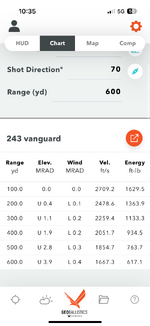
So funny enough a 243 with 100gr interlock running 2950 (theoretical velocity as i have not developed load yet) is almost exactly those numbers.This has not been my experience. MRAD allows much easier and faster wind correction and elevation correction, often without needing dope cards or ballistic calculators.
With a .243 as OP is using, he probably doesn't have a "quick drop" friendly trajectory, but wind is still much more intuitive to hold .1 per hundred yards per 5 mph or 6 mph of wind (depending on specific bullet/speed) than it is to do a similar MOA formula.
Slower cartridges (.223 with 77s, 6mm ARC/Dasher, 6.5CM, some .308 loadings, etc) often have a trajectory that lines up as follows:
100 - 0
200 - 0.5
300 - 1.0
400 - 2.0
500 - 3.0
600 - 4.0
Every 10 yards is another 0.1 so 330 would be 1.3, 480 is 2.8 etc.
With lots of cartridges, I can make hits out to 600 without touching a dope card or ballistic calculator, doing drop and wind in MILs in my head faster than I can look at an MOA drop/wind chart.
My only regret in switching is not having done it sooner.
So i do not have to dial for any shots on game where i am. Every single shot i have ever taken with the exception of three have been inside 200 yards. One if those two was at an uncles 500 yard target with his rifle after he dialed it just to let me shoot it. One was a sighter in north dakota with my other uncle. Third was at a muley the same trip. I will however dial for practice once getting a scope that will. I can stretch a potential 375 yards on our farm so ill set various targets across the field just to practice dialing. I will never get over 2 mils unless i go to a range somewhere which is nowhere close to home. If i was getting this scope simply for hunting then i would not care. My mpbr is almost the same as my max possible shot.In fairness to the mrad guys here…..I have a couple rifles set up like that and once you get maybe 100 yards past MPBR scenarios, it gets iffy.
One hash mark extra elevation on a ‘aim long’ hurried scenario: great. I’ve done it often and several times under pressure including the most rushed shot of my life, and I nailed it. Two hash marks: doable but not ideal.
More than two hashes? My brain starts to slow down and wants to recount. Terrible idea for hunting. Maybe it would be OK if you had a custom reticle with marked distance hashes. But in the shooting I’ve actually done, once you get very far into those holdovers they start to slow you down.
I pretty often shoot a couple of .22lrs, one with a not so great holdover reticle out to 225 yards and one with a somewhat better reticle out to 330 yards. Neither are ideal and I’d much prefer to just dial if I am serious about hitting stuff. I realize that what I’m saying isn’t really a mrad versus moa point of discuss but to the credit of the mrad guys, most of them are adamant about dialing at distances if at all possible outside of that narrow, limited ‘aim long’ scenario, and I applaud them for that.
In short, one extra hash mark is ok. Two is workable. Three is downright iffy. If your brain can process all of that in a manner that is faster than just dialing, my hat is off to you, but I can’t do it.
If I was hunting with OP I’d much rather see him start dialing past 300, regardless of what graduations he was using. YMMV. I’m not saying you should switch. I’m just saying that my kids are learning to dial when possible.
ETA: also, another problem with secondary holds is that they really need to be less visible than the primary hold and at some point in field conditions you’re going to be relying on a less visible hold.
I just had to look up what a wind rose is if that tells my experience level. Also that is great to know that the 10x will at least do me well to get started.OP, SWFA 10X will work for PRS/NRL. Definitely get mils not moa. Learn the bc method or mph gun method (same method, but different people call it different names) for calling wind and learn a legit wind rose. At that point you'll be well on your way.
I am just unsure of the circle around center which is why i leaned to the ares. I understand its purpose but have never been behind a scope with one so i am hesitant. The standard mil cross is basically an educated duplex so i feel more confident there.I have a 2-12 Athlon Helos BTR Gen 2, and so far, think very highly of it. I haven’t dropped it, but it has held zero through miles of riding muzzle down in the front seat of my UTV. Its feature set is superb, it adjust, tracks, and returns to zero correctly. The glass is surprisingly good, and the reticle is useable even at 2x magnification.
For your stated budget, that would be the one I’d be looking at.
John