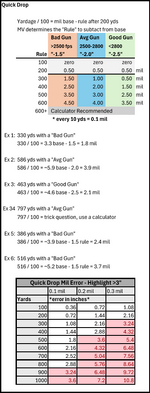
Quick Drop vs Danger Space

Ok, had some time to wrap my head around this a bit and I have some additional questions for the brain trust. Maybe Im misunderstanding or misusing some of this, but it seems many of the advantages of QD are really degraded if you dont have a cartridge that fits into it exceptionally well, but notably also anytime a “partial” or non-linear correction is required on top of the basic qd math. Hence the original question obviously, but given the necessary adjustments it seems even many guns that “fit into QD” will run into this at some DA where a correction is needed…

First, NONE of my guns fit into QD as well as those pictured. That may be the first issue. If I go way up in DA to something like a “western mountains” zone my 6.5’s start to fit pretty well. But just as an example, this morning waking up Im at NEGATIVE 3000’ DA. So nothing I have is a perfect “base qd” that stays within a tenth out to full practice range. So I’ve got limited range to functionally use base QD (which is +\- where Ive had success using it), and/or I frequently have MULTIPLE correction factors just at one DA. Example is my 270, where I can use base qd to 350yds, but after that I have to use a .5 correction. So if “mental load” is a significant goal, then it’s basic qd math (easy enough) but only to 350 yards (hardly past pbr), then past that range its a different math with a correction. The key is that frequently I’ve not been able to apply one correction across the entire trajectory, which introduces an additional thing to remember and an additional mid-shot decision. So “in the moment” when QD is useful, Im left with
1) qd math
2) multiple corrections to remember
3) in the moment decision: choose WHICH correction factor to use
4) apply correct correction factor

Thus far when practicing on a clock I have been unable to consistently apply the correct adjustment to the base qd when Im hovering around my cutoff range (ie first shot is at base qd, but a follow up enters the range where a correction is needed, or vice versa).

So Im left asking the same question that I have been struggling to articulate. I do understand base qd. I do understand a standard correction to it. The issue is that in my situation, for the guns I have, it’s rarely been that simple, even with standard cartridges. In order to stay within a reasonable amount of error for a first shot at an animal, what applies is multiple correction factors all at the same DA. To me this is not achieving “lower mental load”. And while I may have taken one too many wacks to the head as a child, my apparently-smooth brain just hasnt managed it well.

So, in this case, is there a simpler solution? Why not a taped BDC turret marked in yardage…in conjuntion with a correction factor? Folks have argued pretty vocally that such a turret is a bad idea, and I would have tended to agree…but Im curious on this, given the specific situation what youd actually be giving up, and what situations that would make a difference? I guess it just seems to me that utilizing yardage on the turret with ZERO math, and then only using and having to remember a correction factor (ie “dial to X marked on turret, then dial correction clicks) is actually less of a mental load than QD+correction, but would utilize the same correction factor in order to achieve equal precision across DA’s without needing the math. Plus, if that allows a flatter-shooting cartridge it would have the benefit of 1) minimizing the correction needed in the first place, and widening the range of DA’s where no correction is needed, 2) minimizing the impact of ranging errors, etc, everything that goes with that flatter trajectory.

Curious on folks thoughts on this.
You are correct in that what makes QD so useful is it's simplicity and low mental load, and that is diminished when there's multiple correction factors to remember.

Before getting to alternatives, I am curious as to why none of your rifles match up. 6.5 creedmoors are usually close, and fast, flat rifles like your 270 usually match QD better with lower DA. Would you mind sharing some more info on the rifles, bullets, velocities, and dope charts you're working with?

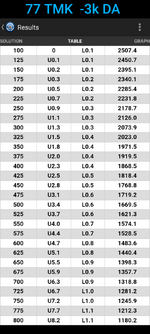
For example, below is a 243 with 95 TMK's at -3,000 DA. It's base QD out to 600.
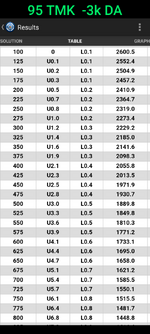
Screenshot_20260318-090840.png

And the 223 from my previous example: base +0.3 out to 500.
Screenshot_20260318-090710.png
 
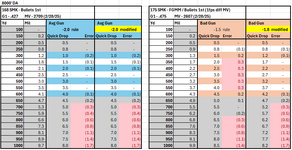
I dove in to Quick Drop when I bought a "dial-y" scope last year. From the Form provided info I made my own cheat sheet & examples as I worked through learning it. Spreadsheets are what I do for work so putting everything into tables really helps show the trends and better understand the the system and how to adjust for different MVs / Loads (168 vs 175 SMK for 308). Admittedly I only own a 308 that fits pretty well with QD so I'm a believer and dont have any experiences with other cartridges that may not work well with QD. Hopefully this helps some people better grasp the system.

1773849531246.png
1773849709373.png
 
I guess the point and the resulting questions are twofold.
1). I am challenging the statement that “a simple 0.5 correction applied beyond 350yds” is an easy thing.
2) i am saying that some rifles that ARE friendly, BECOME unfriendly as you go to an extreme of DA.

Example: My 20” 6.5cm is shooting a 140 eldm at 2598fps mv. Thats garmin chrono velocity. Im at a DA today of -3000’. According to my AB, which is pretty well trued, regular QD puts my cone center almost 5” off target beginning at 300yds, and increasing from there. At 700 yards cone center is off .6mils, or over 16” from poa. Depending on the max range I want to use QD, I can use a correction factor anywhere from .1 thru .4 to do better.
BUT, the exact same rifle at a DA of 8000’ the basic QD formula has me within .1mil all the way past 800 yards.
Two different DA’s, two completely different QD situations.

I have the opposite case with my 270 shooting regular ttsx’s (270win, 130ttsx @3000fps). It fits QD pretty well here near sea level, but it breaks down and requires a correction factor past 350 when Im at a high DA.

So thats what Im getting at:
1) I do not accept on its face that a correction factor applied only at certain distances is a simple thing that sufficiently achieves “reduced mental load” such that it can be brushed off as easy under stress. I may very well be a smooth-brained exception, but I suspect Im not the only one.
2) many guns only fit perfectly into QD across some range of DA. What do you do if you spend time outside that range?
 
Could you elaborate? If youre suggesting I just need a gun that matches better, neither my 24” nor my 20” 6.5creedmoors match especially well with factory-loaded 140eldms, they are better than the example gun I used but only out to moderate range and definitely not as cut and dried as the examples others have posted about, so I think its fair to say its not only an issue of uber-flat shooting cartridges.
It's an opportunity to get a 6.5PRC with a shorter barrel if you want that diameter cartridge or get a 6 or 22 with a shorter barrel.
 
I guess the point and the resulting questions are twofold.
1). I am challenging the statement that “a simple 0.5 correction applied beyond 350yds” is an easy thing.
2) i am saying that some rifles that ARE friendly, BECOME unfriendly as you go to an extreme of DA.

Example: My 20” 6.5cm is shooting a 140 eldm at 2598fps mv. Thats garmin chrono velocity. Im at a DA today of -3000’. According to my AB, which is pretty well trued, regular QD puts my cone center almost 5” off target beginning at 300yds, and increasing from there. At 700 yards cone center is off .6mils, or over 16” from poa. Depending on the max range I want to use QD, I can use a correction factor anywhere from .1 thru .4 to do better.
BUT, the exact same rifle at a DA of 8000’ the basic QD formula has me within .1mil all the way past 800 yards.
Two different DA’s, two completely different QD situations.

I have the opposite case with my 270 shooting regular ttsx’s (270win, 130ttsx @3000fps). It fits QD pretty well here near sea level, but it breaks down and requires a correction factor past 350 when Im at a high DA.

So thats what Im getting at:
1) I do not accept on its face that a correction factor applied only at certain distances is a simple thing that sufficiently achieves “reduced mental load” such that it can be brushed off as easy under stress. I may very well be a smooth-brained exception, but I suspect Im not the only one.
2) many guns only fit perfectly into QD across some range of DA. What do you do if you spend time outside that range?
like anything, QD has its limitations and ideal operating range.
outside that ideal range, you are correct, it's no easier because you have to do all the things that QD eliminates.

it's really that simple, it works or it doesn't.

I realize not everyone has a safe full of guns to choose from, but if you do have multiple different rifles/cartridges, when one doesn't work, a different one may work.
Or if you hunt sea level and 11,000 regularly, it might make sense to have a rifle set up for the average DA for each place.

people keep pointing out the instances where it doesn't work and want to call it pointless or whatever.

In the cases where it does work, which is all I care about, it's stupid quick and easy.

So stupid quick and easy, I'm one of the ones setting up several rifles specifically for QD/avg gun.

For me, most of my fall hunting and all of spring bear fall within average DA's that allow me to use QD.
At that point it's just a matter of range, what rifle/bullet/velocity do I need for the potential max range.
 
That makes sense. Also, just to note, Im not saying any of this as a rationale against qd. I’m saying it because Ive used it and like it where it fits reasonably well, and Im trying to find a better way to do it in those situations where it's a bit more awkward without a complete re-do of my safe, which just aint happenin.

Unfortunately, living and practicing in a cold/low elevation climate is not conducive to practicing with the gun you take to 9000’ in october elsewhere.
 
That makes sense. Also, just to note, Im not saying any of this as a rationale against qd. I’m saying it because Ive used it and like it, and Im trying to find a better way to do it without a complete re-do of my safe, which just aint happenin.

Unfortunately, living and practicing in a cold/low elevation climate is not conducive to practicing with the gun you take to 9000’ in october elsewhere.
This is where I am, I don’t doubt that it works. I want to see the practical limits of it. I am the same with BDC turrets, they work, but what are the practical limitations.

This thread has helped me understand better. Some people I shoot and hunt with don’t want the techno gadgets, and, they don’t shoot past 500. So this seems like a workable solution I can give them, which also works great taped to the stock.

I still don’t see it for me, but maybe it will be what I want if I have a hunt that will require it. AZ glassing/hunting is why I picked my system that works in every situation, but it require me ranging. That is less mental load to me. And, my particular hunting scenarios allow for that here in AZ where I have more time.

Even still, whenever I am walking, I carry a rifle and dial on my MPBZ, and I usually remember how many tenths to add out to 400. If it is further than that, distance gives opportunity. If I am in an ambush spot, I range spots and draw a range card with yardage for open spots, front/back of meadow, etc. I have started to mess with turret tape recently as well.

It isn’t as simple as QD walking around 100% of the time, but they are close enough for me.

I am going to plug my rifles into a spreadsheet and play with it. I bet my 14” 22 creed could work with QD. That’s actually an interesting thought to me, and might be fun to play with.
 
Where did "Quick Drop" come from? I'm curious who started calling it that, and promoting it.

It's actually nothing new, and been used for years. Mostly as a hack or quick way to get rounds on target, mostly COM. Just not with the clever name!
 
Where did "Quick Drop" come from? I'm curious who started calling it that, and promoting it.

It's actually nothing new, and been used for years. Mostly as a hack or quick way to get rounds on target, mostly COM. Just not with the clever name!

It “came” from me- the first mention of it online was from me probably 2012 or 2013. The first time I taught it to people was probably 2009 or 2010.. I didn’t have a “name” for it for a long time and just referred to it as “average gun”, “good gun” and “bad gun”. Several years later Accuracy 1st started teaching “speed drop”, where you reset your turret to match your drops (I.e., 300m was 3 mils on the turret). I think it might have been @PNWGATOR that came up with the quick drop name when he learned 2016 or 17.
 
I am going to plug my rifles into a spreadsheet and play with it. I bet my 14” 22 creed could work with QD. That’s actually an interesting thought to me, and might be fun to play with.
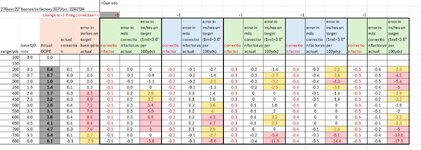
Playing with this and experimenting between various DA's, I already made a excel sheet you can plug in the actual Mil solution values from your calculator, and it'll show you how it lines up with base quick drop in both mils of error as well as inches of error on target for that range. It also does the same for positive or negative correction values of 1, 2, 3 4 and 5, so you can quickly see what lines up best. It was quick and easy to throw together, but if its helpful shoot me a message and I can email it to you (or anyone). Does not look like I can attach a spreadsheet to a post. I dont normally go full-on solarshooter-mode on this stuff, but it was the only way I could get my head wrapped around everything. :ROFLMAO: 270 dope chart from quickdrop calculator.jpg
 
Playing with this and experimenting between various DA's, I already made a excel sheet you can plug in the actual Mil solution values from your calculator, and it'll show you how it lines up with base quick drop in both mils of error as well as inches of error on target for that range. It also does the same for positive or negative correction values of 1, 2, 3 4 and 5, so you can quickly see what lines up best. It was quick and easy to throw together, but if its helpful shoot me a message and I can email it to you (or anyone). Does not look like I can attach a spreadsheet to a post. I dont normally go full-on solarshooter-mode on this stuff, but it was the only way I could get my head wrapped around everything. :ROFLMAO: View attachment 1039223

Nice work. Very cool. Looks like your .3 correction is the ticket.
 
1) I do not accept on its face that a correction factor applied only at certain distances is a simple thing that sufficiently achieves “reduced mental load” such that it can be brushed off as easy under stress. I may very well be a smooth-brained exception, but I suspect Im not the only one.
2) many guns only fit perfectly into QD across some range of DA. What do you do if you spend time outside that range?
The mantra is:
Range/100 - 2 (base)
Add/subtract correction (if needed)

On any given hunt or shooting session, you need to remember 1 correction factor per gun. I usually just keep it simple and only add it past 400, if at all.

Not saying it doesn't require practice. Or that a BDC turret might require less practice. But I do think it's overall a more robust technique. If you go the BDC route, you might run into some situations where you are SOL. Maybe only edge cases, maybe more like 20-30% of situations. I can't speak to that since I don't use that method. But I can say, once I figured out QD and practiced it in novel target engagement situations under time pressure for a few days, I find it to be a manageable mental load. If anything, the QD mantra and wind mantra help me progress smoothly and consistently through my shot sequence. And I feel prepared for many contingency scenarios.
 
Ok, had some time to wrap my head around this a bit and I have some additional questions for the brain trust. Maybe Im misunderstanding or misusing some of this, but it seems many of the advantages of QD are really degraded if you dont have a cartridge that fits into it exceptionally well, but notably also anytime a “partial” or non-linear correction is required on top of the basic qd math. Hence the original question obviously, but given the necessary adjustments it seems even many guns that “fit into QD” will run into this at some DA where a correction is needed…

First, NONE of my guns fit into QD as well as those pictured. That may be the first issue. If I go way up in DA to something like a “western mountains” zone my 6.5’s start to fit pretty well. But just as an example, this morning waking up Im at NEGATIVE 3000’ DA. So nothing I have is a perfect “base qd” that stays within a tenth out to full practice range. So I’ve got limited range to functionally use base QD (which is +\- where Ive had success using it), and/or I frequently have MULTIPLE correction factors just at one DA. Example is my 270, where I can use base qd to 350yds, but after that I have to use a .5 correction. So if “mental load” is a significant goal, then it’s basic qd math (easy enough) but only to 350 yards (hardly past pbr), then past that range its a different math with a correction. The key is that frequently I’ve not been able to apply one correction across the entire trajectory, which introduces an additional thing to remember and an additional mid-shot decision. So “in the moment” when QD is useful, Im left with
1) qd math
2) multiple corrections to remember
3) in the moment decision: choose WHICH correction factor to use
4) apply correct correction factor

Thus far when practicing on a clock I have been unable to consistently apply the correct adjustment to the base qd when Im hovering around my cutoff range (ie first shot is at base qd, but a follow up enters the range where a correction is needed, or vice versa).

So Im left asking the same question that I have been struggling to articulate. I do understand base qd. I do understand a standard correction to it. The issue is that in my situation, for the guns I have, it’s rarely been that simple, even with standard cartridges. In order to stay within a reasonable amount of error for a first shot at an animal, what applies is multiple correction factors all at the same DA. To me this is not achieving “lower mental load”. And while I may have taken one too many wacks to the head as a child, my apparently-smooth brain just hasnt managed it well.

So, in this case, is there a simpler solution? Why not a taped BDC turret marked in yardage…in conjuntion with a correction factor? Folks have argued pretty vocally that such a turret is a bad idea, and I would have tended to agree…but Im curious on this, given the specific situation what youd actually be giving up, and what situations that would make a difference? I guess it just seems to me that utilizing yardage on the turret with ZERO math, and then only using and having to remember a correction factor (ie “dial to X marked on turret, then dial correction clicks) is actually less of a mental load than QD+correction, but would utilize the same correction factor in order to achieve equal precision across DA’s without needing the math. Plus, if that allows a flatter-shooting cartridge it would have the benefit of 1) minimizing the correction needed in the first place, and widening the range of DA’s where no correction is needed, 2) minimizing the impact of ranging errors, etc, everything that goes with that flatter trajectory.

Curious on folks thoughts on this.
Yeah, but play with your zero.

For example, I took a short barrel 308 on a hunt. It shoots a 168 TMK at 2,610 fps.

I’m going from memory, but I think I ended up with a 145 yard zero and it lined up pretty well to 600 yards. By lined up pretty well, I mean that it would have been successfully in the vitals of an animal.

The bullet wouldn’t have expanded much past 600 yards at that velocity anyway. So QD worked nicely.

Second thing: do some math on how much a couple tenths of a mil “off” actually is at certain ranges. A tenth of a mil at 600 yards is 2 inches. You’re not going to fail to complete the objective of your shot over 2 inches. It’s gonna be a solid hit.
 
I guess the point and the resulting questions are twofold.
1). I am challenging the statement that “a simple 0.5 correction applied beyond 350yds” is an easy thing.
2) i am saying that some rifles that ARE friendly, BECOME unfriendly as you go to an extreme of DA.

Example: My 20” 6.5cm is shooting a 140 eldm at 2598fps mv. Thats garmin chrono velocity. Im at a DA today of -3000’. According to my AB, which is pretty well trued, regular QD puts my cone center almost 5” off target beginning at 300yds, and increasing from there. At 700 yards cone center is off .6mils, or over 16” from poa. Depending on the max range I want to use QD, I can use a correction factor anywhere from .1 thru .4 to do better.
BUT, the exact same rifle at a DA of 8000’ the basic QD formula has me within .1mil all the way past 800 yards.
Two different DA’s, two completely different QD situations.

I have the opposite case with my 270 shooting regular ttsx’s (270win, 130ttsx @3000fps). It fits QD pretty well here near sea level, but it breaks down and requires a correction factor past 350 when Im at a high DA.

So thats what Im getting at:
1) I do not accept on its face that a correction factor applied only at certain distances is a simple thing that sufficiently achieves “reduced mental load” such that it can be brushed off as easy under stress. I may very well be a smooth-brained exception, but I suspect Im not the only one.
2) many guns only fit perfectly into QD across some range of DA. What do you do if you spend time outside that range?
Zero it at 145 yards and do that math.

You’ll have useable solution out to 700 yards without remembering any little adjustments.

Assumption:
2.1 bore height
6300 DA
 
The mantra is:
Range/100 - 2 (base)
Add/subtract correction (if needed)

On any given hunt or shooting session, you need to remember 1 correction factor per gun. I usually just keep it simple and only add it past 400, if at all.

Not saying it doesn't require practice. Or that a BDC turret might require less practice. But I do think it's overall a more robust technique. If you go the BDC route, you might run into some situations where you are SOL. Maybe only edge cases, maybe more like 20-30% of situations. I can't speak to that since I don't use that method. But I can say, once I figured out QD and practiced it in novel target engagement situations under time pressure for a few days, I find it to be a manageable mental load. If anything, the QD mantra and wind mantra help me progress smoothly and consistently through my shot sequence. And I feel prepared for many contingency scenarios.
qd mantra is easy--no issue there, nothing new there.
correction isnt such a big deal, although for me I'd say it nearly doubles the mental load from not needing a correction. Not such a big deal usually, just the fringe case where it's applied here but not there, etc.

The above is not new to me, It's just that as I've practiced it I have NOT been able to consistently execute the less-simple corrections under time pressure, even after considerable practice. As others said, some guns just dont fit easily into QD. My hope was that someone had a trick for making them fit better (possibly using a different zero distance), but that does not seem to be the case. That's really the only case where a taped turret seems to make sense to me, and there's zero reason why you couldnt apply a correction to the turret exactly the same as to QD, and simply eliminate the QD portion of that excercise.

What has been interesting in all of this, is that in playing with the numbers I noticed that often there are multiple corrections that "could" work, albeit with slightly different errors at various points in the trajectory. Looking at how DA plays a role in this, it became apparent that in a few cases choosing one correction over another might allow that correction to be more versatile at a wider range of DA.

As an example, the 270 load I posted the photo of above, I've been using that with a no correction simply becasue in the summer/fall the DA isnt so low as today, its a copper mono that runs out of steam at 400 yards anyway. BUT plugging that into a bunch of DA's the .3 correction covers me for a MUCH wider range of DA, and outside of winterat sea-level the one correction could cover most folks for all realistic DA's. Tradeoff there maybe, but food for thought.


Yeah, but play with your zero.

For example, I took a short barrel 308 on a hunt. It shoots a 168 TMK at 2,610 fps.

I’m going from memory, but I think I ended up with a 145 yard zero and it lined up pretty well to 600 yards. By lined up pretty well, I mean that it would have been successfully in the vitals of an animal.

The bullet wouldn’t have expanded much past 600 yards at that velocity anyway. So QD worked nicely.

Second thing: do some math on how much a couple tenths of a mil “off” actually is at certain ranges. A tenth of a mil at 600 yards is 2 inches. You’re not going to fail to complete the objective of your shot over 2 inches. It’s gonna be a solid hit.
I will play with some different zeros for sure, someone else mentioned that as well.
Re your "second thing", the sheet I put together above actually calculates and shows inches of error at range, in addition to the mil error between QD and the actual dope. I flagged anything over 4" of error as a "no go", since that would put half my cone off an 8" target before any other error is introduced--imo thats enough to consistently-enough cause misses.
 
qd mantra is easy--no issue there, nothing new there.
correction isnt such a big deal, although for me I'd say it nearly doubles the mental load from not needing a correction. Not such a big deal usually, just the fringe case where it's applied here but not there, etc.

The above is not new to me, It's just that as I've practiced it I have NOT been able to consistently execute the less-simple corrections under time pressure, even after considerable practice. As others said, some guns just dont fit easily into QD. My hope was that someone had a trick for making them fit better (possibly using a different zero distance), but that does not seem to be the case. That's really the only case where a taped turret seems to make sense to me, and there's zero reason why you couldnt apply a correction to the turret exactly the same as to QD, and simply eliminate the QD portion of that excercise.

What has been interesting in all of this, is that in playing with the numbers I noticed that often there are multiple corrections that "could" work, albeit with slightly different errors at various points in the trajectory. Looking at how DA plays a role in this, it became apparent that in a few cases choosing one correction over another might allow that correction to be more versatile at a wider range of DA.

As an example, the 270 load I posted the photo of above, I've been using that with a no correction simply becasue in the summer/fall the DA isnt so low as today, its a copper mono that runs out of steam at 400 yards anyway. BUT plugging that into a bunch of DA's the .3 correction covers me for a MUCH wider range of DA, and outside of winterat sea-level the one correction could cover most folks for all realistic DA's. Tradeoff there maybe, but food for thought.


I will play with some different zeros for sure, someone else mentioned that as well.
Re your "second thing", the sheet I put together above actually calculates and shows inches of error at range, in addition to the mil error between QD and the actual dope. I flagged anything over 4" of error as a "no go", since that would put half my cone off an 8" target before any other error is introduced--imo thats enough to consistently-enough cause misses.
Yeah you’re on the right track.

I’m not an expert at all, just a fan of the philosophy.

Once I realized I was just as good (probably better) with a $300 SWFA and a 1k rifle, shooting a mild cartridge……as I was with a 6k custom 300 PRC and a $2,500 MOA based scope……game over.

Not even mentioning how much faster and more reliable the wind calls are. I don’t even dial at 600 yards most of the time. Unless there’s a bunch of wind. The hash marks line up.

Has someone explained the wind calls? Like what it means to say you have a “5 mph gun”. I think that’s actually the most useful part.
 
You are correct in that what makes QD so useful is it's simplicity and low mental load, and that is diminished when there's multiple correction factors to remember.

Before getting to alternatives, I am curious as to why none of your rifles match up. 6.5 creedmoors are usually close, and fast, flat rifles like your 270 usually match QD better with lower DA. Would you mind sharing some more info on the rifles, bullets, velocities, and dope charts you're working with?

For example, below is a 243 with 95 TMK's at -3,000 DA. It's base QD out to 600.

View attachment 1039074
Crazy that my 6CM with the 107 is essentially unusable with QD as it sits ... Might have to think about using that one ...
 
Back
Top