
Navigation
Install the app
How to install the app on iOS
Follow along with the video below to see how to install our site as a web app on your home screen.
Note: This feature may not be available in some browsers.
More options
Style variation
You are using an out of date browser. It may not display this or other websites correctly.
You should upgrade or use an alternative browser.
You should upgrade or use an alternative browser.
Quick Drop vs Danger Space
- Thread starter B_Reynolds_AK
- Start date

solarshooter
WKR
What bullet and speed out of your 270? I know some folks are getting basically 6.5 PRC performance from a 270. Which I would consider right at the top end if not above the threshold of tolerable recoil for any decent volume of shooting.I dont want to take this post off topic. Im not sure if this is a tangent or if its a subset of the DS vs QD conversation. So @B_Reynolds_AK if this seems off topic please feel free to shut me down.
Re bdc @solarshooter I may very well be doing things wrong or only in part. But I shoot 2 rifles mainly, a 6.5cm and a .270win. The 6.5 fits into quickdrop well. I basically dont use my calculator except as an occasional double check. Out to the range I routinely practice (generally 550yards and under just based on available place to shoot) the error is always less than .2mil and generally .1 so theres really no relevant correction factor. If I go up 8000’ in da—that is from my local areas at 500-2000’, going up to where we hunt in the rockies at 8 or 9k’ elavation—the amount of error actually is less. So theres is NO correction to make.
My 270 on the other hand does not fit well into quick drop, I have to use a correction factor to make the same hits that I do with the 6.5. Then when I go up in elevation I need an additional correction factor, it ends up being over .6mil off. Im too dumb to effectively manage this mental load, and I commonly make mistakes applying the right correction. I DONT think the correction changes enough in the course of one hunt that it requires much of a change in real life. BUT I havent been able with my level of practice to apply it effectively even within one zone of DA.
Bottom line: quick drop is not the bottleneck on my 6.5. But it may be the bottleneck on my 270. I would not bother with a bdc turret on my 6.5 for all the reasons you outlined. But I think a bdc solution might be a benefit for me on my .270. Id be curious what form or some of the other folks have to say about that, especially given how forgiving of ranging errors some of the flat shooting cartridges can be at more moderate distances.
129lrx @ about 3075fps mv.
BUT Im not talking volume of shooting. Im talking a ballistic solution for any shot. I practice with the 6.5, they are +\- the same gun so my practice easily transfers. Yes, recoil matters and thats a reason why someone might not choose a super-flat cartridge. Yet, the 270, 6.5prc and plenty of other flatter-shooting cartridges still exist, and those folks using them are still left to find a shooting solution—a corrected QD or a BDC turret of some sort are options for those folks. So while I agree that recoil matters, its not relevant for the question of “qd vs ds” or “if qd then why not bdc?”. Substitute a 22cm if you need in order to address the conceptual tradeoffs, I just tossed out the example Im most familiar with.
So my question—if your gun is too flat shooting to neatly fit into quick drop, then why not a bdc turret? The fact that it is a high danger-space cartridge mitigates some of the “close enough” factor inherent in any “quick” system. So if quick drop is “close enough”, then why ISNT a bdc turret also “close enough”, especially when paired with a high danger space cartridge? Or maybe the question is “since qd necessarily gains mental load with a high danger space cartridge, can one achieve something similar in terms of reducing mental load by utilizing a bdc turret with such a gun”?
BUT Im not talking volume of shooting. Im talking a ballistic solution for any shot. I practice with the 6.5, they are +\- the same gun so my practice easily transfers. Yes, recoil matters and thats a reason why someone might not choose a super-flat cartridge. Yet, the 270, 6.5prc and plenty of other flatter-shooting cartridges still exist, and those folks using them are still left to find a shooting solution—a corrected QD or a BDC turret of some sort are options for those folks. So while I agree that recoil matters, its not relevant for the question of “qd vs ds” or “if qd then why not bdc?”. Substitute a 22cm if you need in order to address the conceptual tradeoffs, I just tossed out the example Im most familiar with.
So my question—if your gun is too flat shooting to neatly fit into quick drop, then why not a bdc turret? The fact that it is a high danger-space cartridge mitigates some of the “close enough” factor inherent in any “quick” system. So if quick drop is “close enough”, then why ISNT a bdc turret also “close enough”, especially when paired with a high danger space cartridge? Or maybe the question is “since qd necessarily gains mental load with a high danger space cartridge, can one achieve something similar in terms of reducing mental load by utilizing a bdc turret with such a gun”?

I think what’s been missing in this discussion is a real picture of how much is gained or lost by prioritizing QD vs DS.
Here is a table I made this morning comparing a prototypical QD load of 77tmk vs 2 DS loads. A 16” 22creed and a 6um.
Numbers were generated in shooter app based on this mornings DA of 775.
Between 500 and 550 yds the danger space certainly gets bigger for the faster cartridges. But the RSS 77tmk isnt exactly dropping like a rock either. Almost 30 yds of error (or danger space forgiveness) for a 10” target is very generous, and highlights how capable these systems are.
Here is a table I made this morning comparing a prototypical QD load of 77tmk vs 2 DS loads. A 16” 22creed and a 6um.
Numbers were generated in shooter app based on this mornings DA of 775.
| Cartridge (velocity) | Drop in inches (550-500yds) | Inch Drop/10yds | 8” vs 10” target ranging error AKA Danger Space |
| 77tmk 223 (2750) | 74.9-57.7 (17.2”) | 3.44”/10yds | 23.2yds/29.0yds |
| 77tmk 22cm (3050) | 57.8-44.4 (13.4”) | 2.68”/10yds | 29.8yds/37.3yds |
| 116tmk 6um (3100) | 48.2-37.4 (10.8”) | 2.16”/10yds | 37.0yds/46.3yds |
Between 500 and 550 yds the danger space certainly gets bigger for the faster cartridges. But the RSS 77tmk isnt exactly dropping like a rock either. Almost 30 yds of error (or danger space forgiveness) for a 10” target is very generous, and highlights how capable these systems are.
129lrx @ about 3075fps mv.
BUT Im not talking volume of shooting. Im talking a ballistic solution for any shot. I practice with the 6.5, they are +\- the same gun so my practice easily transfers. Yes, recoil matters and thats a reason why someone might not choose a super-flat cartridge. Yet, the 270, 6.5prc and plenty of other flatter-shooting cartridges still exist, and those folks using them are still left to find a shooting solution—a corrected QD or a BDC turret of some sort are options for those folks. So while I agree that recoil matters, its not relevant for the question of “qd vs ds” or “if qd then why not bdc?”. Substitute a 22cm if you need in order to address the conceptual tradeoffs, I just tossed out the example Im most familiar with.
So my question—if your gun is too flat shooting to neatly fit into quick drop, then why not a bdc turret? The fact that it is a high danger-space cartridge mitigates some of the “close enough” factor inherent in any “quick” system. So if quick drop is “close enough”, then why ISNT a bdc turret also “close enough”, especially when paired with a high danger space cartridge? Or maybe the question is “since qd necessarily gains mental load with a high danger space cartridge, can one achieve something similar in terms of reducing mental load by utilizing a bdc turret with such a gun”?
Mac,
There's nothing wrong with a BDC reticle or BDC turret, as long as the shooter knows the limitations.
For your 270 w/129gr LRX, you could tweak the zero to make it line up better. I know, you may not want to tweak the zero. It's just a tradeoff to a quick solution.
I just made a post about this in the other thread, about tweaking the zero (orig post from 24hrcampfire in 2021):
https://rokslide.com/forums/threads/stuck-on-quick-drop.430425/page-7#post-4617238
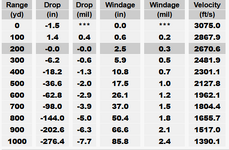
For my primary shooting location, I could get your 129 LRX load to line up quite well using minus 3, but it would require a 200 yard zero - see screenshot below.
"Quick Drop", or whatever it's being called now, isn't anything new. Just another tool in the shooter's toolbox!

Fireflyfishing
WKR
So I read through this whole thread and others that are actively discussing the QD subject.How do you square Increased Danger Space with perfect Quick Drop?
These are both highly valued qualities, but, they don't necessarily compliment each other.
Where and when would you choose one gun over the other that is optimized for either?
Which will lead to increased effectiveness, hit rates and ultimately more killing?
Example 1: The 6 UM, developed with the intent of maximizing Danger Space. Does not line up with QD very well, ie 600 yards - 2.6 mil., requiring increased mental load to factor in the correction.
Example 2: 223 with 88 TMK's at 2750. Perfect Quick Drop ie 400 -2 mil, 500 - 3 mil, 600 - 4 mil.
To answer your question: I just don’t care about QD or DS. The reality is I have range finding binos with an onboard calculator. I shoot with them often. They work…the end.
Prior to my current setup, I used Leica Geovid R binos…the QD method would have been great for those as they range only. But, that never stopped me from taking game at longer ranges. I still have those binos and if I break my Swaros, I’ll put them and QD into practice.
If they both go down, or regulations change to no range finders, I’ll get better at ranging with my reticle and put QD to use. And…utilize MPBR with a zippier cartridge.
But until then, I’m not going to lose sleep over-analyzing these two subjects. I’m not going to change my loads or rifle setups so it matches QD.
I know this won’t be a popular post, but I’m not concerned. What I’m doing is within my budget, legal, and fills my freezers.


RockAndSage
WKR
Correction factors can change significantly with DA real time within one day on a hunt.
Real question - how much does this actually matter with common cartridges, out to 400, on deer? How much more does it matter at 600?

- Joined
- Oct 22, 2014
- Messages
- 15,255
I know this won’t be a popular post, but I’m not concerned. What I’m doing is within my budget, legal, and fills my freezers.
Who would care if you use QD or not?

huntnful
WKR
- Joined
- Oct 10, 2020
- Messages
- 3,978
Thank you for the explanation and your reasonings!Some scenarios I have personally experienced many times which to me illustrate why QD is the most robust and flexible system:
You're on the gun, your buddy is ranging. He doesn't have your ballistics uploaded or he doesn't have a ballistic RF, and he can only tell you a range. What do you do?
Or, you are ranging for your buddy. Same situation flipped.
Or, you get a range and an elevation, get on the gun, then the animal trots 60yds closer to you and pauses. What do you do? Come off the gun and get the RF out? Or just correct instantly in your mind and hold/dial under?
Or, you have multiple targets or different fields of fire and you don't know where the animal will appear. Rather than having to remember a range and an elevation correction for each one, you can just remember range.
Quickdrop is not the most precise or the outright lowest mental load. But it is a guaranteed system that works without any external input in ALL scenarios with nearly ALL guns (other than a range, but there are tricks for that too). It's extremely robust and flexible.
The one about just remembering random yardages throughly a field of fire is especially valid IMO.

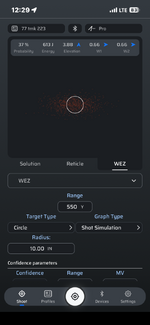
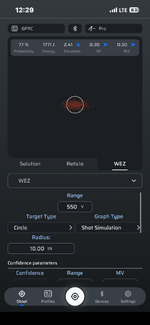
It makes a difference. I have a 223 with that matches those specifications almost perfectly and my 6prc with 112mb. 5mph wind at 550I think what’s been missing in this discussion is a real picture of how much is gained or lost by prioritizing QD vs DS.
Here is a table I made this morning comparing a prototypical QD load of 77tmk vs 2 DS loads. A 16” 22creed and a 6um.
Numbers were generated in shooter app based on this mornings DA of 775.
Cartridge (velocity) Drop in inches (550-500yds) Inch Drop/10yds 8” vs 10” target ranging error AKA Danger Space 77tmk 223 (2750) 74.9-57.7 (17.2”) 3.44”/10yds 23.2yds/29.0yds 77tmk 22cm (3050) 57.8-44.4 (13.4”) 2.68”/10yds 29.8yds/37.3yds 116tmk 6um (3100) 48.2-37.4 (10.8”) 2.16”/10yds 37.0yds/46.3yds
Between 500 and 550 yds the danger space certainly gets bigger for the faster cartridges. But the RSS 77tmk isnt exactly dropping like a rock either. Almost 30 yds of error (or danger space forgiveness) for a 10” target is very generous, and highlights how capable these systems
Attachments
Fireflyfishing
WKR
Probably the same folks who are asking questions on why QD doesn’t really work with the ballistics with their rifle but they feel like they need to make it work. The reality is you don’t need to make it work for your rifle to be successful.Who would care if you use QD or not?
I’m new to the QD method for scope dialing. I have been reading through all the threads discussing it. I understand how it works and this thread is highlighting the window where it works best. Seems pretty handy if it fits your ballistic profile and you don’t have an on board calculator that simply tells you what to dial. I’ve been tearing through my ballistics tables on my calculator to see where I can use it in the field. My 20” .223 REM shooting 77 TMKs works perfectly. I’ll give it a shot (pun intended) next time I’m at the range. QD doesn’t align well with other rifles I own. For those rifles, I’m not going to ram a square peg through a round hole to make it work. I’ll just use my binos.
So I may use QD in the future in certain circumstances. But…my point is you don’t need it to acquire a solutions quickly with available technology. For the folks that like their rifle and load that doesn’t fit the QD model, there are other ways. Those ways have worked for me. I’m sharing that experience with other forum members.
- Joined
- Oct 22, 2014
- Messages
- 15,255
Probably the same folks who are asking questions on why QD doesn’t really work with the ballistics with their rifle but they feel like they need to make it work. The reality is you don’t need to make it work for your rifle to be successful.
I understand. The way you worded it, it was like people were berating you to use it.
Quick drop isn’t just about a rifle matching perfectly- it’s about knowing that most rifles will fit a correction off of perfect “range minus 2”, and learning to use that system well. Same as wind bracket/gun wind number/etc. for wind calls.
I’m new to the QD method for scope dialing. I have been reading through all the threads discussing it. I understand how it works and this thread is highlighting the window where it works best. Seems pretty handy if it fits your ballistic profile and you don’t have an on board calculator that simply tells you what to dial.
Quick drop works with most guns. You and others are conflating the perfect “average gun” which is “range -2” (530 yards, minus 2= 3.3) with quick drop. The 6XC load that I use has a .4 mil correction out to 900 yards at 5k DA (530 yards= 2.9 mils).
I’ve been tearing through my ballistics tables on my calculator to see where I can use it in the field. My 20” .223 REM shooting 77 TMKs works perfectly. I’ll give it a shot (pun intended) next time I’m at the range. QD doesn’t align well with other rifles I own. For those rifles, I’m not going to ram a square peg through a round hole to make it work. I’ll just use my binos.
So I may use QD in the future in certain circumstances. But…my point is you don’t need it to acquire a solutions quickly with available technology. For the folks that like their rifle and load that doesn’t fit the QD model, there are other ways. Those ways have worked for me. I’m sharing that experience with other forum members.
Overall the several threads going right now about it are- multiple people that learned a thing and used it heavily in the field for hundreds to thousands of rounds under some form of stress compared to what they and everyone else does; and a bunch of people that haven’t used it- that don’t understand what they are arguing against, arguing things that either aren’t true, aren’t applicable, or are just ignorant of the subject.
LRF binos do not alleviate all the advantages of being truly competent with quick drop- it goes farther than “read elevation from a button press”; @solarshooter has written pretty solidly about it, however there is more to but still. Things one of those subjects that people think they “know”, that you simply don’t until you see the success/failure live.
Fireflyfishing
WKR
TrackingI understand. The way you worded it, it was like people were berating you to use it.
Quick drop isn’t just about a rifle matching perfectly- it’s about knowing that most rifles will fit a correction off of perfect “range minus 2”, and learning to use that system well. Same as wind bracket/gun wind number/etc. for wind calls.
TrackingQuick drop works with most guns. You and others are conflating the perfect “average gun” which is “range -2” (530 yards, minus 2= 3.3) with quick drop. The 6XC load that I use has a .4 mil correction out to 900 yards at 5k DA (530 yards= 2.9 mils).
Ok, here’s one example from the ballistics on one of my rifles:Overall the several threads going right now about it are- multiple people that learned a thing and used it heavily in the field for hundreds to thousands of rounds under some form of stress compared to what they and everyone else does; and a bunch of people that haven’t used it- that don’t understand what they are arguing against, arguing things that either aren’t true, aren’t applicable, or are just ignorant of the subject.
2716 fps; 5000’ DA
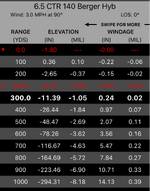
Reading the directions for the correction factor, it seems you need to be ok with some fudge factor at some of the ranges for the above ballistics, right? Hence the discussion of the danger space coupled with QD. At least that’s my interpretation.
I will look into the suggested reading.LRF binos do not alleviate all the advantages of being truly competent with quick drop- it goes farther than “read elevation from a button press”; @solarshooter has written pretty solidly about it, however there is more to but still. Things one of those subjects that people think they “know”, that you simply don’t until you see the success/failure live.
I get that none of the tech is perfect, but it works pretty well most of the time. Understanding limitations is always needed.
- Joined
- Oct 22, 2014
- Messages
- 15,255
Ok, here’s one example from the ballistics on one of my rifles:
2716 fps; 5000’ DA
View attachment 1037621
Reading the directions for the correction factor, it seems you need to be ok with some fudge factor at some of the ranges for the above ballistics, right? Hence the discussion of the danger space coupled with QD. At least that’s my interpretation.
Correct. That gun would be .5 at 200 like (almost) all rifles, 1 mil at 300, and then average gun -.3 mils. So- 500 yards would be 2.7.
I will look into the suggested reading.
I get that none of the tech is perfect, but it works pretty well most of the time. Understanding limitations is always needed.
Bino LRF’s are great- I use them nearly exclusively for my own hunting. Quick drops and wind brackets aren’t about tech failing- or at least that is not the primary purpose.
Ok, here’s one example from the ballistics on one of my rifles:
2716 fps; 5000’ DA
View attachment 1037621
Reading the directions for the correction factor, it seems you need to be ok with some fudge factor at some of the ranges for the above ballistics, right? Hence the discussion of the danger space coupled with QD. At least that’s my interpretation.
FYI - If you use minus 2 for that example, you'll be ~5.6" high at 500 yards using 3 mils instead of 2.69.
@Formidilosus how do you deal with a quickdrop adjustment that isnt linear? Im sold on qd and use it, and Id LIKE to with this gun—but from a mental load perspective I apparently dont have the mental horsepower to consistently manage a non-constant correction. In part thats because it’s not the gun I shoot the most. Beyond that, does it just break down at some point? This isnt extensively trued, but using the measured velocity and box bc my correction from standard quick drop is:
To 300: <=-.1
350: -.2
400: -.4
450: -.5
500: -.7 (over a foot of error from std QD)
550: -.8
Etc.
What I tried was to use standard qd to 350, and past that use a .5 correction, as Im not practiced to be shooting critters past 500 anyway. Where I got tripped up was on either side of using the correction or not under time stress, especially when some of my field of fire was below 350 and some well past. But if I wanted to practice at much longer ranges then Ive got a second correction factor at some point to stay within a tenth or two. Any tips? Or any “plan B” options to take advantage of most of the QD benefits, but for us “challenged” folks?
To 300: <=-.1
350: -.2
400: -.4
450: -.5
500: -.7 (over a foot of error from std QD)
550: -.8
Etc.
What I tried was to use standard qd to 350, and past that use a .5 correction, as Im not practiced to be shooting critters past 500 anyway. Where I got tripped up was on either side of using the correction or not under time stress, especially when some of my field of fire was below 350 and some well past. But if I wanted to practice at much longer ranges then Ive got a second correction factor at some point to stay within a tenth or two. Any tips? Or any “plan B” options to take advantage of most of the QD benefits, but for us “challenged” folks?
Fireflyfishing
WKR
My math came to about 5.4”, but I’m tracking.FYI - If you use minus 2 for that example, you'll be ~5.6" high at 500 yards using 3 mils instead of 2.69.
My math came to about 5.4”, but I’m tracking.
You used 2.7 and I used 2.69

- Joined
- Oct 22, 2014
- Messages
- 15,255
@Formidilosus how do you deal with a quickdrop adjustment that isnt linear? Im sold on qd and use it, and Id LIKE to with this gun—but from a mental load perspective I apparently dont have the mental horsepower to consistently manage a non-constant correction. In part thats because it’s not the gun I shoot the most. Beyond that, does it just break down at some point? This isnt extensively trued, but using the measured velocity and box bc my correction from standard quick drop is:
To 300: <=-.1
350: -.2
400: -.4
450: -.5
500: -.7 (over a foot of error from std QD)
550: -.8
Etc.
What I tried was to use standard qd to 350, and past that use a .5 correction, as Im not practiced to be shooting critters past 500 anyway. Where I got tripped up was on either side of using the correction or not under time stress, especially when some of my field of fire was below 350 and some well past. But if I wanted to practice at much longer ranges then Ive got a second correction factor at some point to stay within a tenth or two. Any tips? Or any “plan B” options to take advantage of most of the QD benefits, but for us “challenged” folks?
There are some combinations that really just don’t work well with QD. And quick drop isn’t necessarily supposed to be perfect- a .1 or even .2 mil error at closes ranges isn’t a deal killer. For your load above, I would use average gun to 350y and then a .5 mil correction to 500- like you stated. You need real data beyond that.
solarshooter
WKR
5k ft DA changes can easily happen in a day, but you're right, it's not a make or break. Just another couple tenths of error. If you were already dealing with some error, it could put bump you out of the vitals. So maybe correcting within a day is a little over dramatic. But I personally have hunted 10k+ DA variations from one week to the next, so you might still be adjusting week to week.Real question - how much does this actually matter with common cartridges, out to 400, on deer? How much more does it matter at 600?
Similar threads


- Replies
- 1
- Views
- 921


Featured Video
Latest Articles
- How to Kill Giant Bulls with Ryan Carter
- Kifaru Enters the Hunting Apparel Space: Review
- From Big Bucks to Bear Hunts: Catching Up with Jordan Budd
- Mule Deer Days Wildlife Conservation Mashup
- A Hidden Gem: Hunting Washington with Kari Thomas
- Prime Divide Bow Review
- Knowledge From Storms: Surviving and Thriving in the Backcountry with John Barklow
- DIY Wyoming Pronghorn Hunt
- Unlock Precision Shooting: Master Your Hunting Game with Competitive Insights
- Topo Topper Rincon Review