Quick Drop vs Danger Space

Ranging targets/animals is a skill most shooters would benefit from some serious practice in. That’s where a lot of this matters, both ways.

How many times have you ranged an animal only to knock off an estimate of the traveled distance you thought it made while in the scope. Understanding drop and having decent danger space helps with this.

On top of that, for me shooting mainly at farily close range, I prefer not to be shooting animals with 3000 plus fps match bullets. I want everything and the ability to make a decent shot from close to far. I like the 2800ish fps range.

And again I greatly prefer just shooting the same thing, or similar. When you shoot one combination all year it makes it easy to understand without thinking. If you shoot a 223 as a 4mph gun all summer and expect to pull stuff out of your head in the moment with you 3300 fps 6um your going to be placing a lot of reliance on danger space and electronics.
 
Quick drop and it’s efficacy has nothing to do with whether your range finder fails or not.

It’s about reducing mental load.
Can you expand on this? Why would I use quick drop if my range finder works? I found it to be useful in competition with known ranges, but not so much with the unknown. Maybe I’m missing something here
 
How is quick drop a major mental load benefit when you still need a rangefinder to use it, and that same rangefinder can give you the exact necessary dial up from 0’ to 13,000’ elevation (with no additional mental math for the changes) within .5 seconds after obtaining the range with no mental effort at all?

I understand it for sure if you’re not using a ballistic rangefinder of course.

But with a ballistic rangefinder I can’t really comprehend the benefit of it.

I only use NRL as an example because it decently close to hunting. Moderate ranges, timed event, mental duress. No one is using quick drop to hit more targets and come out on top. If it genuinely led to increased hit rates, it would be being utilized.

Are ballistic rangefinders making it obsolete in those circumstances?
Mirrors my opinion exactly.

In the absence of ballistic rangefinders it's perfect.

Ballistic RF's make it just a good sanity check on your outputs.

I recognize that im not great at mental math on the clock. Ive outsourced my ballistics and windcalls to my electronics and it works pretty good. Ive still got a lot of work to do on understanding windcalls and recognizing subtle shifts, features blocking or accelerating wind etc. But I manage to hold my own out there.

A little extra speed helps reduce the magnitude of any ranging or wind call errors.

All that said. I just look at my Ballistic table and figure out the correction factor. -2 mils off the range is easy. But 2.2 or 2.5 or 3 or whatever isnt much harder. So you can still quick drop with faster stuff to a decent proficiency.

Shot my mule deer at 430. My 25 prc is a -3. Ballistic output was 1.3, perfectly matched my "quick drop".
 
Bottom line up front—pick something and get proficient executing your chosen method under timed and field positions. The entire shooting process needs to be like driving a car, where you can also read a map and road signs, and dodge traffic. A new driver can’t even manage to change the radio without driving off the road. Watching the animal is like reading a map and signs and dodging traffic. Building the position and shooting needs to be as automatic as the vehicle operation.

QD works, and if your load is too fast, load it slower. Give it a try and if you like it build a new gun.

If you like your rifle and fast load, there are other solutions with low mental load if your rifle doesn’t match up easily or it doesn’t work for you.

If you want quick without any mental load except remembering the yardage, burn a turret, use tape, or mark yardage out to 500.

For me, Rangefinder linked with Garmin on my wrist, range, set up for the shot, look at dope on my wrist, dial or hold, and shoot. If the animal moves far enough, I range again.

Quick drop is more handy if you are not ranging for yourself or your spotter uses it too.
 
How is quick drop a major mental load benefit when you still need a rangefinder to use it, and that same rangefinder can give you the exact necessary dial up from 0’ to 13,000’ elevation (with no additional mental math for the changes) within .5 seconds after obtaining the range with no mental effort at all?

I understand it for sure if you’re not using a ballistic rangefinder of course.

But with a ballistic rangefinder I can’t really comprehend the benefit of it.

I only use NRL as an example because it decently close to hunting. Moderate ranges, timed event, mental duress. No one is using quick drop to hit more targets and come out on top. If it genuinely led to increased hit rates, it would be being utilized.

Are ballistic rangefinders making it obsolete in those circumstances?
I can only speak for myself here…..

1. For me, getting two factors….like…..643 yards and 4.4 mils……in my binos…..I’m always going back to ranging to get the drop calculation again. It’s silly, for sure, but I still do it.

This is way compounded if it is in MOA.

2. I realize it’s not EXACTlY perfect, but knowing 500 yards is 3 mils, 550 is 3.5 mils…..600 is 4 mils etc etc…….makes the hash marks in my mil reticle quick and reliable for, let’s say, a 12 inch plate. Which is essentially the vital zone of a game animal.

Anything inside 400 yards I don’t even mess with dialing.

If you go to distance measured in meters, 2,800 gos works about the same way.
The magic is how simple and easy it is to remember. With practice, it means 600-650 yards is cake.

It just works…..and like shit that works and doesn’t have me chasing velocity and math.
 
I can only speak for myself here…..

1. For me, getting two factors….like…..643 yards and 4.4 mils……in my binos…..I’m always going back to ranging to get the drop calculation again. It’s silly, for sure, but I still do it.

This is way compounded if it is in MOA.

2. I realize it’s not EXACTlY perfect, but knowing 500 yards is 3 mils, 550 is 3.5 mils…..600 is 4 mils etc etc…….makes the hash marks in my mil reticle quick and reliable for, let’s say, a 12 inch plate. Which is essentially the vital zone of a game animal.

Anything inside 400 yards I don’t even mess with dialing.

If you go to distance measured in meters, 2,800 gos works about the same way.
The magic is how simple and easy it is to remember. With practice, it means 600-650 yards is cake.

It just works…..and like shit that works and doesn’t have me chasing velocity and math.
I appreciate your in-depth explanation and reasoning! Thank you 👊🏼
 
How is quick drop a major mental load benefit when you still need a rangefinder to use it, and that same rangefinder can give you the exact necessary dial up from 0’ to 13,000’ elevation (with no additional mental math for the changes) within .5 seconds after obtaining the range with no mental effort at all?

I understand it for sure if you’re not using a ballistic rangefinder of course.

But with a ballistic rangefinder I can’t really comprehend the benefit of it.

I only use NRL as an example because it decently close to hunting. Moderate ranges, timed event, mental duress. No one is using quick drop to hit more targets and come out on top. If it genuinely led to increased hit rates, it would be being utilized.

Are ballistic rangefinders making it obsolete in those circumstances?
Some scenarios I have personally experienced many times which to me illustrate why QD is the most robust and flexible system:

You're on the gun, your buddy is ranging. He doesn't have your ballistics uploaded or he doesn't have a ballistic RF, and he can only tell you a range. What do you do?

Or, you are ranging for your buddy. Same situation flipped.

Or, you get a range and an elevation, get on the gun, then the animal trots 60yds closer to you and pauses. What do you do? Come off the gun and get the RF out? Or just correct instantly in your mind and hold/dial under?

Or, you have multiple targets or different fields of fire and you don't know where the animal will appear. Rather than having to remember a range and an elevation correction for each one, you can just remember range.

Quickdrop is not the most precise or the outright lowest mental load. But it is a guaranteed system that works without any external input in ALL scenarios with nearly ALL guns (other than a range, but there are tricks for that too). It's extremely robust and flexible.
 
I do practice quick drop. Question I have is why a bdc turret (ie one marked in yardage, not in angular measurements) is any more problematic than quick drop itself.

To me basic quick drop with a “correction factor” is simple and easy and makes perfect sense to me. What Im missing a bit is why a bdc turret is problematic in comparison, because all of the factors that add variability to a bdc turret, also add exactly the same variation to quick drop. So if you are willing to accept that quick drop is “close enough to xx range”, why is a bdc turret any different? Is it simply that it prevents or makes it more difficult to utilizing a correction factor? Or?

In either case a cartridge with more “danger space” will be more forgiving of any method that involves “close enough”. Seems a cartridge on the high-end of fitting into quick drop would be quantifiably better than a cartridge on the low end of fitting. At a minimum, from that perspective danger space seems relevant and beneficial to quick drop, at least to a point.
 
I do practice quick drop. Question I have is why a bdc turret (ie one marked in yardage, not in angular measurements) is any more problematic than quick drop itself.

To me basic quick drop with a “correction factor” is simple and easy and makes perfect sense to me. What Im missing a bit is why a bdc turret is problematic in comparison, because all of the factors that add variability to a bdc turret, also add exactly the same variation to quick drop. So if you are willing to accept that quick drop is “close enough to xx range”, why is a bdc turret any different? Is it simply that it prevents or makes it more difficult to utilizing a correction factor? Or?
Correction factors can change significantly with DA real time within one day on a hunt. Your BDC turret cannot.

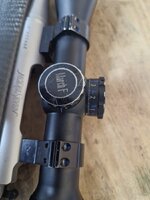
Another issue, just looking at that picture above, I would for sure confuse the mil marks and the range marks on that turret under stress. Or if it was slightly dark. My brain sees "2 1 3 2 4 3 5" and says "wtf is going on??!!"
 
@solarshooter Isnt that a question of application method, rather than being inherent in the concept? For instance, Ive seen people use tape and a marker for a bdc turret. That is certainly something thats pretty easy to do mid-hunt, and there is no mixing up of turret markings if you use a new wrap of tape.
It’s maybe peripheral to the original post, but Im curious because at least in my head it accomplishes 99.9% the same thing, perhaps even better. I personally have an easy time with quick drop, but I have a hard time with a correction factor on top of quick drop, hence a diy bdc solution looks attractive for that situation.
 
Isnt that a question of application method, rather than being inherent in the concept? For instance, Ive seen people use tape and a marker for a bdc turret. That is certainly something thats pretty easy to do mid-hunt.
It’s maybe peripheral to the original post, but Im curious because at least in my head it accomplishes 99.9% the same thing, perhaps even better.
But why even bother? QD is so easy once you get the hang of it there is just literally no point. And even if you carry a marker and tape in the woods and sit down twice a day to redo your BDC turret, you are giving up the much larger second order benefits, which are:
  • being able to quickly adapt to other guns/cartridges
  • being able to quickly adapt to changing environmentals
  • being able to use the reticle to quickly adapt to changing target ranges (same reticle and turret system)
  • developing an intuitive mental model of bullet trajectories relating range and change in range to drop
 
Back
Top