Quick Drop vs Danger Space

I’ve had a handful of misses due to ranging errors that a cartridge with better danger space might have otherwise prevented. It’s pretty easy to range beyond or in front of a deer at longer ranges.

I have not (yet) been in a situation where quick drop would have saved the day..but to be fair I’m not terribly well versed in it and haven’t really used it much.

For now I am shooting a flatter trajectory 22cm to help a bit with danger space..I also have a very basic/imprecise quick drop in my head for this load in case things get western


Edit: ran my numbers again comparing my 22cm to my slower 25 creedmoor and the difference in danger space seems pretty trivial at the distances where I’ve had ranging errors in the past 🤷
Inside 500 yards, differences can be minimal.

22 and 25 creed are both on the fast side with good BC bullets.

There’s a lot of theory mixed in with practical.

Shooter skill still makes more of an issue, I think.
 
Just from my NRL experience... ive got a 16# 6.5 creed shooting 144s at 2670.

Ive got a 10# 25 prc shooting 133/135s at 3050.

The 6.5 creed is a cupcake. The prc bucks a bit.

I scored/placed better with the 25 prc. The speed and wind bucking makes novel shots more certain. The target shooter logic of being able to watch a slow bullet and see exactly what happens makes sense. But what if you cant actually make out what happened? Half of the shots ive missed at nrl's have given me no indication.

So im doubling down. Ive got a 28" long 25 creed barrel due any day. Hoping for 2950.

And I just ordered a 26" 25 prc to replace the barrel that I'll inevitably burn out. This 2.75" longer and with a longer freebore. Really hoping for a mild 3150-3200.

I can't really see shit under 350-400 with the 25 prc. But that doesnt matter if you dont miss 😅

....

But i did just order a 18" 6 creed barrel too. It'll be my "this mountain looks f'ing steep" and 0-600 gun.

As long as your optics output a ballistic solution, quick drop isn't as valuable. But it is a good sanity check.
 
@Formidilosus, do you care to share a concise explanation on the subject?

Silly question maybe, but could someone define “danger space” and illustrate the real-world benefit between two cartridges? I think I understand the concept mostly how its used but not certain.


Danger space is the range error before, and past the target that the round will still strike the target while aiming center. For instance range the target at 500 yards. Target is 12” tall. If instead the target is actually closer than 500- how much closer can the target be and still results in a hit? Same for if it is farther than 500 yards.


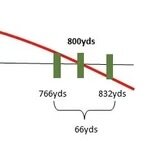
A visual representation. Black line is LOS, red arc is the bullets trajectory. In this case- while aiming for 800 yards, the bullet will still hit from 766-832 yards- for a 66 yard danger space.

IMG_4477.jpeg


Another combo my only hit from 791-804 yards- for a 13 yard danger space, etc.


Danger space is for elevation, what wind drift is for errors in wind call .
 
How do you square Increased Danger Space with perfect Quick Drop? These are both highly valued qualities, but, they don't necessarily compliment each other.


You don’t- they are at odds with each other.


Where and when would you choose one gun over the other that is optimized for either?

The target and situations.

If the greatest error or problem is getting a solid range on the target (say rutting deer that don’t stay still), maximized danger space can be a huge benefit. However, if the targets don’t make ranging and elevation corrections difficult, and most shots are 600’ish and under, and especially is speed is any factor- quick drop can help greatly.


Which will lead to increased effectiveness, hit rates and ultimately more killing?

Well, I can tell you measuring and hit rates on 8-15” targets in various broken terrain, under stress, and sometimes under time constraints- a gun and shooter that uses quick drop and has a good wind bracket gets more hits faster, with less mental load. Watching the difference side with several hundred animals each- confirms that.

Overall, across the totality of shots taken while hunting all over the country, from muzzle contact to 600’ish yards- a cartridge and bullet combo that tracks quick drop and has a 5 mph or high wind bracket/wind gun number, with the least recoil results in the least screw ups, and/or failed and missed opportunities.


Example 1: The 6 UM, developed with the intent of maximizing Danger Space. Does not line up with QD very well, ie 600 yards - 2.6 mil., requiring increased mental load to factor in the correction.

No it does not. The 6UM was specifically made to maximize danger space for rutting deer that won’t stop moving.
 
Danger space is the range error before, and past the target that the round will still strike the target while aiming center. For instance range the tablet at 500 yards. Target is 12” tall. If instead the target is actually closer than 500- how much difference closer still results in a hit? Same for if it is farther than 500 yards.


A visual representation. Black line is LOS, red arc is the bullets trajectory. In this case- while aiming for 800 yards, the bullet will still hit from 766-832 yards- for a 66 yard danger space.

View attachment 1036673


Another combo my only hit from 791-804 yards, etc.


Danger space is for elevation, what wind drift is for windage.
Rather than me messing around with ballistics tables for a couples hours, can you give me the punchline. How much is a 6 UM beating your typical 6.5 creed with a 140 at 2,700 fps?

Does it really matter that much?

If so, at what distance does it really start to matter?
 
I value a cartridge that bucks the wind and maximizes danger space. I've hunted with cartridges that have lined up perfectly with quick drop and never had a reason to apply it. I figure if my rangefinder dies in the field I'll just have to get a lot closer. I'm not even going to try and determine distance by guessing the size of an object, pumping it into some long forgotten formula and then applying quick drop. just my 2cents


Quick drop and it’s efficacy has nothing to do with whether your range finder fails or not.

It’s about reducing mental load.
 
You don’t- they are at odds with each other.


The target and situations.

If the greatest error or problem is getting a solid range on the target (say rutting deer that don’t stay still), maximized danger space can be a huge benefit. However, if the targets don’t make ranging and elevation corrections difficult, and most shots are 600’ish and under, and especially is speed is any factor- quick drop can help greatly.


Well, I can tell you measuring and hit rates on 8-15” targets in various broken terrain, under stress, and sometimes under time constraints- a gun and shooter that uses quick drop and has a good wind bracket gets more hits faster, with less mental load. Watching the difference side with several hundred animals each- confirms that.

Overall, across the totality of shots taken while hunting all over the country, from muzzle contact to 600’ish yards- a cartridge and bullet combo that tracks quick drop and has a 5 mph or high wind bracket/wind gun number, with the least recoil results in the least screw ups, and/or failed and missed opportunities.


No it does not. The 6UM was specifically made to maximize danger space for rutting deer that won’t stop moving
Good, I’ll just stick with QD. I don’t have the wind chops to hunt past 500-600 yards anyway unless it’s dead calm.
 
Rather than me messing around with ballistics tables for a couples hours, can you give me the punchline. How much is a 6 UM beating your typical 6.5 creed with a 140 at 2,700 fps?

Does it really matter that much?

If so, at what distance does it really start to matter?

It matters at all ranges. How much depends on the target size and range. FWIW- the very first animal killed with the 6UM, would not have been killed with a 6.5cm.

Here is that scenario: 5,000ft DA for both. It was on an elk that was a quick shot after a blown stalk where the shooter was dialed for 600, and right after getting up and another elk came into the opening on a knife ridge a bit to the left of where the elk had been. The elk pops up- shooter (Ryan Avery) plops down, and shoots it right as it starts to turn and run. The bullet hit right at the bottom of the chest- because what looked to be the same range, was actually 642 yards IIRC.


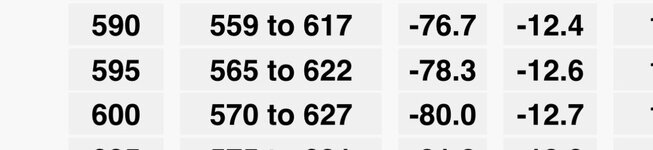
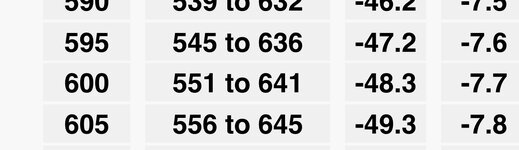
Using a 12” target, this is the danger space for that shot for both.

6.5cm with 140gr ELD-M at 2,700fps MV. Danger space of 570 to 627 yards (would have been a miss)
IMG_4480.jpeg


6UM, 115gr DTAC, 3,350fps MV. Danger space of 551 to 641 yards (hit).
IMG_4482.jpeg
 
Back
Top