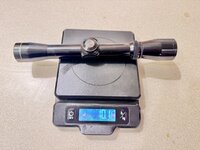
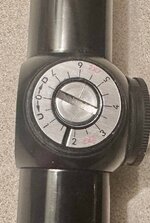
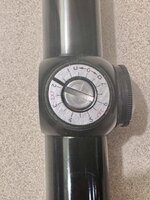
Q&A Leupold Vari-X II 2-7x33mm Field Eval

Formidilosus

Not A Moderator
Shoot2HuntU
Joined
Oct 22, 2014
Messages
13,934
See-

 
Killed my first several deer with that scope and a model 88 Winchester in 308. Might have to run it through the paces just for kicks
 
The last one of these I had was pretty all over the place, when it came to zero retention. Even without drop tests.
 
I still have one of these in a drawer, its killed a stack of animals on everything from 22lr to .308 to .223.
Great to see it still fares OK
I still have a 1994 vintage 2.5-8 vari-x III and a 1995 vintage vari-x III 4.5-14x in regular use. Shot a deer this fall with a 2001(?) vintage 3.5-10x vari-x-iii.

(If OP is running out of scopes to test I'd be happy to dismount and mail him any of them, FWIW, too...not sure I've ever seen a vari-xIII tested here since they haven't been made in 2 decades).

Also, I have a question for OP:

I notice that this test showed a zero shift on shots 4-6 then either shifted again or shifted *back* for shot 7.

It seems like that's a thing - after an impact that causes a shift, some scopes at least appear to shift *back*. Like maybe there's some sort of play in a mechanism that allows the impact to 'bounce' the mechanism, but then subsequent drops bounce it back....right?

Or is that just a chance thing where the scope isn't shifting back to zero, it's just shifting again and sometimes happens to shift back in the general direction it started from? Reading multiple reviews it seems like scopes shift back towards zero more often than they shift in any other direction, after an initial shift occurs.

I'm trying to understand (if anyone else knows) not only that scopes are failing, but what that looks like inside.

I had already been wondering about this but the other day the middle kid and I were in a stand and we had her AR stock set one notch short of her normal position (my bad) and when we sat the rifle in the gun rack it was shorter than the top of the rack, and slid and fell over in the stand (a 90 degree fall sideways onto a wood floor). We didn't get a shot that day. The next day I fired the rifle - first shot from sandbags was ~2.5moa low. The next six shots were centered and within 1.5moa. That was all the ammo I had in the magazine at the moment and deer season is over, there was no need to go any deeper into the test than that. This rifle/load has consistently been 1.75moa or less over dozens of shots (in aggregate) over the last several months. Except for that one shot, which was the first shot after a halfway decent 'bump' as described above, with the 2001 era vari-x iii mentioned above.

In short I guess I'm wondering if many scopes have springs in the adjustments strong enough to resist recoil impulses down the axis of the scope but not strong enough to resist those impulses from the side. I'm sure you've discussed this somewhere before but I don't think I've read every word on the subject yet. Or maybe I read that somewhere and remembered the takehome point but not how it was made.

??

 
I still have a 1994 vintage 2.5-8 vari-x III and a 1995 vintage vari-x III 4.5-14x in regular use. Shot a deer this fall with a 2001(?) vintage 3.5-10x vari-x-iii.

(If OP is running out of scopes to test I'd be happy to dismount and mail him any of them, FWIW, too...not sure I've ever seen a vari-xIII tested here since they haven't been made in 2 decades).

Also, I have a question for OP:

I notice that this test showed a zero shift on shots 4-6 then either shifted again or shifted *back* for shot 7.

It seems like that's a thing - after an impact that causes a shift, some scopes at least appear to shift *back*. Like maybe there's some sort of play in a mechanism that allows the impact to 'bounce' the mechanism, but then subsequent drops bounce it back....right?

Or is that just a chance thing where the scope isn't shifting back to zero, it's just shifting again and sometimes happens to shift back in the general direction it started from? Reading multiple reviews it seems like scopes shift back towards zero more often than they shift in any other direction, after an initial shift occurs.

I'm trying to understand (if anyone else knows) not only that scopes are failing, but what that looks like inside.

I had already been wondering about this but the other day the middle kid and I were in a stand and we had her AR stock set one notch short of her normal position (my bad) and when we sat the rifle in the gun rack it was shorter than the top of the rack, and slid and fell over in the stand (a 90 degree fall sideways onto a wood floor). We didn't get a shot that day. The next day I fired the rifle - first shot from sandbags was ~2.5moa low. The next six shots were centered and within 1.5moa. That was all the ammo I had in the magazine at the moment and deer season is over, there was no need to go any deeper into the test than that. This rifle/load has consistently been 1.75moa or less over dozens of shots (in aggregate) over the last several months. Except for that one shot, which was the first shot after a halfway decent 'bump' as described above, with the 2001 era vari-x iii mentioned above.

In short I guess I'm wondering if many scopes have springs in the adjustments strong enough to resist recoil impulses down the axis of the scope but not strong enough to resist those impulses from the side. I'm sure you've discussed this somewhere before but I don't think I've read every word on the subject yet. Or maybe I read that somewhere and remembered the takehome point but not how it was made.

??


Yes, that is very common. That phenomenon is caused by the erector system. What you are describing is mostly the erector spring.
 
after an impact that causes a shift, some scopes at least appear to shift *back*. Like maybe there's some sort of play in a mechanism that allows the impact to 'bounce' the mechanism, but then subsequent drops bounce it back....right?

I know several old guys who tap on the knobs after making an adjustment. I also know that it used to be pretty common for guys to shoot, adjust, notice no change, repeat the adjustment (IE double it) and the next shot be off the paper.

In hindsight im amazed at the crap I used to put up with when it comes to scopes.
 
I know several old guys who tap on the knobs after making an adjustment. I also know that it used to be pretty common for guys to shoot, adjust, notice no change, repeat the adjustment (IE double it) and the next shot be off the paper.

In hindsight im amazed at the crap I used to put up with when it comes to scopes.
I still do that. I’m fifty; old habits die hard.
 
I know several old guys who tap on the knobs after making an adjustment. I also know that it used to be pretty common for guys to shoot, adjust, notice no change, repeat the adjustment (IE double it) and the next shot be off the paper.

In hindsight im amazed at the crap I used to put up with when it comes to scopes.
I've been using these scopes for years. I like the simplicity and light weight. I have noticed many times they don't move at first when adjusting. I was taught to tap them as well. I have always had issues zeroing these, but once I have a good reliable zero, they stay put in normal use year after year, in my non abusive experience.

This might just be me, but the way they adjust and function seems very similar to my experience with Trijicon ACOGS.
 
So, if these (or any other brand/model) show this pattern of bouncing off-zero after a drop, then going back once they're shot a time or two....

Let me preface my question here. I get that the goal of these tests is to figure out what equipment simply works and is as close as possible to being bulletproof; ultimately these tests are about product improvement. I absolutely understand the goal there and the value in it. But I also read this stuff from the perspective of a 'farm mentality'. Stuff breaks, or fails to perform as advertised. And you weld it back together and keep it and learn to live with its quirks, and if you're willing to do that, maybe you can make it last another couple years and you can afford to go hunting one year instead of forking over more money to the local equipment dealer. Or if you know something's weakness in advance maybe you can avoid it. That's reality for a lot of us that live on budgets and don't go replacing every less-than-perfect piece of gear we have.

So - from that perspective:

This scope went back to zero after one 'off' shot post-drop. As I mentioned above, one of my own old vari-x IIIs did the same thing the other day.

Would it be wise, if I drop it again in similar fashion, to mitigate the potential error by then unloading it and slamming the butt on the ground just hard enough to simulate recoil a couple times, to re-seat the spring mechanism? Obviously it would be best to shoot it again to check it, but there are scenarios where that isn't really a good option - nobody wants to blow up the woods during hunting season checking zero and I can't always just hop in the car and drive 15 miles to the range.

I realize that isn't a fix, it's more of a 'hack' or patch at best and couldn't possibly be guaranteed to work, but if we're speaking strictly in terms of increasing the probability of the first post-drop shot being on zero, would this possibly work, or just be completely stupid superstition?
 
So, if these (or any other brand/model) show this pattern of bouncing off-zero after a drop, then going back once they're shot a time or two....

Let me preface my question here. I get that the goal of these tests is to figure out what equipment simply works and is as close as possible to being bulletproof; ultimately these tests are about product improvement. I absolutely understand the goal there and the value in it. But I also read this stuff from the perspective of a 'farm mentality'. Stuff breaks, or fails to perform as advertised. And you weld it back together and keep it and learn to live with its quirks, and if you're willing to do that, maybe you can make it last another couple years and you can afford to go hunting one year instead of forking over more money to the local equipment dealer. Or if you know something's weakness in advance maybe you can avoid it. That's reality for a lot of us that live on budgets and don't go replacing every less-than-perfect piece of gear we have.

So - from that perspective:

This scope went back to zero after one 'off' shot post-drop. As I mentioned above, one of my own old vari-x IIIs did the same thing the other day.

Would it be wise, if I drop it again in similar fashion, to mitigate the potential error by then unloading it and slamming the butt on the ground just hard enough to simulate recoil a couple times, to re-seat the spring mechanism? Obviously it would be best to shoot it again to check it, but there are scenarios where that isn't really a good option - nobody wants to blow up the woods during hunting season checking zero and I can't always just hop in the car and drive 15 miles to the range.

I realize that isn't a fix, it's more of a 'hack' or patch at best and couldn't possibly be guaranteed to work, but if we're speaking strictly in terms of increasing the probability of the first post-drop shot being on zero, would this possibly work, or just be completely stupid superstition?
How would you know it actually went back? You need to shoot it to verify. Or assume it's off until you do.

Sent from my SM-S928U using Tapatalk
 
How would you know it actually went back? You need to shoot it to verify. Or assume it's off until you do.

Sent from my SM-S928U using Tapatalk
You wouldn't, and you're right. I'm speaking in probability, not certainty, and thought that was made clear enough the way I asked.
 
It would certainly be worth testing. I dont know enough about how scope guts work to understand the failure mode exactly but I do know I've seen it in some cheap scopes.

For us, SOP was always if you hit your scope (rifle fell out of truck, got whacked on four-wheeler rack etc) you were just out of commission until you could check it.
 
For us, SOP was always if you hit your scope (rifle fell out of truck, got whacked on four-wheeler rack etc) you were just out of commission until you could check it.
I wouldn't say I have a universal SOP that applies to all scopes and all potential failure incidents. I'd pretty much throw rocks at a coyote if that's all I had.
 
So, if these (or any other brand/model) show this pattern of bouncing off-zero after a drop, then going back once they're shot a time or two....

Let me preface my question here. I get that the goal of these tests is to figure out what equipment simply works and is as close as possible to being bulletproof; ultimately these tests are about product improvement. I absolutely understand the goal there and the value in it. But I also read this stuff from the perspective of a 'farm mentality'. Stuff breaks, or fails to perform as advertised. And you weld it back together and keep it and learn to live with its quirks, and if you're willing to do that, maybe you can make it last another couple years and you can afford to go hunting one year instead of forking over more money to the local equipment dealer. Or if you know something's weakness in advance maybe you can avoid it. That's reality for a lot of us that live on budgets and don't go replacing every less-than-perfect piece of gear we have.

So - from that perspective:

This scope went back to zero after one 'off' shot post-drop. As I mentioned above, one of my own old vari-x IIIs did the same thing the other day.

Would it be wise, if I drop it again in similar fashion, to mitigate the potential error by then unloading it and slamming the butt on the ground just hard enough to simulate recoil a couple times, to re-seat the spring mechanism? Obviously it would be best to shoot it again to check it, but there are scenarios where that isn't really a good option - nobody wants to blow up the woods during hunting season checking zero and I can't always just hop in the car and drive 15 miles to the range.

I realize that isn't a fix, it's more of a 'hack' or patch at best and couldn't possibly be guaranteed to work, but if we're speaking strictly in terms of increasing the probability of the first post-drop shot being on zero, would this possibly work, or just be completely stupid superstition?


No. Because they don’t always go back to zero or close. The don’t go back most of the time. Sometimes they do, sometimes they don’t. Sometimes the shift 10-12”. Sometimes they break and start shooting 8” plus groups. You have no idea what happened or will happen.
 
Back
Top