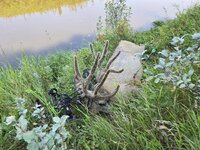
Protocols: what to do with meat while CWD test is pending?

The University of Wyoming, U of Calgary, and U of Alberta are all working hard on a vaccine for CWD prions in Cervids. I know Alberta has been hit particularly hard with some areas of infected animals being upwards of 85%. While I’m skeptical, it sounds like significant progress has been made even since 2019. How that vaccine would be administered to wild animals is another issue in itself but at least there’s something positive on this front. It’s pretty depressing when you start looking into this issue.
 
The University of Wyoming, U of Calgary, and U of Alberta are all working hard on a vaccine for CWD prions in Cervids. I know Alberta has been hit particularly hard with some areas of infected animals being upwards of 85%. While I’m skeptical, it sounds like significant progress has been made even since 2019. How that vaccine would be administered to wild animals is another issue in itself but at least there’s something positive on this front. It’s pretty depressing when you start looking into this issue.
Well, won't they all be extinct shortly?

To OP:
Just eat it FCOL.
 
Prions bind to various surfaces differently, e.g. higher affinity for clay soil vs sandy soil. It's not like you can't wash prion-containing soil off your boot outsoles. Are you going to remove all of the prions? Probably not, but you're almost certainly going to be tracking material less around.

Here's a study where they compare different materials and whether they were able to sample detectable amounts of prion off of each.

If I had to bet, my money is on hay and feed being the mechanism by which it is jumping state lines, not anything hunting related.
 
Exactly how accurate are the tests?
If not 100% shouldn’t we throw all the meat away “just to be safe”?
Wouldn’t it be even safer if we never came in contact with the animal in the first place?
That’s no further a stretch than saying it “could possibly” transfer to humans through eating the meat though it has never happened (though I have no doubt there are biologists somewhere working feverishly to figure out how to accomplish it)
 
In Washington and Oregon the wild game processors (butcher shops) Im familiar with process wild game as a side hustle. They also process and sell commercial meat products to the general public.

It seems to me that if government thought CWD was a human health issue they would have addressed processing of wild game.

Cattle, bison, and sheep inhabit the same areas deer and elk inhabit. It would seem the livestock industry also has no concerns about CWD spreading to cattle through prion ingestion.

To me it appears, through the actions of game departments and government, that they only view CWD as being an impact to game populations.
 
In Washington and Oregon the wild game processors (butcher shops) Im familiar with process wild game as a side hustle. They also process and sell commercial meat products to the general public.

It seems to me that if government thought CWD was a human health issue they would have addressed processing of wild game.

Cattle, bison, and sheep inhabit the same areas deer and elk inhabit. It would seem the livestock industry also has no concerns about CWD spreading to cattle through prion ingestion.

To me it appears, through the actions of game departments and government, that they only view CWD as being an impact to game populations.
Yeah that's a good point - it does appear that way. It may also be that it's too hard to set guidelines since there are no immediate concerns and its a controversial issue no one wants to stick their neck out about.
 
Exactly how accurate are the tests?
If not 100% shouldn’t we throw all the meat away “just to be safe”?
"The exact accuracy of current CWD testing methods is surprisingly difficult to pin down in the scientific literature, but it is generally considered to be greater than 90%. Both positive and negative results are considered reliable, but animals in the earliest stages of an infection may not be detected due to the small amount of CWD prion present. This is why laboratories report their results as “not detected” instead of “negative.” The current tests are also labor intensive and rely on a small number of accredited laboratories, which slows results. New testing methods have been invented that amplify small quantities of prion to increase their detectability. These tests (abbreviated RT-QuIC and PMCA) still need tweaking but may be approved for routine use in coming years." -Dr. Jenn Ballard

People still drive cars even though they could die in an accident. Wearing a seatbelt, having airbags, and good tires all mitigate. I'd take a test's results as "good enough", personally.
 
It’s not the same.

If no one had ever died in a car accident there would be no reason to have seat belts or airbags other than to create jobs for seat belt and air bag companies.
 
Back
Top