Painless Load Prep (Precursor to Painless Load Development)

I have had the exact opposite experience with Peterson. 6.5PRC, 7PRC and 30-06 necked down to 25-06 or up to 35 Whelen has been great. I also have had great luck with Lapua in 6.5 Creed and 300PRC. Plus in a really hot load the Peterson and Lapua brass lasts a lot longer. Which is nice if you have a caliber for which you need to fire form, 25-06AI in my case, where the primer pockets only last 2 or 3 firings in lesser brass.

I actually enjoy proper brass treatment. To me the real focus is simplified load development. Modifying Form's process a bit the following works for me.

1. Load a pressure ladder test going up from a little below where the load data says the velocity you'd be happy with to a grain or two over max. Seat at .03 off the lands if magazine allows.

2. Shoot the ladder test. Stop when you hit pressure signs you are not comfortable with.

3. Load 10 with the powder charge in the middle of the best grouping of your ladder test.

4. If the 10 shot group is .75 MOA or better, done. If not move on to another bullet or powder.

I may be fooling myself into thinking this is a good process, but it works for me. Plus I want to do a pressure test anyway because I want to know where my max load is.
I’ve shot a lot Peterson with no issues as well. Same with ADG. But I’ve still had issues with both. Just giving examples. I’ve shot A LOT of Lapua, with zero issues or inconsistency. And so far Alpha seems to be consistent as well. But I haven’t shot near as much of that.
 
So, I've read the painless load development several times and now I've read the painless reloading thread.

Correct me if I'm wrong in my summary.

Painless Load development: Pick a bullet. Pick a powder charge, close to max, that will give you the velocity that you want. Seat the bullet to your magazine and/or close to the lands (how close/far doesn't matter) If it doesn't shoot well, just randomly pick something else and repeat the process.

Painless Reloading: Don't worry about cleaning, just resize and load brass up until it won't chamber, then throw it away and get some new brass.

Are these summaries correct?
 
I’m here to learn. How do you size in a way that reduces brass growth?
Bump shoulder back only 2.5-3 thou, rather than the 8-10+ thou required to get back to unfired factory brass length. As some mentioned you need some clearance in case dust or grit enters your chamber, or if your sizing is off a thou or two. You can use scotch tape on the back of the case to test clearance, one layer is 1-1.5 thou thick. I like my rounds to just barely chamber with two layers of scotch tape on the case head.
 
Another thing when you’re sizing the initial piece of brass to get a proper shoulder bump (or just making it fit in your chamber), you should use a new piece each time you’re adjusting the die. If you keep resizing the same piece, and just bumping it further and further and further until it’s correct, it’ll actually be much harder and have more spring back.

So when you grab another piece, you’ll actually bump it more than that initial piece that you spent all that time setting up

I have never considered this, always just used one piece (with expander removed) to set bump. This probably explains some of the issues i've had getting it consistent. Good tidbit.
 
So, I've read the painless load development several times and now I've read the painless reloading thread.

Correct me if I'm wrong in my summary.

Painless Load development: Pick a bullet. Pick a powder charge, close to max, that will give you the velocity that you want. Seat the bullet to your magazine and/or close to the lands (how close/far doesn't matter) If it doesn't shoot well, just randomly pick something else and repeat the process.

Painless Reloading: Don't worry about cleaning, just resize and load brass up until it won't chamber, then throw it away and get some new brass.

Are these summaries correct?

On the cleaning front, you still dont want lube on the brass. I think the idea is that it doesn't need to be spotless/shiny and a little carbon on it isn't a problem. I dont clean before sizing unless brass is filthy but definitely clean lube off after sizing. I dont see tumbling in rice as a nuisance compared to wiping off cases with rags.

Picking a spot close to max from go - Takes understanding of what influences pressure and familiarity with some cartridges IMO otherwise i would do the 1 shot ladder for velocity pressure first.

Ex: i'm pretty confident how much H4350 in Lapua brass for a new 6.5 creedmoor to start with. Give me ADG brass (likely different capacity than lapua) and a powder i've never used and i'm not going to just take a load manuals published max as the gospel especially when manual data uses different brass.
 
I have never considered this, always just used one piece (with expander removed) to set bump. This probably explains some of the issues i've had getting it consistent. Good tidbit.
I learn everything the hard way lol. Spend 10 minutes getting a perfect .002 bump, then grab another “fresh” piece and it bumps .005. WTF? lol


So just use a new piece after each adjustment, then once it’s dialed, grab all the pieces you used while setting the die and run them through one more time. They’ll be good enough.


Also: tighten sizing dies with a wrench. They can come loose when you’re half way through sizing a batch of brass and you won’t catch it and they won’t even bump the shit.
 
On the cleaning front, you still dont want lube on the brass. I think the idea is that it doesn't need to be spotless/shiny and a little carbon on it isn't a problem. I dont clean before sizing unless brass is filthy but definitely clean lube off after sizing. I dont see tumbling in rice as a nuisance compared to wiping off cases with rags.

Picking a spot close to max from go - Takes understanding of what influences pressure and familiarity with some cartridges IMO otherwise i would do the 1 shot ladder for velocity pressure first.

Ex: i'm pretty confident how much H4350 in Lapua brass for a new 6.5 creedmoor to start with. Give me ADG brass (likely different capacity than lapua) and a powder i've never used and i'm not going to just take a load manuals published max as the gospel especially when manual data uses different brass.

I've reloaded for over 20 years. I clean my brass after every firing and after every lube application. Is it 100% necessary? I'm sure it's not, but it's how I like to do the process. I have a dedicated press (a cheap Christmas discount Lyman) with a dedicated depriming die. I do not use that press for anything else.

I haven't always done that, but I can see a significant difference in my reloading presses and dies. Now that I keep my brass clean, my press rams stay clean and my dies stay clean and debris free. Which, in my mind at least, keeps things more consistent in my ammo production. I had large batch of 45 ACAP and 9mm brass I was processing one day. After around 250, the ram on my press froze in place from all of the carbon/primer residue the cases were losing. I usually do much smaller batches of rifle ammo, but that day showed me exactly how quickly and easily that stuff builds up. So, I keep the brass clean on the other processes. All I'm losing is a little time. I do all of my reloading in the evenings so processing everything at night and overnight doesn't really lose me anything.
 
I learn everything the hard way lol. Spend 10 minutes getting a perfect .002 bump, then grab another “fresh” piece and it bumps .005. WTF? lol
Cannot count the amount of times I have lived out that scenario at the reloading bench

I read the use a different piece for setting the sizing die post and smacked myself in the forehead. That makes Perfect sense, thank you
 
Also: tighten sizing dies with a wrench. They can come loose when you’re half way through sizing a batch of brass and you won’t catch it and they won’t even bump the shit.
Yup. Get sloppy and you get to pull bullets somewhere down the line.

School of hard knocks here too.
 
Another “might seem obvious to some, but not to me” post about how to “minimize the shoulders bump (I went for .002-.003), and the likely corresponding neck length growth … yep, it’s AI (Gemini specifically), but I followed it, and it worked, so posting here for the others in my boat (dense newbie)…

Here is the step-by-step process to set up your 31801 die: (RCBS 6CM FL sizer)

1. The Tooling Prep
To do this accurately, you cannot "eyeball" it. You need:
* Headspace Comparator: A tool that attaches to your calipers (like the Hornady Lock-N-Load).
* The Correct Bushing: For 6mm Creedmoor, use the .375" bushing (the same one used for 6.5 Creedmoor, as they share the same shoulder datum).
* 3–5 Fired Cases: These must be fired from your rifle and not resized yet.

2. Establish Your Baseline
* Measure 3–5 of your fired cases using the comparator.
* Average the readings. (Example: If they measure 1.524" at the shoulder datum, your target resized length is 1.522").
* Write this target number down.

3. Initial Die Placement
* Raise the press ram to the very top.
* Screw the sizer die into the press until it touches the shell holder.
* Back the die OUT (counter-clockwise) 1 full turn.

4. Apply a light coat of lube to one of your fired cases (don't forget the neck).
* Run the case into the die and back out. At this stage, it will only size the neck and won't touch the shoulder.

5. “Walking In" the Shoulder Bump. This is the "Precision Nudge" phase.
* Lower the Die: Loosen the lock ring and screw the die down (clockwise) in very small increments.
* Rule of Thumb: 1/8th of a turn is roughly .009". A tiny 5-degree nudge is roughly .001".
* Size and Measure: * Screw the die down about 1/4 turn from your starting point.
* Lube and size the case again.
* Measure with your comparator. If it still says 1.524", you haven't touched the shoulder yet.
* Fine Tuning: Continue lowering the die in 5-degree increments until you see the measurement drop.
* The Target: Once the comparator shows exactly .002" less than your starting average (e.g., 1.522"), you have found your setting.

6. See how they feed
* take four or five of the resize cases, and make sure they chamber in your rifle easily. If they do, go to the next step, if they don’t, you’re gonna need to bump the shoulder some more.

7. Final Lockdown
* With the case still inside the die and the ram at the top, tighten the die lock ring. (Having the case inside "centers" the die in the press threads for better alignment).
* Tighten the set screw on the lock ring.
* Verify: Take a new fired case and run it through. If it measures exactly at your target, you are perfectly set.


* Gap Check: Once set for a .002" bump, you will likely see a tiny visible gap between the bottom of the die and the shell holder when the ram is at the top. This is normal; it means you are no longer "over-sizing" to SAAMI minimums.
* Expander Ball Tension: Ensure your expander ball is lubed. If it's too dry, it can "pull" the shoulder back forward as you withdraw the case, ruining your .002" bump.


Sent from my iPhone using Tapatalk

 
[mention]philcox [/mention] keep in mind that the brass you are measuring for shoulder length, has bounced back a bit from your true chamber measurements. Likely mouse turds territory but when you thank your bumping it .002, you may be .004. May not be a bad thing since brass is cheap and you want it to cycle 100% of the time


Sent from my iPhone using Tapatalk
 
That last piece of advice, might want to use .003 or .004, to account for some grit and grime in the fields, but mine always bumping like .008+, so hope this helps me a bit …


Sent from my iPhone using Tapatalk
 
Does bumping shoulder 2-4 thou, vs bumping 8-12 thou have any meaningful impact on accuracy as long as your consistent in the bump?

I get wanting to have a tight fit to the chamber, but this smells of dogma that was never actually proved out with meaningful groups.
 
Does bumping shoulder 2-4 thou, vs bumping 8-12 thou have any meaningful impact on accuracy as long as your consistent in the bump?

I get wanting to have a tight fit to the chamber, but this smells of benchrest fuddlore f class dogma that was never actually proved out with meaningful groups.

I mean if you want case head separation in short order or really like trimming brass, bumping 12 thou is a good way to get there.

Maybe even ignition issues too?
 
I mean if you want case head separation in short order or really like trimming brass, bumping 12 thou is a good way to get there.

Maybe even ignition issues too?
Definitely possible ignition issues as well. I’ve had it personally with brass that was bumped too far. Click bangs and even a couple light strikes that never went bang.

That was from over annealing and then just using the die at the same setting I used it last time. Stupid lazy shit. Bumped everything like .008 and had to throw it all away eventually because the shoulders started cracking from how much I cooked them 🤣.

100 pieces of fire formed 300 NMI Lapua, in the trash, from annealing. That was a flame annealer.
 
I mean if you want case head separation in short order or really like trimming brass, bumping 12 thou is a good way to get there.
Ha that’s fair.
So I have had case head separations before, but it was on 223 brass after 12 reloads. I just chalked it up to the price of doing business.

I’m 100% for learning a better way of doing things as long as there is a good reason.

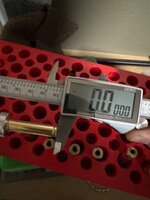
So here is a sized piece of Starline 223. Using a 30cal competitor bushing to capture the shoulder datum. I zeroed my calipers to this case length. This length represents where my die is currently set. AKA I screwed the die down until it touched the shell holder, and then a little extra so I could get “cam-over” on my press.
image.jpg
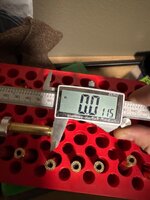
Now here is a fired piece of brass from the same lot. Fired today. So I had 0.0115” of growth compared to the resized case above.
image.jpg

If I were to bump less, you’re telling me my groups would likely be more consistent, I’d have less case length growth, and potentially more case life? Possibly at the expense of reliable feeding at extremely short shoulder bumps?
 
Back
Top