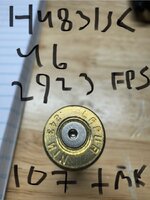
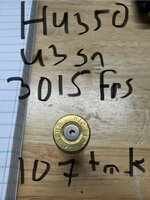
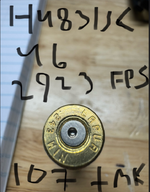
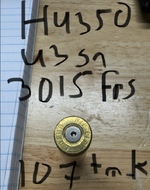
Painless load development (mine)

Are you taking about the circle on the “w”
Yeah, flattened primer, ejector marks on Virgin brass is usually a no go for me. I have had to drop 1.5 grains on once fired brass if I was already seeing signs on Virgin. I now make a point to have no real signs of pressure on virgin brass. It just doesn't leave you much room error.
 
Yeah, I probably credit cartridge too much when a lot of it is good blank, machined well, and good components = shoots tight. My buddy just got a benchmark and a bartlein chambered in 260 rem from same smith and they both hammer. This one is a krieger.
For sure man. I don't necessarily disagree with you at all either. I've just seen a lot of random bullshit cartridges with basically zero data shoot really good too. And they would have shot substantially better yet if the guns weighed 5 more pounds. Your groups are certainly exceptional though, but I do think more of the precision comes from component choices and build specs, before the actual chamber selection itself. Those 144's sure are a great shooting bullet. I may hunt with them this year. They put a hell of a hole in a couple coyotes and a coues buck last time I tested them.
 
Kinda looks like a wee raised lip around the firing pin strike, whatever they call that.
Yeah, flattened primer, ejector marks on Virgin brass is usually a no go for me. I have had to drop 1.5 grains on once fired brass if I was already seeing signs on Virgin. I now make a point to have no real signs of pressure on virgin brass. It just doesn't leave you much room error.
Both probably, the 107 may get you a bit more speed due to less bearing length, but I would back off a bit on the next loading if I was you
All thanks for the feedback. Did some reading and looks like I was over pressure on 116. But am I missing something on my 2 107 loads to show over pressure?
 

Attachments

  • IMG_7692.jpeg
    IMG_7692.jpeg
    358.5 KB · Views: 54
  • IMG_7698.jpeg
    IMG_7698.jpeg
    464.7 KB · Views: 9
Doesn't look like it has a favorite. 😆. Damn son!
Yeah this one is going to be ZERO issues lol.

Better ocw, ladder, and seating depth test that one to make sure you’re not leaving anything on the table.. 😁
Hahaha that’s the next step. Should have 10 rounds left of barrel life when I start REALLY honing in on it 🤣.

I’m just going to shoot 144’s and H1000 until season gets closer, and then pull out the fire 🔥
 
All thanks for the feedback. Did some reading and looks like I was over pressure on 116. But am I missing something on my 2 107 loads to show over pressure?

Nothing obvious just looking at those pictures. Like others said, trying to find pressure on virgin brass isn't going to do you any favors. Some of that energy is going into expanding your brass and subsequent firings tend to show sticky bolt lift a little sooner.

What is the barrel length? Velocity should be a fair sanity check. Those velocities dont seem out of sorts depending on barrel length.
 
I'd back off a grain or more. You have ejector marks on Virgin brass. On once fired, your bolt is likely to be a stiff open, if it isn't already.

This isn’t always true- you can get ejector marks on virgin brass well below pressure depending on what your chamber looks like and how much your brass is growing- if you are moving that shoulder out a bunch and having a lot of brass flow you will get an ejector mark- or if you have a really tight chambered neck and moderate brass flow, you will get an ejector mark- ejector marks on virgin brass can mean a lot of different things and it isn’t always a sign of pressure- now on fire formed brass, with a .002 shoulder bump and not a bunch of brass flow, on a rifle without any sharp edges on the ejector relief, absolutely an ejector mark is a sign of pressure- but just an extractor mark alone on virgin brass doesn’t always really tell you you’re at pressure, it just doesn’t, there are far too many other variables there on virgin brass


Sent from my iPhone using Tapatalk
 
Nothing obvious just looking at those pictures. Like others said, trying to find pressure on virgin brass isn't going to do you any favors. Some of that energy is going into expanding your brass and subsequent firings tend to show sticky bolt lift a little sooner.

What is the barrel length? Velocity should be a fair sanity check. Those velocities dont seem out of sorts depending on barrel length.
My barrel is 20”. Book max is as follows

24” barrel
107 2800
108 3015 fps
 
This isn’t always true- you can get ejector marks on virgin brass well below pressure depending on what your chamber looks like and how much your brass is growing- if you are moving that shoulder out a bunch and having a lot of brass flow you will get an ejector mark- or if you have a really tight chambered neck and moderate brass flow, you will get an ejector mark- ejector marks on virgin brass can mean a lot of different things and it isn’t always a sign of pressure- now on fire formed brass, with a .002 shoulder bump and not a bunch of brass flow, on a rifle without any sharp edges on the ejector relief, absolutely an ejector mark is a sign of pressure- but just an extractor mark alone on virgin brass doesn’t always really tell you you’re at pressure, it just doesn’t, there are far too many other variables there on virgin brass


Sent from my iPhone using Tapatalk
Agree it isn't 100%, but if you read his posts and my next one, more likely than not, he is over pressure. He is above max on charge weight, flattened primers and ejector marks. There are times tho where you do get ejector marks without being at max pressure, I'll give you that.
 
Perfect example of how "Book Max" is a joke on occasion. No way in hell should one expect to push a 108 ELDm 215 FPS faster than a 107 SMK at same pressures with same barrel, brass, powder, etc.

I don't understand the reasons why books do what they do (im sure there is a reason...maybe..lol).

But, in this particular case, The 107 SMK was a COAL of 2.850", 37.5gr of powder with pressure measured in CUP of 50,000
The 108 ELDM was a COAL of 2.700", 41gr of powder with a pressure of 59,300 PSI.

That SMK load real world is a pretty low pressure, legacy gun load. The ELDM load is a somewhat more modern rifle oriented load.

The .243 in general, has alot of under pressured load recipes, like alot of legacy cartridges, due to older guns, lever and pump guns etc. In most "Modern" rifles, with decent brass, your not going to see pressure signs until you get somewhere above 62K PSI, although this also depends on the barrel chamber specs, which can be all over the place on .243's.

 
I don't understand the reasons why books do what they do (im sure there is a reason...maybe..lol).

But, in this particular case, The 107 SMK was a COAL of 2.850", 37.5gr of powder with pressure measured in CUP of 50,000
The 108 ELDM was a COAL of 2.700", 41gr of powder with a pressure of 59,300 PSI.

That SMK load real world is a pretty low pressure, legacy gun load. The ELDM load is a somewhat more modern rifle oriented load.

The .243 in general, has alot of under pressured load recipes, like alot of legacy cartridges, due to older guns, lever and pump guns etc. In most "Modern" rifles, with decent brass, your not going to see pressure signs until you get somewhere above 62K PSI, although this also depends on the barrel chamber specs, which can be all over the place on .243's.

My understanding is that 50,000 CUP and 59k PSI are likely relatively close to the same pressure.

I'd assume that in the case of that data, they were tested at different dates with different test barrel, powder lots, gauges, etc. But they should be tested to at least close to the same SAAMI standard and calling max load 215 FPS different with those bullets is just an indication of garbage data IMO.
 
My understanding is that 50,000 CUP and 59k PSI are likely relatively close to the same pressure.

I'd assume that in the case of that data, they were tested at different dates with different test barrel, powder lots, gauges, etc. But they should be tested to at least close to the same SAAMI standard and calling max load 215 FPS different with those bullets is just an indication of garbage data IMO.
CUP and PSI don't really correlate....


I hear ya....I don't know why they chose what they chose. Personally I completely ignore CUP loads. Why muddy the waters. I also ignore any load that has less then 90% case fill. And that SMK load is at like 79%. Its a weird load.

But, if your gonna load a short bullet, out long, with less powder, then its pressure curve is not going to be the same....and your going to be slower, and less pressure. Simple as.
 
This brings up the question I've been wondering about a lot lately. As part of my painless load dev, I've started just seating out to the boat-tail to neck-shoulder junction. Which most of the time means I'm well above the published load data COL.

Is there any rule of thumb as to how much a given increase in COL drops pressure? Can I safely start at book max, assuming I've increased COL by 0.xxx inches (or percent?) and am still 0.yyy inches off the lands? Or is there no mathematical way to correlate?
 
Agree it isn't 100%, but if you read his posts and my next one, more likely than not, he is over pressure. He is above max on charge weight, flattened primers and ejector marks. There are times tho where you do get ejector marks without being at max pressure, I'll give you that.
My understanding is that 50,000 CUP and 59k PSI are likely relatively close to the same pressure.

I'd assume that in the case of that data, they were tested at different dates with different test barrel, powder lots, gauges, etc. But they should be tested to at least close to the same SAAMI standard and calling max load 215 FPS different with those bullets is just an indication of garbage data IMO.
thanks guys. Any suggestions for a next step for the "painless load development" method. Shoot a 10 shot group with 4831 at 45gn & 4350 at 42gn? Or back down further. Then pick the best group as my load and let it rip at distance? FYI i was shooting a t 1500 ft and it was 90 degrees out, so I dont see my self hunting in hotter or low elevation than this.


1774889091219.png
1774889100434.png
 
This brings up the question I've been wondering about a lot lately. As part of my painless load dev, I've started just seating out to the boat-tail to neck-shoulder junction. Which most of the time means I'm well above the published load data COL.

Is there any rule of thumb as to how much a given increase in COL drops pressure? Can I safely start at book max, assuming I've increased COL by 0.xxx inches (or percent?) and am still 0.yyy inches off the lands? Or is there no mathematical way to correlate?

There definitely is a way to correlate. The problem is we...or most of us, just don't have the data to do so effectively. If we had some load data that showed the same bullet, powder, brass etc with loads at 3 or 4 different COL then we could do some extrapolating. Just don't have the info. You can do some simulation stuff on Quickload or GRT. But I wouldn't trust either explicitly.

Where to safely start would probably depend on what cartridge your running, and how big of an increase in in COL. Personally I would start maybe 1grain lower instead of the "standard" 2 grain drop to pressure ladder. But it would depend on how big a difference in COL it is, what cartridge it is, and which powder it is.
 
Back
Top